If you are thinking about studying Thai, taking a course, or building a longer stay in Thailand, the Non-Immigrant ED Visa, often called the Thailand ED Visa, is the route that usually comes up first. It is not the fantasy version of expat life. It is slower, more structured, and a little more paperwork-heavy than people expect, but it can also be a very real way to settle into Thailand for a meaningful stretch of time.
The trick is knowing what this visa actually allows, what it does not, and what daily life looks like once the novelty wears off. If you are considering working in Thailand later, many expats eventually compare this route with teaching English in Thailand before deciding which long-term path makes the most sense.
Also Read: Explorexp blog
Quick Answer
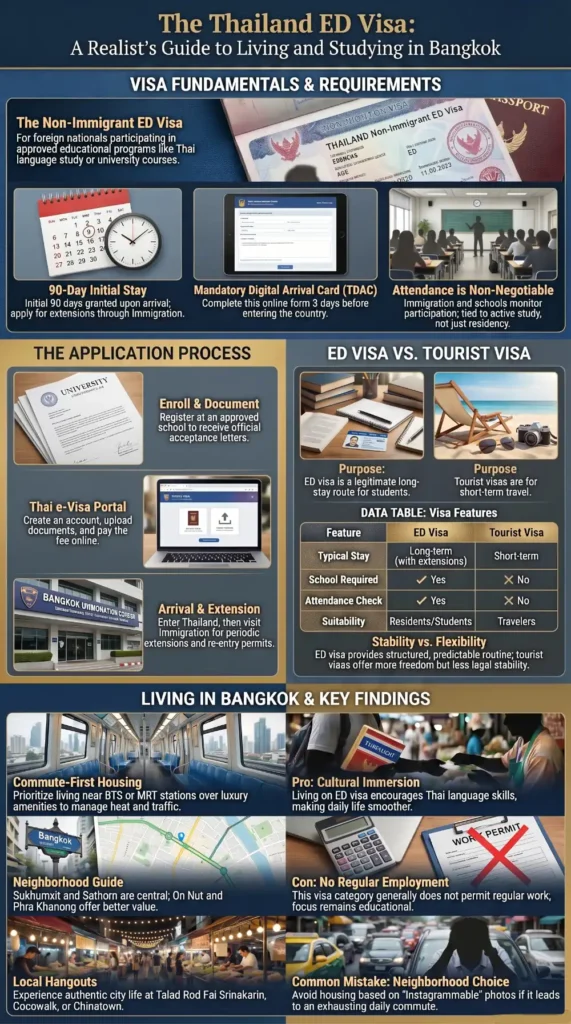
A Thailand ED Visa, officially known as the Non-Immigrant ED Visa, allows foreign nationals to live in Thailand while participating in an approved educational program such as Thai language study, university courses, or other recognized learning activities. Most visa holders receive an initial 90-day stay and may apply for extensions if they remain enrolled and compliant with immigration requirements. For people who want to spend several months or longer in Thailand while studying, the ED Visa offers a more structured and legitimate long-stay option than relying on tourist visas.
Key Takeaways
- The Non-Immigrant ED Visa is intended for genuine educational activities in Thailand.
- Most holders receive an initial stay of up to 90 days and may apply for extensions.
- Attendance and participation in your approved program matter.
- The visa provides a more stable long-stay option than a tourist visa.
- Bangkok is one of the easiest cities in Thailand for ED Visa holders due to transportation, healthcare, and expat-friendly services.
- Staying organized with immigration deadlines and school requirements is essential.
What Is a Non-Immigrant ED Visa?
Many expats casually refer to the Non-Immigrant ED Visa as the Thai Education Visa, although both terms generally describe the same education-based visa category. The Non-Immigrant ED Visa is Thailand’s education visa. Officially, it is for people who want to study in Thailand.
According to the Ministry of Foreign Affairs of Thailand, education is one of the approved purposes under the Non-Immigrant ED visa category, covering study, training, and other recognized educational activities. Depending on your program, this can mean Thai language study, academic study, training, or other approved education-related activity.
In everyday conversation, many expats also refer to the ED Visa as a Thai Student Visa because it allows foreign nationals to remain in Thailand while participating in an approved educational program.
What this means in real life is that the visa is tied to your actual study plan. You are not just buying time in Thailand. You are signing up for a visa that expects you to learn, attend, and stay within the rules of the program that sponsored or supported your application. If your mindset is “How can I stay in Thailand as long as possible?”, this visa can still be useful, but only if your education plan is genuine.
Requirements to Get the Education Visa
The exact checklist can vary a little by embassy or consulate, but the official Thai guidance consistently points to the same core documents, and embassies can ask for extra paperwork if they need it.
The usual starting documents are:
- A passport valid for at least 6 months.
- A completed visa application form.
- A recent passport-size photo.
- An acceptance letter, enrollment letter, or confirmation from the school or institution.
- Any supporting documents the embassy asks for, such as proof of the course, school registration, or sponsor details.
That is the clean version. In the real world, the school or institution often plays a big role in helping you get the right letter or confirmation. Some applicants still need more documents depending on their nationality, where they apply, and what kind of course they are joining. So the safest mindset is not “What is the minimum I can submit?” It is “What does this embassy want to see to feel comfortable approving me?”
Visa requirements can change without notice. Always verify current documentation requirements directly with the Thai embassy, consulate, or e-Visa portal handling your application before submitting documents.
Choosing a School for an ED Visa
Most ED Visa applicants work directly with a language school, university, or approved educational institution. The school typically provides the enrollment documents required for the visa application and may also guide students through extension procedures after arrival.
Before enrolling, confirm that the institution is eligible to support ED Visa applications and understand any attendance requirements associated with the program.
What Does an ED Visa Cost?
Costs vary depending on your nationality, school, and application location.
Most applicants should budget for:
- Visa application fees.
- School tuition or course fees.
- Immigration extension fees.
- Transportation costs for immigration appointments.
- Everyday living expenses while studying.
Because visa fees and immigration rules can change, verify current costs directly with your school, the Thai embassy handling your application, or official Thai government sources.
How to Apply for a Thailand ED Visa
- Enroll in an approved educational program.
- Obtain acceptance documents from the school.
- Create an account on the Thai e-Visa system.
- Submit the required documents and application fee.
- Wait for visa approval.
- Travel to Thailand and complete entry requirements.
- Apply for extensions if your program continues beyond the initial stay period.
Most people start with the official Thai e-Visa system or with instructions from the Thai embassy or consulate in the country where they are applying. The Ministry of Foreign Affairs says visa applications are submitted through the official Thai e-Visa portal, and the e-Visa manual shows the basic process clearly: create an account, fill in the application, upload supporting documents, pay the fee, wait for processing, then receive the confirmation by email.
In practical terms, the process usually feels like this. You first get accepted by a school or program. Then you gather the required documents. Then you submit the visa application through the official channel your embassy uses. After that, you wait. Sometimes the approval is quick. Sometimes it takes longer than you hoped. That is normal. Immigration is not a place to build your identity around speed. It is a place to be organized.
If you are coming into Thailand, do not forget the Thailand Digital Arrival Card. The official immigration guide says all non-Thai nationals entering Thailand must complete TDAC online before entry, and it must be submitted 3 days in advance. That is not the visa itself, but it is part of the modern entry process now, and it matters.
Once you are in Thailand, you need to pay attention to your stay dates and extension timing. Many ED Visa holders become familiar with the extension process because maintaining legal status usually involves periodic immigration visits and ongoing compliance with program requirements.
The official ED guidance says the visa holder is granted an initial stay period of up to 90 days on arrival, and then can apply for an extension of stay and a multiple re-entry permit from the Immigration Bureau. That is where many people get surprised. They think the visa means “one year handed to me neatly.” It usually does not feel that simple in practice.
Why Should I Get an Edu Visa vs. a Tourist Visa?
This is one of the most important questions, because a lot of people compare the two and only look at convenience. That is the wrong way to compare them. A tourist visa is for tourism. The Thai Ministry of Foreign Affairs says tourist visa holders are allowed a limited stay, commonly up to 60 days on arrival depending on the visa type, and they may apply for an extension if eligible. The ED visa, by contrast, is built around study and education-related activity.
So why choose the ED visa? Because it matches a longer plan. If you really want to live in Thailand while studying, taking classes, or building language skills, the ED visa is cleaner than trying to stretch a tourist setup beyond what it was meant for. That does not just matter legally. It matters mentally too. With a tourist visa, you often feel like you are always counting the days. With an ED visa, your time is still structured, but the structure fits your real purpose better.
For people planning to study and live in the country for several months or longer, a Thailand study visa is generally a more practical and sustainable option than relying on tourist status and repeated extensions.
There is also a practical difference in how you organize your life. An ED visa makes sense if you want to commit to a school routine, keep your paperwork tidy, and stay longer with less improvising. A tourist visa makes more sense if you are truly just visiting, exploring, or testing the waters. If your goal is “I want to live in Thailand for a while and actually build a life here,” the ED visa is usually the more honest choice.
One more thing people forget. A tourist visa is a poor foundation for a serious relocation plan. It is fine for a trip. It is not the same as building a stable day-to-day life around study, routine, and compliance. That is why so many people who arrive with tourist thinking eventually end up looking for a more appropriate long-stay path.
ED Visa vs Tourist Visa
| Feature | ED Visa | Tourist Visa |
| Primary Purpose | Study | Tourism |
| Typical Stay | Longer-term with extensions | Short-term |
| School Enrollment | Required | Not required |
| Attendance Expectations | Yes | No |
| Suitable for Long-Term Living | Yes | Limited |
Who Is the ED Visa Best For?
The ED Visa is usually a good fit for people who:
It may be less suitable for travelers who simply want maximum flexibility without school commitments or attendance requirements. If you work remotely instead, the Thailand Digital Nomad Visa may be a better fit than an education-based visa because it is designed for a different type of long-term stay.
Pros and Cons of the Thailand ED Visa
Do I Actually Have to Learn Thai?
Not in the dramatic, pass-or-fail way people imagine. But yes, you should be doing the thing your visa is tied to. If your course is Thai language study, then learning Thai is the whole point. If your program is an academic course, internship, or other approved study option, then you are expected to participate in that program in good faith. The visa is for study, not just for sitting in Thailand with a stamp in your passport.
In plain English, this visa is not meant to be fake school insurance. If you enroll in a language school and never show up, you are turning a legitimate visa category into a problem. That is where people get careless. They think immigration will not notice or that attendance does not matter. It does matter. If your school is serious, they will expect you to behave like a student.
That said, you do not need to be fluent in Thai on day one. Most people on an ED visa begin as total beginners. You learn the language slowly, learn how the city works, and then build confidence over time. That is the real gift of the visa. It gives you time to be bad at Thai before you get better at it. And honestly, that is how learning works anywhere.
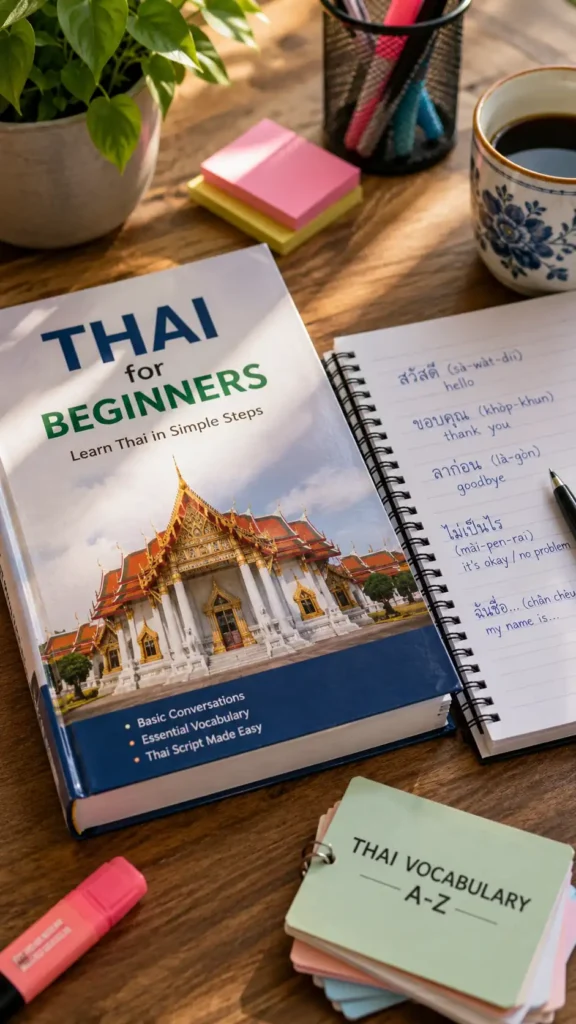
If you live in Bangkok, basic Thai becomes useful quickly. You can survive with English in many expat-heavy areas, but simple Thai helps in taxis, markets, apartment buildings, local restaurants, and government offices. You do not need to become a poet. You just need enough language to make daily life smoother and to show respect to the country you are living in.
What’s It Like Living in Bangkok?
Living in Bangkok is a mix of convenience, noise, heat, food, traffic, and constant movement. That sounds dramatic, but it is true. Bangkok is exciting, messy, practical, loud, and very livable once you figure out your own rhythm. The city offers strong healthcare, a wide range of international services, transport options, and one of the easiest long-term lifestyles in Southeast Asia for people who adapt well.
The first thing you notice is that Bangkok is built around convenience. There is almost always somewhere nearby to eat, buy groceries, get coffee, grab a ride, or sort out a basic task. The second thing you notice is that convenience comes with traffic, humidity, and a level of sensory overload that never fully goes away. That is why some people love Bangkok immediately and others take months to feel settled. Both reactions are normal.
The third thing you notice is that your lifestyle becomes very neighborhood-based. For example, someone studying Thai near Asok may eventually spend most of their week moving between the same BTS stations, coffee shops, restaurants, and grocery stores. Over time, Bangkok starts feeling less like a massive city and more like a collection of familiar routines.
You stop thinking about the whole city all the time and start thinking in terms of your own routes, your own shops, your own stations, your own favorite Thai food place, and your own circle of people. Bangkok becomes easier when it stops being one giant city in your head and starts becoming a handful of familiar zones.
Healthcare is another big part of the Bangkok story. Many long-term residents eventually build routines around BTS and MRT access because transportation often has a bigger impact on quality of life than apartment amenities. Living close to public transit can significantly reduce commute times and make daily errands easier.
The city has widely used private hospitals and many English-speaking staff, which is one reason expats often feel comfortable there. Food is another plus. You can eat cheaply, eat well, or eat very expensively, sometimes all in the same week. The city gives you options. It also tempts you to spend more than you planned.
The hard parts are real too. Traffic can test your patience. Heat can make a short walk feel like a workout. Bureaucracy can wear you down if you are not organized. And once the early excitement fades, you may have a week where the city feels more functional than magical. That does not mean you picked the wrong place. It usually means you are moving from tourist brain to resident brain.
If you are the kind of person who likes structure, Bangkok can actually be a very good city. You learn your favorite transport line, your grocery store, your visa schedule, your neighborhood market, and your usual commute. Then life starts to feel predictable in a good way. Not boring. Just manageable. That is a bigger deal than it sounds.

Where Should You Live in Bangkok?
If you are serious about living in Bangkok on a Non-Immigrant ED Visa, the first thing I would tell you is this: do not choose a place based only on a pretty photo. Choose a place based on how you will actually live. A 10-minute walk to BTS or MRT often matters more than a bigger room, a nicer pool, or a glossy lobby. That advice comes through very clearly in our Living in Bangkok guide, and it is still true.
For most new arrivals, the best areas are the ones that make daily life simpler. Sukhumvit is popular because it is easy, central, and full of options. Sathorn works well if you want a more businesslike base. Ari has a more neighborhood feel. On Nut and Phra Khanong are often where budget-conscious expats start because they are still connected to the train line without the higher price tag of the most famous central zones.
If you are studying, your best neighborhood is often the one that keeps your commute short and your routine calm. Bangkok is a city where distance looks small on a map and turns into a long, sweaty, annoying journey in real life. So the right area is the one that helps you show up consistently, not the one that looks best on Instagram. That matters even more on an ED visa, because your life is partly built around routine.
A lot of people on education visas also end up living near other foreigners, not because they are avoiding Thai life, but because it makes the first months easier. That is normal. You can always branch out later. The first job is just to get your feet under you, learn the city, and stop making everyday life harder than it needs to be.
Bangkok is the obvious choice for many students, but it is not the only option. If you prefer a slower pace, lower living costs, and a larger digital nomad and language-learning community, Living in Chiang Mai is another route many long-term expats consider before deciding where to settle.
My honest advice is to think in this order: commute first, school second, rent third, lifestyle fourth. People usually do it the other way around and regret it later. A beautiful condo far from your school can become miserable very quickly. A modest place in the right zone can feel like a win every single day.
Popular Local Hangouts in Bangkok
This is where the city gets interesting, because Bangkok is not just a place people pass through. It is a place people actually live. Locals eat out a lot, meet friends after work, wander malls, grab drinks, go night markets, and build social lives around food and neighborhood convenience. That is why Bangkok feels alive even on ordinary weekdays.
Talad Rod Fai Srinakarin – Best Night Market
One of the most local-feeling things you can do is go to a night market and just watch how the city relaxes. Talad Rod Fai Srinakarin is a good example of that kind of evening. It has that classic Bangkok feeling where food, browsing, socializing, and small discoveries all happen at the same time. It is not just about shopping. It is about hanging out.
Cocowalk – Chill Night Out
For a more low-key night, Cocowalk is the sort of place people go when they want something easy rather than intense. Not every Bangkok evening needs a big plan. Sometimes locals just want to meet friends, eat, sit around, and talk without making the night a whole event. That is part of why the city works so well for long stays. You do not have to “do Bangkok” every night. You can just live in it.
Chinatown – A Cool Place to Walk Around
And then there is Chinatown, which is one of those places that still feels worth walking around even when you are not there for anything specific. People go for food, energy, movement, and the sense that something is always happening. You can spend an hour there and feel like you have actually been somewhere, which is exactly the kind of place residents keep returning to.
What locals do most often, though, is much less glamorous than travel content makes it look. They run errands. They commute. They eat at the same places over and over. They go to familiar malls.
They meet friends in the same neighborhoods. That is the truth of city life anywhere, and Bangkok is no different. The famous places matter, but the routine places matter more.
The Part Nobody Tells You About the ED Visa Life
The biggest surprise is that life on a Non-Immigrant ED Visa is often less about “visa freedom” and more about discipline. You have to keep track of your dates. You have to respect your school. You have to stay aware of reporting requirements. You have to stay organized when you travel. It is a student life, not a loophole life.
That is also why this visa can be a very good fit for the right person. If you like learning, structure, and a slower relocation process, it can work beautifully. If you just want to disappear into Thailand and avoid paperwork, it will probably frustrate you. The visa does not remove responsibility. It replaces one kind of responsibility with another.
The good news is that once the system makes sense, daily life becomes easier. You learn your school routine. You get your favorite neighborhood. You understand how to extend your stay. You stop treating every immigration task like a crisis. Then Thailand starts to feel less like a temporary experiment and more like a real chapter of your life.
What Does an Average Week on an ED Visa Look Like?
For many people, life on an ED Visa settles into a routine that feels much more like normal residency than extended travel.
A typical week might include attending language classes, commuting on the BTS or MRT, running errands, studying for a few hours, meeting friends for dinner, and dealing with occasional immigration or school paperwork.
The first few months often feel exciting and unfamiliar. After that, daily life becomes more predictable. You develop favorite restaurants, regular grocery stores, preferred coffee shops, and a routine that starts to feel surprisingly normal.
That shift is often the biggest surprise. Most people expect the visa to change their life dramatically. In reality, the visa simply gives them enough time to build a life in Thailand.

Also Read: Living in Chiang Mai: What Every Expat Should Know in 2026
Common Mistakes to Avoid
Many ED Visa holders run into problems because they:
The easiest way to avoid problems is to stay organized, attend your program consistently, and follow immigration requirements carefully.
Immigration rules, visa procedures, and entry requirements can change. Before applying, always verify the latest information through official Thai government sources and the Thai embassy or consulate responsible for your application.
Final Thoughts
A Non-Immigrant ED Visa is not glamorous, but it can be one of the most practical ways to spend real time in Thailand. It gives you a reason to stay, a structure to follow, and a better footing than trying to force a tourist setup into a long-term lifestyle. If you want the truth, this is a good visa for people who are actually ready to live, learn, and keep their paperwork in order.
Bangkok adds its own layer to that experience. The city can be chaotic, but it is also full of convenience, energy, and daily surprises that make the long stay feel worth it. Once you know where to live, how to move around, and what kind of routine suits you, the whole thing gets much easier. That is when Thailand stops feeling like a trip and starts feeling like a life.