Thailand has become one of those places remote workers keep circling back to, and for good reason. It is easy to like on paper and even easier to like once you are actually there. What many people miss, though, is that the Thailand Digital Nomad Visa is not just a long stay. It is a flexible five-year system that can shape how you move, work, and plan life in Southeast Asia. The real advantage is not only the length. It is the breathing room.
Also Read: Explorexp blog
Thailand Digital Nomad Visa Quick Answer
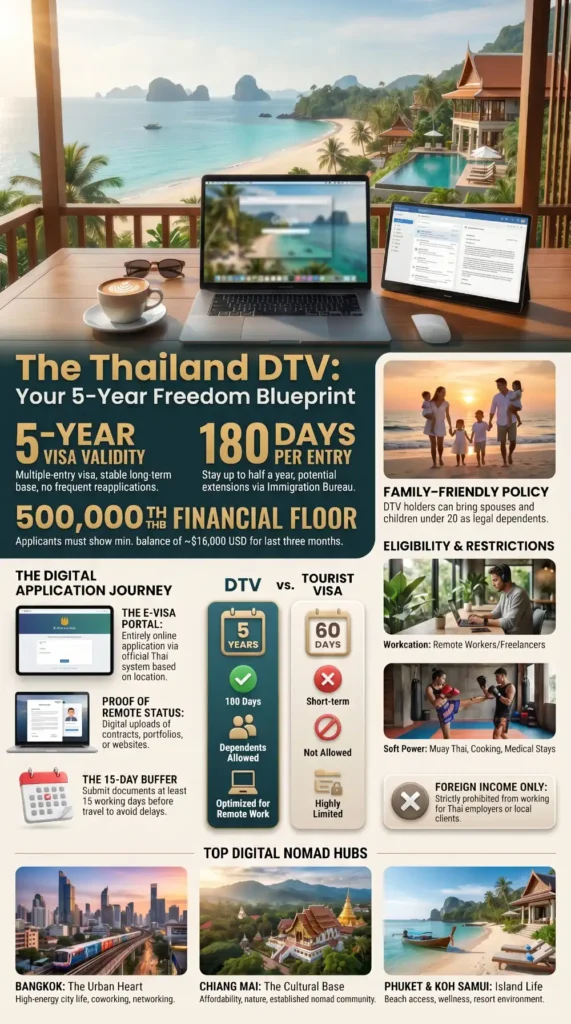
Thailand’s Digital Nomad Visa, officially called the Destination Thailand Visa (DTV), allows eligible remote workers, freelancers, and certain long-stay visitors to stay in Thailand for up to 180 days per entry on a visa valid for five years. The biggest advantage is not simply the stay length but the ability to build a long-term base in Thailand without constantly reapplying for short-term visas.
Key Takeaways
- Thailand’s DTV is valid for five years.
- Eligible holders can stay up to 180 days per entry.
- The visa is designed for remote workers, freelancers, and approved soft-power activities.
- DTV holders cannot work for Thai employers or Thai clients.
- Applicants generally need proof of at least 500,000 THB in savings.
- Continuous stays may trigger 90-day reporting and Thai tax residency considerations.
- Families can apply through the dependent route.
What Is the Thailand Digital Nomad Visa?
The Thailand Digital Nomad Visa, officially known as the Destination Thailand Visa (DTV), is a five-year multiple-entry visa that allows eligible remote workers, freelancers, and long-stay visitors to spend up to 180 days per entry in Thailand. Unlike a traditional work visa, it does not permit employment with Thai companies or Thai clients.
Destination Thailand Visa (DTV) at a Glance
- Official visa name: Destination Thailand Visa (DTV)
- Visa validity: 5 years
- Stay length: Up to 180 days per entry
- Target audience: Remote workers, freelancers, digital nomads, and approved soft-power participants
- Dependents allowed: Yes, eligible spouses and children
- Thai employment permitted: No
DTV vs Tourist Visa Comparison
| Feature | DTV | Standard Tourist Visa |
| Visa Validity | 5 Years | Usually 60 Days |
| Stay Length | Up to 180 Days Per Entry | Short-Term |
| Remote Work Friendly | Yes | Limited |
| Dependents Allowed | Yes | No |
| Long-Term Planning | Excellent | Poor |
How Easy Is It to Live in Thailand as a Digital Nomad?

In day-to-day life, Thailand is usually easier than the visa paperwork makes it look. That sounds obvious, but it matters. The hard part is often not the coffee shop, the apartment, or the routine. The hard part is getting your documents right the first time and understanding how the visa system works.
Once that is sorted, many remote workers find Thailand straightforward because the country already has a long history of welcoming long-stay visitors, and the main digital nomad hubs are well known. Bangkok, Chiang Mai, Phuket, and Koh Samui all stand out as established destinations with their own vibe, pace, and lifestyle.
Remote workers also benefit from Thailand’s established digital nomad ecosystem. Major hubs such as Bangkok, Chiang Mai, Phuket, and Koh Samui offer reliable internet, coworking spaces, networking events, and active expat communities.
For many newcomers, building a social circle and maintaining a productive work routine is easier than expected because there are already large groups of remote workers and long-term international residents.
The real answer is that Thailand is easy if you are comfortable living abroad. You will still deal with normal adult stuff, like finding housing, setting up internet, sorting transport, and learning a few local habits.
But compared with many countries, Thailand gives you a lot of choice. For many newcomers, building a social circle and maintaining a productive work routine is easier than expected.
You can live in a big city, a beach town, or a quieter northern base without changing countries. That flexibility is a big reason digital nomads keep coming back. The visa does not make life effortless, but it does make long-term planning much more realistic.
Why Is Thailand’s “Digital Nomad Visa” Unique?
What people casually call the Thailand Digital Nomad Visa is officially the Destination Thailand Visa (DTV). According to the Royal Thai Embassy in Budapest, the visa is valid for five years and was specifically created for workcation travelers, approved soft-power activities, and eligible dependents. The Thai Embassy in Washington says it is a five-year visa for workcation, Thai soft power activities, and spouses and children under 20 of DTV holders.
The embassy in Budapest adds that it allows up to 180 days per entry, is valid for five years, and is treated as a special kind of tourist visa, which means holders cannot get a Thai work permit or work for Thai companies or Thai clients. That is the part many people overlook. It is long-stay freedom, but not a permission slip to take local Thai employment.
The uniqueness goes beyond the headline. Thailand did not just make a visa for remote workers. It built a visa that also fits people who want to spend serious time in Thailand through approved cultural or wellness activities.

That means the visa can work for a freelancer, a remote employee, or someone doing a legitimate soft-power stay such as Muay Thai or cooking training. It is not the narrowest visa category on earth, and that is exactly why it stands out. It gives Thailand a way to welcome more long-stay visitors without pretending everyone fits the same box.
Introducing The Destination Thailand Visa or DTV
Here is the simplest way to think about the DTV. It is not a traditional work visa in the way many Westerners imagine it. It is more like a structured long-stay visa for people who can support themselves and have a legitimate reason to spend long stretches in Thailand.
The official embassy pages describe the workcation route, the soft-power route, and the dependent route. In practice, that makes the DTV feel like a practical middle ground between a tourist visa and a more formal long-term stay. You get far more runway than a standard tourist entry, but you still need to respect the rules around work and stay length.
That is why the five-year benefit is so important. People hear “Thailand Digital Nomad Visa” and focus on the 180 days. That is only half the story. The real benefit is that you are not starting from zero every few months.
You can plan life around a five-year visa, then use each entry as a long, usable block of time. For many remote workers, that is the difference between feeling like a visitor and feeling settled.
Who Is the DTV Best For?
The DTV is generally a good fit for:
- Remote employees working for foreign companies
- Freelancers with international clients
- Online business owners
- Digital nomads seeking a long-term base in Southeast Asia
- Individuals participating in approved Thai cultural or wellness programs
- Couples and families looking for a longer stay option
It may be less suitable for travelers who only visit Thailand occasionally or individuals seeking employment with Thai companies. If your goal is to work for a Thai employer rather than remain a remote worker, teaching English in Thailand is one of the most common long-term employment paths available to foreigners.
Thailand Digital Nomad Visa Requirements
For the workcation route, the Thai Embassy in Washington lists a passport valid for at least six months, a recent photo, proof of your current location, recent bank statements for the last three months showing an ending balance of at least 500,000 THB or about 16,000 USD, and an employment contract, employment certificate, or portfolio showing remote-worker, freelancer, or digital nomad status.
For soft-power applicants, the embassy lists the same core identity and financial documents, plus a letter of acceptance from the relevant institute or company organizing the activity, or a medical appointment letter. For dependents, you also need proof of relationship and the DTV holder’s details.
A few details are worth slowing down for. First, the money proof matters. This is not a visa where you just say you are remote and hope for the best. Second, the proof of work needs to show that you really are a remote worker, freelancer, or foreign talent, not someone trying to squeeze a tourist stay into a work visa shape. Third, families are included, which is a genuinely useful part of the DTV if you are moving as a couple or with children. That makes the visa more practical than many people expect.
Because DTV requirements can change and embassy interpretations may vary by location, always review the latest requirements from the Thai embassy or consulate handling your application before submitting documents.
Applicants should also budget for the visa application fee, which varies depending on nationality and the embassy or consulate processing the application. Checking the latest fee schedule before applying can help avoid surprises.
Acceptable evidence may include employment contracts, freelance client agreements, invoices, portfolios, professional websites, or employer verification letters. The goal is to demonstrate that your income comes from sources outside Thailand and that your work can be performed remotely.
How to Apply for the Thailand DTV Visa
The official Thai e-Visa manual explains the process in a straightforward way. You create an account, fill in your personal details, check your eligibility, upload your passport and photo, complete the application, pay the fee, and then download the e-Visa once it is approved.
Before You Apply
Use this checklist before starting your application:
- Confirm which DTV category applies to you.
- Gather three months of financial records.
- Prepare proof of remote work or qualifying activity.
- Verify that your passport validity meets embassy requirements.
- Choose the country from which you will submit your application.
The manual also shows that the eligibility step asks for your passport country, your current location, and where you are applying from, which is why this visa is usually handled through the official e-Visa system rather than by walking into Thailand and sorting it out later. Some embassies, such as Kuala Lumpur, also advise applicants to submit at least 15 working days before the intended travel date.
Processing times can vary depending on the embassy, application volume, and whether additional documents are requested. Applying well before your intended travel date gives you time to respond to any requests for clarification or supplementary documentation.
The cleanest way to apply is to treat it like a document project, not a quick form. Put your bank statements in order. Make sure your proof of work is readable. Save everything as clear files, because the embassy in Washington warns that unclear scans or missing documents can delay processing. If your case is simple, the process can feel very manageable. If your paperwork is messy, the process gets annoying fast. That is the real difference.
Common Reasons DTV Applications Are Delayed or Rejected
- Incomplete financial documentation
- Unclear proof of remote work
- Missing location verification
- Inconsistent supporting documents
- Unreadable uploads
Most delays can be avoided by organizing documents carefully and ensuring all supporting evidence is clear, complete, and consistent before submission.
Do I Need a Visa Agent?
No, you do not need a visa agent to apply for the DTV. The official Thai e-Visa system exists for exactly this reason. That said, some people use agents because they want help organizing their documents or they are nervous about rejection.
That can be useful, but it is a convenience, not a requirement. Some applicants choose to work with specialized visa agencies for document review and application support, but the DTV can also be completed independently through Thailand’s official e-Visa system.
If your paperwork is clean, you can absolutely handle the application yourself through the official portal. Use an agent only if the process genuinely saves you stress or if your case has extra moving parts.
Otherwise, keep the fee in your pocket and do it yourself. The DTV is already expensive enough without paying someone to copy your documents into a portal. The more important thing is not the agent. It is whether your bank statements, location proof, and work proof line up cleanly.
Where Can I Apply From?
The official e-Visa manual asks for your passport country, current location, and where you are applying from. That means your application is tied to the post responsible for the place where you are currently based. In plain English, you apply from where you actually are, not where you wish you were.
If you are already moving around Southeast Asia, it can make sense to spend a little time in Vietnam or Indonesia while you sort your paperwork, rather than rushing back home just to file.
The cleanest approach is to choose your filing location early and then keep your documents consistent with it.
Your current location proof should make sense. Your travel timing should make sense. Your bank and work documents should make sense. That may sound fussy, but visa officers like fussy. The more your story lines up, the easier your application usually feels.
Check-Ins, Border Runs
If you stay in Thailand continuously, the follow-up paperwork matters. The Immigration Bureau’s TM47 online guide says the 90-day address notification can be submitted up to 15 days before the due date, and the official DTV pages say that for extensions of stay, you should contact the Immigration Bureau once you are in Thailand. In other words, the visa is long, but it is not hands-off. You still need to keep an eye on your calendar.
This is where many people get sloppy. They hear “five years” and assume they can forget about admin. Not quite. If you are the type who likes to travel in and out of Thailand, your reporting rhythm may feel simple.
If you stay put for long stretches, you need to stay organized. Depending on current immigration policies, DTV holders may also be able to apply for an extension of stay through the Thai Immigration Bureau. Because extension rules can change, it is best to verify the latest requirements directly with immigration authorities before making long-term plans. I would not plan a move around the idea that border hopping is a magic solution. Treat each entry, extension, and report as real immigration business, because that is what it is.
Common Mistakes DTV Applicants Make
Most DTV problems are not caused by eligibility issues. They are caused by paperwork mistakes, missed reporting deadlines, or misunderstandings about what the visa actually allows.
Do I Have to Pay Thai Taxes?
Maybe, and the answer depends on how long you stay. The Thai Revenue Department says a resident is anyone staying in Thailand for more than 180 days in a tax year. Residents are liable for Thai tax on Thai-source income and on the portion of foreign-source income that is brought into Thailand.
Non-residents are generally taxed only on Thai-source income. The Revenue Department also notes that foreign tax paid can sometimes be credited against Thai tax where a double tax agreement applies.
This is one of those subjects where a quick tax consultation can save real money. If you are using Thailand as a home base but staying under the tax-residency threshold, your situation is usually simpler. If you are living there long enough to cross the 180-day line, it gets more serious.
The safest move is to keep good records and speak to a tax professional before you assume anything. That is especially true if you earn from multiple countries or receive income from outside Thailand.
Tax rules can change, and individual circumstances vary significantly. Before making residency or tax-planning decisions, verify current requirements with the Thai Revenue Department or a qualified cross-border tax advisor.
Best Places to Live in Thailand as a Digital Nomad

If I had to narrow Thailand down for a remote worker, I would start with Bangkok, Chiang Mai, Phuket, and Koh Samui. Bangkok gives you the biggest-city experience, with Thailand’s main capital energy and a deep mix of culture and modern life. If you’re considering the capital as your long-term base, our guide to living in Bangkok covers housing, costs, healthcare, neighborhoods, and everyday expat life in much more detail.
Chiang Mai is known for its blend of nature, Lanna culture, and a strong local feel. Phuket is Thailand’s biggest island and sits on the Andaman Sea. Koh Samui offers beaches, water, and a lifestyle that leans lighter and slower. Those are not just names on a map. They are very different ways of living.
Many first-time nomads underestimate how different these locations feel in practice. A freelancer who enjoys walkability, networking events, and public transit may thrive in Bangkok, while someone prioritizing lower living costs and a slower pace often finds Chiang Mai a better fit. Choosing the right city can have a bigger impact on your experience than the visa itself.
My shortcut is this. Choose Bangkok if you want movement and convenience. Choose Chiang Mai if you want a calmer base that still feels connected. Choose Phuket if you want island access without disappearing into the middle of nowhere.
Choose Koh Samui if you want the softest landing of the four. And if you want a deeper comparison, link to your own guide on best places to live in Thailand so readers can keep exploring after they finish this article.
Things to Know Before Moving to Thailand
There are a few practical things I would keep in mind before packing a bag. First, Thailand now requires the Thailand Digital Arrival Card, or TDAC, for non-Thai nationals entering by air, land, or sea, and the official system says it should be completed online before arrival.
The TDAC guidance says travelers can submit it within three days before arrival. Second, if you stay continuously, the 90-day reporting rhythm may still apply. Third, the DTV is not a work permit, so do not treat it like one. Those three facts alone prevent a lot of stress later.
One reason Thailand remains popular with remote workers is that it can accommodate a wide range of budgets. Living costs vary significantly between Bangkok, Chiang Mai, Phuket, and Koh Samui, but many digital nomads find they can maintain a comfortable lifestyle for less than they would spend in major cities in North America, Western Europe, or Australia. Before moving, estimate your expected housing, transportation, healthcare, and coworking expenses to determine whether your preferred destination fits your budget.
Thailand is also known for its private healthcare system, particularly in major cities such as Bangkok, Chiang Mai, and Phuket. Many expats and remote workers appreciate having access to modern medical facilities, English-speaking healthcare providers, and a broad range of healthcare services.
Thailand’s transportation infrastructure is another advantage for remote workers. Major cities have international airports, domestic flight networks, and transportation options that make it relatively easy to travel throughout Thailand and the rest of Southeast Asia.
Beyond the paperwork, think about your lifestyle honestly. Thailand can be very easy if you like movement, food, and warm weather, but it is still a real move, not a holiday that accidentally lasted six months. Learn a little Thai.
Build a budget that leaves room for rent, transport, coworking, and healthcare. And do not underestimate how useful it is to choose your neighborhood well from the beginning. A good base makes everything else feel lighter.
Also Read:
Start Your Workcation with a Thailand Digital Nomad Visa Today!
The best way to use the Thailand Digital Nomad Visa is to think beyond the first entry stamp. Build a simple plan. Decide where you want to live first. Decide whether you are applying as a remote worker, a soft-power visitor, or a dependent.
Decide what your calendar looks like if you need to report your address, extend a stay, or leave and come back. That little bit of planning turns the DTV from a cool idea into an actual life option.
That is the part remote workers often miss. The visa is not only about getting into Thailand once. It is about creating a five-year runway that gives you freedom to move with less friction. If you are the kind of person who likes a base, but still wants room to travel and work without constant visa panic, Thailand’s DTV is one of the better tools available.
Conclusion
The Thailand Digital Nomad Visa is popular for a reason, but the real story is bigger than the headline. Yes, it offers a five-year validity. Yes, it supports remote workers, soft-power stays, and dependents.
But the part most people miss is how much long-term planning freedom it creates when you understand the 180-day stay cycle, the extension option, the reporting rules, and the tax implications. That is where the value really lives.
If you are a remote worker who wants more than a short holiday visa but less bureaucracy than a traditional work route, Thailand is worth a serious look.
For remote workers seeking a long-term base in Southeast Asia, Thailand’s DTV is one of the most flexible visa options currently available.
The combination of five-year validity, long stays per entry, family eligibility, and access to some of Asia’s most established nomad hubs makes it a compelling choice. However, success depends on understanding the reporting requirements, tax implications, and work restrictions before you move.