Living in Koh Pha Ngan offers a very different experience from simply visiting the island. If you’ve pictured yourself waking up to the sound of waves instead of an alarm clock, Koh Pha Ngan has probably crossed your mind at some point. This small tropical island in the Gulf of Thailand in southeast Thailand has quietly become one of Southeast Asia’s favorite expat hideouts, and not just for the Full Moon crowd anymore. Here’s what you should know before moving to Koh Pha Ngan.
Also Read: Living in Phuket: The Complete Expat Guide for 2026
Quick Answer
Koh Pha Ngan is one of Thailand’s most popular islands for expats, especially remote workers, entrepreneurs, and retirees seeking a slower pace of life. While local employment opportunities are limited, affordable living costs, established expat communities, and beautiful beaches make it an attractive long-term destination. Before moving, make sure you understand Thailand’s visa options, healthcare system, and transportation limitations.
Key Takeaways
- Koh Pha Ngan is best suited to remote workers, entrepreneurs, and retirees rather than job seekers.
- Most residents rely on scooters because the island has no formal public transportation system.
- Housing costs vary significantly between high and low seasons.
- Visa planning is essential if you intend to stay longer than a few months.
- Spending time in several neighborhoods before renting long-term can help you find the best fit.
What Koh Pha Ngan Is Really Like
Before choosing where to live, it’s worth understanding how the island is laid out, what the climate is like, and how daily life differs from a short vacation.
Koh Pha Ngan sits in the Gulf of Thailand, part of Surat Thani province, about 12 kilometers north of its much bigger, much busier neighbor, Koh Samui. There’s no airport on the island itself, so the only way in is by ferry, either from the mainland town of Surat Thani or from Koh Samui, which has its own airport with regular flights to Bangkok.
Ferry schedules, weather conditions, and seasonal demand can occasionally affect travel times, especially during the monsoon season. Checking ferry operators in advance is recommended if you’re traveling with connecting flights. That lack of an airport is actually part of the island’s charm. It keeps the pace slower and the crowds smaller than you’d find on Samui or Phuket. If you’re deciding between the two islands, our guide to living in Phuket explores how the lifestyle, costs, and expat experience compare.
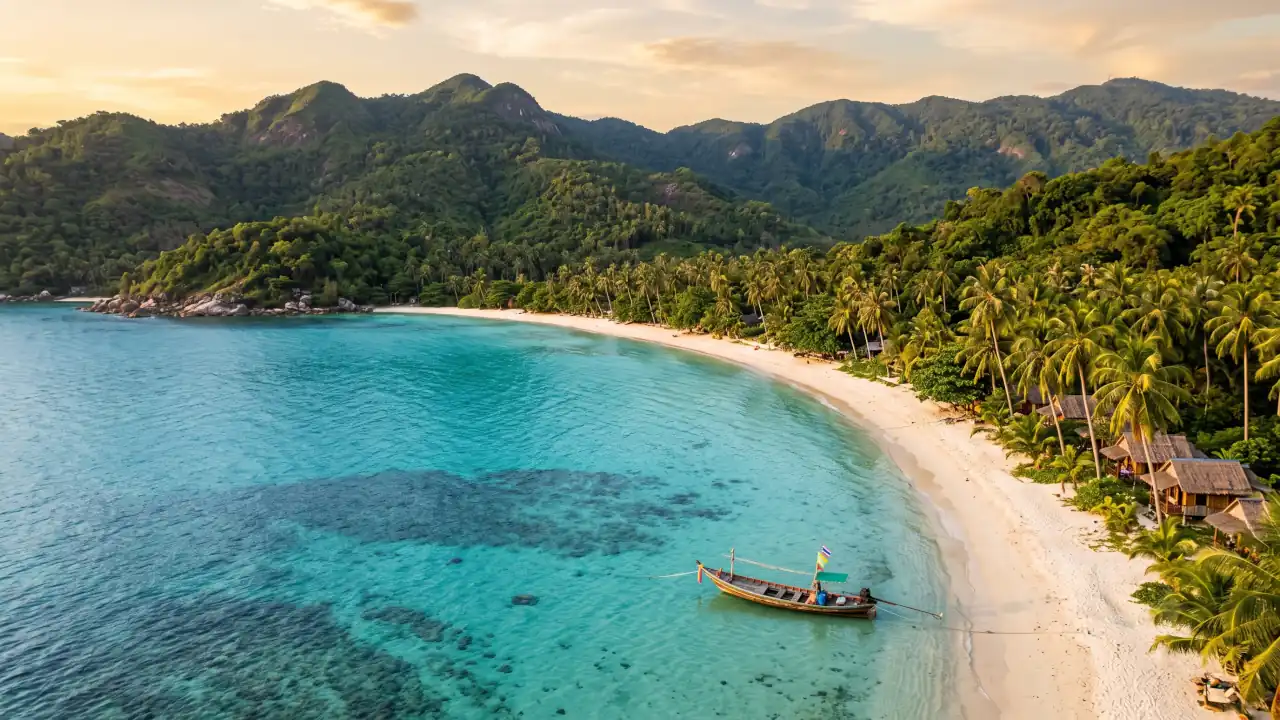
For years, Koh Pha Ngan’s reputation was built almost entirely on the Full Moon Party, the monthly beach rave on Haad Rin that draws thousands of backpackers. And yes, that party still happens, and yes, it’s still wild. But if you actually live on the island, you quickly realize the party scene is just one small slice of what’s going on. Most of Koh Pha Ngan is jungle-covered hills, quiet fishing villages, waterfalls you can hike to in an afternoon, and long stretches of white-sand beaches where you might not see another person for an hour.
Temperatures stay warm throughout the year, typically ranging from 24°C to 32°C, although the hottest months can climb into the mid-30s while cooler evenings occasionally dip to around 20°C. Humidity is high, as you’d expect on a tropical island, but the sea breeze does a lot of the work in keeping things bearable. Although Koh Pha Ngan stays warm throughout the year, your experience can vary significantly depending on the season.
The hot season runs from roughly January through April, and the rainy season stretches from May into early December, with a noticeable dip in tourist numbers outside of the July and August summer holiday rush. If you’re thinking about visiting before you commit to moving, aim for the quieter shoulder months. You’ll find cheaper rent, fewer crowds, and a much better sense of what daily life is actually like once the tourists go home.
Many expats find that visiting during both the dry and rainy seasons gives them a more accurate sense of whether the island’s climate suits their lifestyle year-round.
Find Your Neighborhood
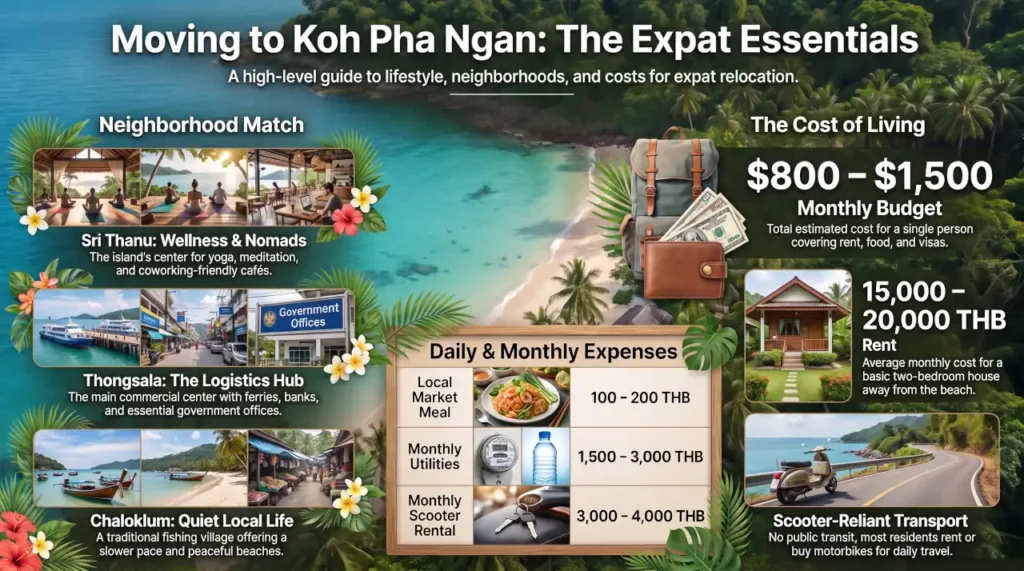
One of the first things people get wrong about Koh Pha Ngan is assuming the entire island has the same atmosphere. It doesn’t. Although Koh Pha Ngan covers only about 168 square kilometers, each area has its own personality, and choosing the right neighborhood can have a big impact on your experience as an expat.
Haad Rin
Haad Rin is the island’s nightlife hub and home to the famous Full Moon Party. It’s a fun place to visit, and many younger expats, backpackers, and seasonal workers choose to live here because of its lively social scene. However, if you’re planning to work remotely or prefer quieter evenings, the constant nightlife may become tiring. It’s worth experiencing at least once, but not everyone enjoys living here long term.
Baan Thai
Baan Thai offers a quieter, more residential atmosphere while still providing easy access to everyday essentials. You’ll find grocery stores, cafés, medical facilities, and an international elementary school nearby, making it one of the better choices for families or anyone looking for a balance between convenience and a relaxed lifestyle.
Thongsala
Thongsala is Koh Pha Ngan’s main commercial and transportation hub. The island’s primary ferry pier is located here, along with banks, ATMs, pharmacies, markets, clinics, government offices, and a wide variety of shops and restaurants. Many long-term expats choose to live in or near Thongsala simply because it makes daily errands much easier.
Sri Thanu
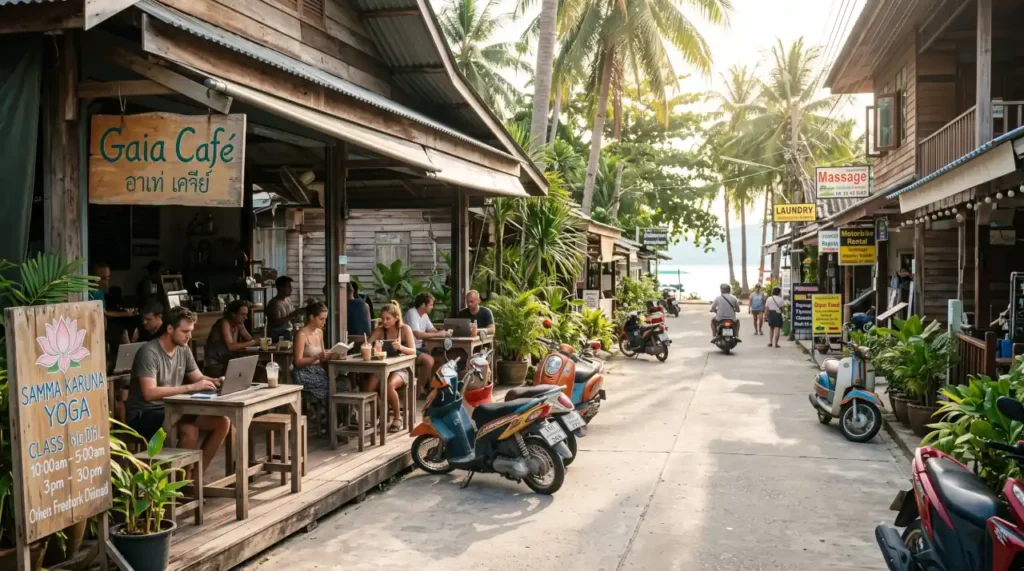
Sri Thanu has become known as Koh Pha Ngan’s wellness and digital nomad center. The area is home to numerous yoga studios, meditation retreats, coworking-friendly cafés, and healthy restaurants, giving it a laid-back, international atmosphere. If you’re looking for a community of remote workers or enjoy a wellness-focused lifestyle, Sri Thanu is often considered one of the island’s most desirable neighborhoods.
Chaloklum
Chaloklum is a traditional fishing village on the island’s northern coast with a noticeably slower pace of life. It’s known for its fresh seafood, quieter beaches, and stronger local character than some of the island’s more tourist-oriented areas. If you’re looking for a peaceful place near the ocean without the crowds, Chaloklum is well worth considering.
Choosing between these neighborhoods ultimately depends on the lifestyle you want. Someone looking for nightlife and a busy social scene will have very different priorities from a family with children or a remote worker seeking peace and quiet. If possible, spend a few weeks exploring different parts of the island before committing to a long-term lease. And if Koh Pha Ngan doesn’t feel like the right fit, our guide to the best places to live in Thailand explores several other islands and cities that offer completely different lifestyles.
Working in Koh Pha Ngan
Let’s be honest about this part upfront. Finding a traditional job on Koh Pha Ngan as a foreigner is genuinely difficult. The island’s economy runs on tourism and hospitality, and most of those positions either go to local Thai workers or don’t pay enough to sustain a foreigner’s cost of living, let alone cover a work permit.
That said, a difficult local job market hasn’t stopped a growing community of expats in Koh Pha Ngan from building successful lives on the island. Most of them just take a different route. If you’re looking for more local employment opportunities while still enjoying Thailand’s expat lifestyle, living in Chiang Mai is often a better fit than settling on a smaller island.
The two most common paths are starting a small business or working remotely. Koh Pha Ngan has developed something of a reputation as a haven for entrepreneurs, digital nomads, and freelancers, and there’s a real sense of community among them. If you’re trying to figure out how to set up a business, find a reliable web developer, or just need advice on which bank to use, chances are someone in the island’s expat network has already been through it and is happy to help. It’s a small enough island that these networks form naturally, through cafés, coworking spaces, and local community groups dedicated to the island.
Teaching is another route a lot of people take, though it’s more common on the Thai mainland and in bigger cities than it is on Koh Pha Ngan itself, simply because the island doesn’t have the same density of language schools. Still, if teaching interests you as a way to fund life in Thailand more broadly, it’s worth looking into teaching English in Thailand, which walks through what schools are actually looking for and how to get your foot in the door.
Some people also combine this path with study. Enrolling in a language program qualifies you for a Non-Immigrant ED visa, and it’s genuinely one of the more practical ways to stay in the country long-term while you sort out your business or remote work situation. We’ve broken down the requirements to getting the Thai ED visa in detail if that route appeals to you.
Working under a tourist visa isn’t technically permitted, and it’s not something we’d recommend building a long-term strategy around. While some remote workers continue to work for overseas employers while staying in Thailand, the legal treatment of remote work depends on your visa status and individual circumstances. If you’re planning to stay long term, it’s worth confirming the most appropriate visa before relocating.
English is spoken widely enough around the island that the language barrier is rarely a dealbreaker, especially in the more expat-heavy areas like Sri Thanu and Thongsala. Locals tend to be patient and genuinely friendly toward foreigners who make even a small effort to learn a few Thai phrases, and that goodwill goes a long way when you’re trying to navigate anything from renting an apartment to registering a motorbike.
Beyond the work itself, there’s a lot to fill your time when you’re not at your desk. Waterfall hikes, snorkeling trips, muay thai gyms, and a genuinely lively food and nightlife scene all exist alongside the quieter, more spiritual side of the island. Whether your idea of a good evening is a fancy dinner overlooking the water or a plastic stool and a cold Chang beer at a beach bar, Koh Pha Ngan tends to have an option that fits.
Cost of Living in Koh Pha Ngan
The short version is that Koh Pha Ngan is affordable by Western standards, but not quite as cheap as it was a decade ago, and there are a couple of costs that catch newcomers off guard.
Housing is usually the biggest line item, and it’s also where you have the most control over your budget. A basic two-bedroom place away from the beach can often be found in the range of 15,000 to 20,000 baht a month, which works out to somewhere around 400 to 550 USD depending on the exchange rate at the time.
Go for a beachfront villa or something with a private pool and you can easily push that number several times higher. Rent also fluctuates a lot with the season. Landlords tend to offer noticeably better rates during the rainy season and for anyone willing to sign a six-month or annual lease, so if you’re flexible on timing, you can save a meaningful amount just by moving during the off-peak months. Rental agreements vary considerably between individual landlords, and deposits of one to two months’ rent are common for long-term leases. Always request a written agreement that clearly outlines utility charges, maintenance responsibilities, and notice periods before signing.
Food is where Koh Pha Ngan genuinely shines. Thai food from local markets and street stalls is remarkably cheap, and a full meal with a drink often costs somewhere in the 100 to 200 baht range, roughly 3 to 6 USD. If you want a change of pace with Italian, Mediterranean, or another international cuisine, expect to pay more, typically somewhere between 300 and 700 baht for a full meal at a nicer restaurant.
Interestingly, a lot of long-term residents find that cooking at home actually costs more than eating out once you factor in imported grocery items, since fresh produce and street food are subsidized by an entire local economy built around feeding people cheaply, while imported pasta, cheese, and wine at the grocery store carry a real markup.
Two costs deserve special attention because they trip up almost every new arrival.
First, Factor Visa Costs into Your Budget
This is the one that catches people off guard the most, because it’s easy to assume a tropical island life is a one-time expense. As of 2026, most Western nationalities, including US, UK, Australian, and EU passport holders, receive a 60-day visa-exempt stamp on arrival, which is longer than the 30 days it used to be. That stamp can be extended once for an additional 30 days at any Thai immigration office for a fee of 1,900 baht, bringing your total stay to 90 days before you need to leave the country or switch to a different visa category.
According to the Royal Thai Embassy, a single-entry Tourist Visa currently carries a government application fee of 1,000 baht, allows a 60-day stay, and may generally be extended once for an additional 30 days through Thai Immigration. Miss your deadline and you’re looking at an overstay fine of 500 baht per day, so it’s worth marking your calendar the moment you land.
If you’re planning to stay for more than a few months, it’s worth looking past the endless border run cycle. Options like the Non-Immigrant ED visa, the Destination Thailand Visa (DTV), or a retirement visa if you qualify by age can all provide a more stable, longer-lasting legal status than repeatedly renewing a tourist stamp every 60 to 90 days. If you’re planning to work remotely, our guide to the Thailand Digital Nomad Visa explains who qualifies and whether it’s a better option than relying on short-term stays.
Whichever route you choose, budget for embassy or immigration fees, the occasional visa agent fee if you’d rather not handle the paperwork yourself, and the cost of a flight or ferry ticket if a border run is involved. None of these individual costs are enormous, but they add up over a year, and they’re easy to forget when you’re mentally budgeting only for rent and food.
Second, Transportation is an Essential Expense
Koh Pha Ngan simply doesn’t have buses, trains, or a metro system. What you’ll find instead are songthaews, the open-backed pickup trucks that function as informal shared taxis, running set routes around the island for a set fare. They work fine for getting from the pier into town, but they’re not a practical way to get around day to day, especially if you’re living outside of Thongsala.
Most residents end up buying a motorbike or scooter, which is by far the most common and most affordable way to get around. International Driving Permits are generally required for visitors who intend to ride legally in Thailand, and helmets are mandatory under Thai traffic laws. Insurance providers may also deny claims if riders are unlicensed. You can pick up a decent used scooter for a few hundred dollars, or rent one long-term for roughly 3,000 to 4,000 baht a month if you’d rather not own one outright.
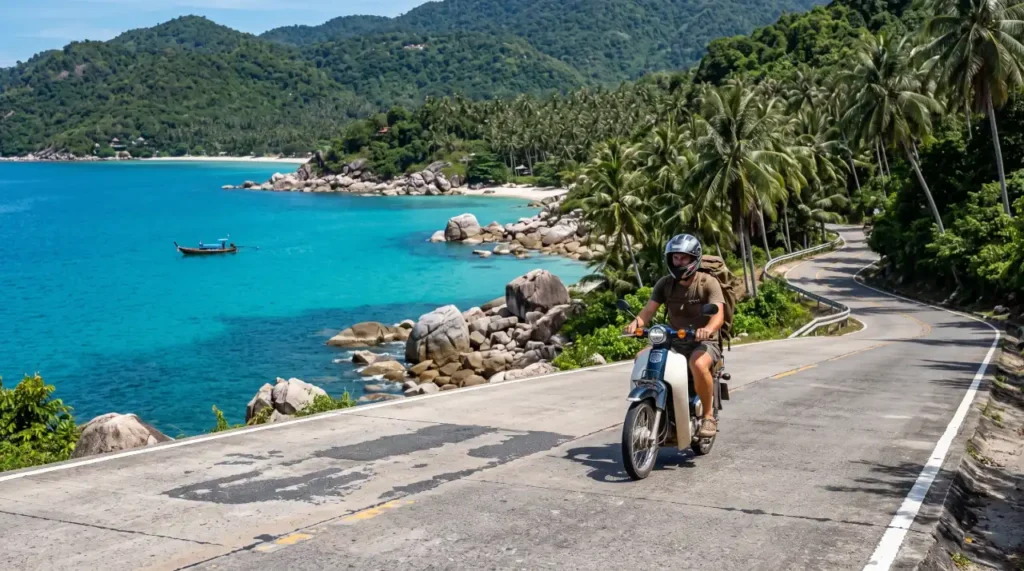
Many of the island’s roads, especially away from the main routes, are steep, unpaved, or both, so it’s worth taking your time to get comfortable on two wheels before you start exploring the more remote corners of the island. A car is an option too, but it’s a much bigger expense to buy or rent, and honestly not necessary unless you have a family or specific mobility needs. Learning to ride confidently is genuinely one of the most freeing things you can do here. Once you’re comfortable on a scooter, the whole island opens up, from hidden waterfalls to viewpoints you’d never reach otherwise.
Beyond housing, food, visas, and transportation, day-to-day costs stay fairly reasonable. Utilities for a modest apartment typically run somewhere between 1,500 and 3,000 baht a month, more if you’re running air conditioning constantly, which most people do given the climate. Internet is generally solid enough for remote work, particularly in areas like Thongsala and Sri Thanu where fiber connections have become more common, though it’s worth checking a specific property’s connection speed before committing, since quality can vary quite a bit block by block.
Healthcare is another pleasant surprise for expats in Koh Pha Ngan. Thailand’s private hospitals, including facilities on nearby Koh Samui for anything more serious, offer quality care at a fraction of Western prices, and a basic health insurance policy for expats is inexpensive enough that skipping it isn’t worth the risk.
All told, a single person living reasonably comfortably, renting a modest place, eating a mix of local and imported food, and covering transportation and visa costs, can expect to spend somewhere in the range of 800 to 1,500 USD a month. Couples and families will naturally spend more, especially if international schooling is part of the picture, but even then, Koh Pha Ngan remains considerably cheaper than most comparable coastal destinations in the Western world.
Also Read: Best Places to Live in Thailand: A Complete Guide for Expats in 2026
Common Mistakes New Expats Make
Most newcomers make at least one of these mistakes during their first few months on Koh Pha Ngan. Avoiding them can save you money, time, and unnecessary frustration.
Common ones include:
Final Thoughts
Koh Pha Ngan isn’t for everyone, and that’s honestly part of its appeal. It rewards people who are comfortable with a bit of unpredictability, who don’t mind occasionally losing power during a storm or waiting an extra week for a package to clear the ferry. In exchange, you get a genuinely tight-knit expat community, some of the most beautiful, least crowded beaches in Thailand, and a pace of life that’s almost impossible to find back home.
If you’re coming from a fast-paced Western city, expect an adjustment period. Things move slower here, bureaucracy can be frustrating, and the rainy season will test your patience more than once. But most people who commit to giving it a real chance, rather than just a two-week vacation, end up staying far longer than they originally planned. Come during the quieter months if you can, spend time in a few different neighborhoods before you settle, and give yourself permission to change your mind about which part of the island feels like home. Koh Pha Ngan has a way of reshaping people’s priorities, usually for the better.
If you’re unsure whether Koh Pha Ngan is the right fit, consider spending a month on the island during the low season before committing to a long-term move. You’ll experience day-to-day life with fewer tourists, lower rental prices, and a much more realistic picture of what living on the island is actually like.