
Thinking about teaching English in Vietnam? You’re not alone. Every year, thousands of people trade their office jobs, retirement plans, or laptop-and-coffee-shop routines for a classroom in Hanoi, Ho Chi Minh City, or somewhere quieter along the coast. Vietnam has a well-established market for foreign English teachers, particularly in its major cities, although the requirements and job quality vary considerably between employers.
If you’ve already looked into how to move to Vietnam, teaching can be one of the more practical ways to make the move happen because you can secure an income and have an employer involved in the legal employment process. Here’s exactly how to do it, step by step.
Also Read: Explorexp blog
Quick Answer
To teach English legally in Vietnam in 2026, the most practical route is to secure a job with a school or education company that can legally employ foreign workers, then complete the required work-permit and immigration process. Your qualifications, the teaching position, employer, and supporting documents all matter, so verify the current requirements before accepting a job.
How to Teach English in Vietnam
- Understand the requirements — Check the qualifications and documents needed for the type of teaching job you want.
- Choose where to live — Compare Vietnam’s main teaching destinations based on jobs, lifestyle, and cost of living.
- Apply and verify the job — Find employers, interview, review the contract, and confirm how your legal employment will be handled.
- Build experience — Use your first year to develop your teaching skills, professional credentials, and understanding of the local job market.
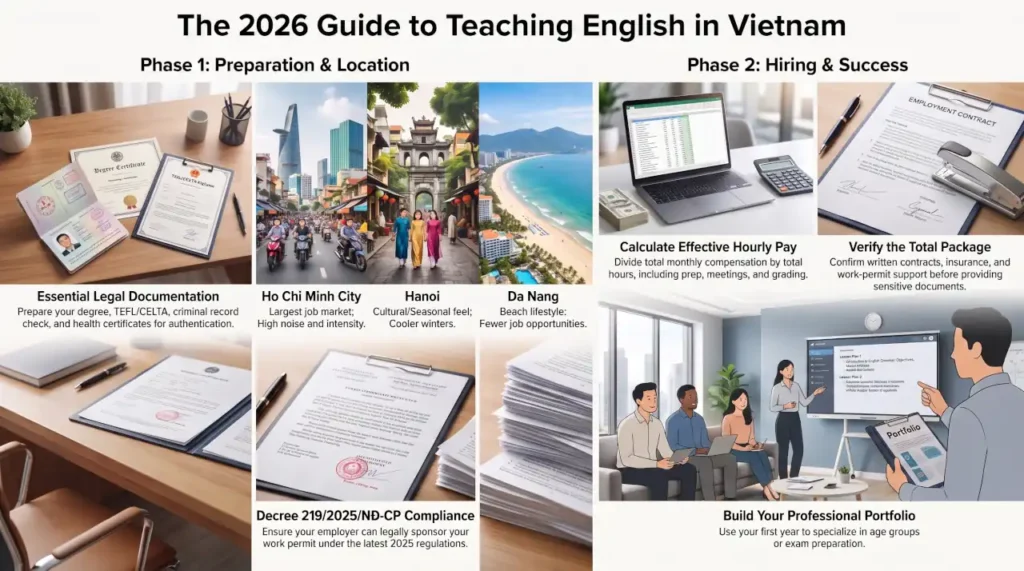
1. Understand the Requirements to Get Hired
Before you start applying, understand the difference between being allowed to enter Vietnam and being legally authorized to work there. A visa or immigration status that lets you enter or stay in Vietnam does not automatically give you permission to work as an English teacher.
For most teachers seeking a conventional school or language-center job, the cleaner route is to work with an employer that can legally employ foreign workers and handle the applicable work-permit and immigration procedures. Vietnam’s foreign-worker rules changed in 2025, so older articles that describe the previous process may no longer be reliable.
The current framework is set out in Decree 219/2025/NĐ-CP, which took effect on August 7, 2025. That means you should evaluate a teaching job based on whether the employer can legally employ you in the position—not simply whether someone says you can enter Vietnam on a particular visa.
Common Requirements for Legal Employment as an English Teacher
The exact documents and qualifications depend on the teaching position, employer, and applicable regulations, so don’t treat an old checklist as universal. For a typical foreign English teacher, you should be prepared to provide documentation such as:
Some of these documents relate to legal work authorization, while others may simply be part of an employer’s hiring requirements.

A bachelor’s degree is a common requirement employers look for, but the legal requirements should be checked against the specific position rather than presented as a blanket rule for every foreign English teacher.
Likewise, TEFL, TESOL, or CELTA can make you much more competitive, but don’t assume that a 120-hour certificate is automatically the statutory minimum for every teaching job. Schools can impose their own hiring standards, and the qualification rules can vary depending on the type of educational institution and position.
Do You Need to Be a Native English Speaker?
Being a native English speaker is not the only factor that determines whether you can teach English in Vietnam. Employers may have their own language, qualification, and experience requirements, while legal work authorization depends on the position and applicable regulations.
If English is your second language, don’t assume that you are automatically excluded. Instead, ask prospective employers whether they hire non-native English speakers and confirm that the position has a valid legal employment pathway.
The practical takeaway is simple: get your documents in order before you arrive, and have the prospective employer confirm exactly what it needs for your position.
What If You Don’t Meet the Requirements?
If you don’t meet the requirements for a particular teaching position, don’t assume that a tourist or other temporary visa allows you to work. Instead, look for ways to strengthen your qualifications, gain relevant experience, or find an employer and position that match your credentials.
You may hear about teachers working informally or taking private students without appropriate work authorization. That may happen in practice, but it isn’t a reliable basis for a long-term move. If an employer tells you to arrive on a tourist visa and start teaching, ask how and when your legal work authorization will be handled before accepting the job.
2. Choose Which City You Prefer
Vietnam has three cities that dominate the English-teaching scene, and each one has a completely different personality. Spend a little time deciding which environment suits you before you commit to a lease or contract. Your city will affect your commute, living costs, social life, and the types of teaching jobs available.
Ho Chi Minh City, still called Saigon by locals, is the biggest and busiest of the three. It’s loud, fast, and endlessly entertaining, with a huge expat community, countless language centers, and a nightlife scene that never really shuts off. If you want variety, both in job options and in things to do after work, this is usually the easiest place to land your first role.
Hanoi is the capital, and it feels older and a bit more reserved than Saigon, with narrow streets, French colonial architecture, and a slower pace once you get outside the tourist center. It still has a strong job market for teachers, especially in international schools and well-established language centers, and many people find the cost of living here just as manageable.
Da Nang is the quieter, beachier alternative to the two big cities. It’s grown enormously over the past decade, with a lot of new construction and a growing digital nomad crowd, and it sits close to Hoi An if you want easy weekend trips. The teaching market here is smaller, but it’s still active, and a lot of people who try Saigon or Hanoi first end up settling in Da Nang for the long term because the lifestyle is simply calmer.
Hanoi vs. Ho Chi Minh City vs. Da Nang
| City | Best for | Main advantage | Potential drawback |
| Ho Chi Minh City | Maximum job choice and busy city life | Large education and language-center market | Busier, noisier, and more intense |
| Hanoi | Culture, history, and a more seasonal climate | Strong education market and distinctive local character | Cooler winters and a different pace from southern Vietnam |
| Da Nang | Beach lifestyle and a slower pace | Smaller-city feel with easy access to the coast | Fewer teaching opportunities than the two biggest cities |
If your first priority is finding the largest number of potential employers, start with Ho Chi Minh City or Hanoi. If lifestyle matters more than having the biggest possible job market, Da Nang may be the better fit.
There are teaching jobs outside these three cities too, particularly through franchised English centers that place teachers in smaller towns, but the opportunities thin out the further you get from the major hubs. If you’re still deciding where you’d actually want to live day to day, it’s worth reading through the best places to live in Vietnam before you lock in a location. Ideally, spend a couple of weeks visiting more than one city before you sign anything. Vietnam is small enough, and travel is cheap enough, that there’s no real reason to pick blind.
3. Start Applying and Understand the Hiring Process
You can start your job search from outside Vietnam. In fact, that’s often the smarter approach because it lets you compare employers before committing to flights, accommodation, or an employment arrangement.
Some schools and language centers interview remotely, while others prefer to meet candidates in person or conduct a demo lesson. Don’t assume that you need to enter Vietnam first.
If an employer wants you to travel to Vietnam for an interview, ask what immigration status you should use for the visit and, separately, how your legal work authorization will be arranged if you’re hired. Those are two different questions.
The goal isn’t simply to get an offer. It’s to get an offer from an employer that can explain your contract, compensation, teaching schedule, and work authorization clearly.
Where to Find English Teaching Jobs in Vietnam
Start with established language schools, private and international schools, reputable ESL job boards, professional networks, and direct applications to education companies. Facebook groups can also provide useful leads, but treat listings as leads to investigate rather than proof that an employer is legitimate.
Before sending passports, degrees, criminal-record documents, or other sensitive paperwork, verify who the employer is and why it needs each document.
The Interview Process
Some Vietnamese schools and language centers interview candidates remotely, while others prefer an in-person interview or demonstration lesson. If you’re applying from overseas, ask whether the initial interview can be completed online. If you’re asked to travel to Vietnam, clarify the appropriate immigration status for the visit separately from how your legal work authorization will be handled if you’re hired.
Once you have an interview, be ready to discuss your teaching experience, classroom management style, teaching philosophy, and experience with the relevant age group. Research the school beforehand so you understand its teaching approach and what it expects from teachers.
What to Expect From a Teaching Demo
Some schools may ask you to teach a short demo lesson, particularly for young learners. Ask how long the demonstration should be, what age group you’ll teach, whether the school provides materials, and whether the demo is paid.

The Reality of Getting a Job
Check the Employer Before You Accept
A teaching offer is only as good as the employer behind it. Before accepting, ask for the important details in writing and look beyond the advertised hourly rate.
At a minimum, confirm the salary, guaranteed teaching hours, contract length, payment schedule, expected duties, and who is responsible for the work-permit and immigration process. It’s also worth asking whether preparation, meetings, training, grading, or travel between teaching locations are paid.
Be especially cautious if an employer refuses to provide a written contract, asks for unexplained recruitment fees, wants to hold your original passport, or tells you that you can simply work on a tourist visa.
If possible, speak with current or former teachers. A short conversation can reveal problems that aren’t obvious during an interview, such as late pay, unpredictable schedules, unpaid work, or high staff turnover.
English Teacher Salary in Vietnam: How to Compare Offers
Teaching pay in Vietnam varies substantially by employer, teaching setting, qualifications, experience, city, guaranteed hours, and benefits. Because compensation structures differ, a monthly salary alone doesn’t tell you whether an offer is competitive.
When researching English teacher salaries in Vietnam, compare the guaranteed monthly income with the actual number of hours you are expected to teach and the amount of required unpaid work. Also check whether the package includes insurance, paid leave, bonuses, transportation, housing assistance, or work-permit support.
If an employer advertises an hourly rate, ask whether that rate applies only to classroom teaching or also covers required preparation, meetings, training, grading, and other duties.
Don’t compare teaching jobs using the headline salary alone. A higher monthly salary may be less attractive if it requires substantially more classroom time, unpaid preparation, a long commute, or additional duties.
When comparing offers, calculate:
Effective hourly pay = total monthly compensation ÷ total hours actually required
Include classroom teaching, mandatory meetings, training, preparation, grading, and other required work where applicable. Then compare paid leave, insurance, bonuses, transportation, housing assistance, and work-permit support.
The goal is to compare the total employment package, not just the advertised salary.
How Many Hours Do English Teachers Work in Vietnam?
Teaching schedules vary by employer and position. Don’t evaluate an offer based only on the number of classroom hours.
Ask how many hours you’ll spend teaching each week and whether the schedule also includes lesson planning, staff meetings, training, grading, student assessments, or travel between locations.
Also clarify whether the position is full-time or part-time, how many hours are guaranteed, and whether the employer can change your schedule after you start.
4. Use Your First Year to Build Experience
Once you’ve found a legitimate teaching position, treat the first year as both a job and a test of whether Vietnam is right for you.
Keep copies of your employment documents, contracts, teaching records, professional qualifications, and references. These can become valuable if you later apply for another school or decide to teach in another country.
Your first year is also a good time to learn what type of teaching suits you. Young learners, teenagers, adults, exam preparation, corporate English, and one-to-one tutoring can feel like completely different careers.

Don’t assume that because Vietnam is relatively accessible to new teachers, every teaching job will be a good fit. Pay attention to workload, classroom management, commuting time, school culture, and whether the employer delivers what was promised during recruitment.
If you enjoy the work, your next move can be to specialize, negotiate better employment terms, pursue additional teaching qualifications, or use your Vietnamese experience to qualify for opportunities elsewhere.
Common Mistakes to Avoid When Teaching English in Vietnam
1. Treating a visa as permission to work
Being able to enter or stay in Vietnam is not the same as being authorized to work. Before you begin teaching, ask your employer how your legal employment and work authorization will be handled.
2. Relying on outdated requirements
Vietnam’s foreign-worker rules changed in 2025, so older guides may describe requirements or procedures that no longer apply. If a recruiter or article gives you conflicting information, check the current rules and ask your prospective employer to confirm what applies to your specific position.
3. Choosing a job based only on salary
A higher advertised salary does not necessarily mean a better job. Consider the total teaching hours, unpaid preparation, commute, benefits, contract terms, and other required duties before comparing offers. A slightly lower salary can be more attractive if the workload and employment conditions are significantly better.
4. Trusting an employer before verifying the job
Don’t rely on verbal promises or a job advertisement alone. Before accepting an offer, confirm the employer’s identity, written contract, salary, working hours, duties, and work-permit arrangements. Be cautious if you’re asked for sensitive documents or money before you’ve verified who you’re dealing with.
5. Falling for a teaching job scam
Be cautious when a recruiter or school refuses to provide basic information about the employer, pressures you to pay unexplained fees, requests sensitive documents before explaining why they are needed, or promises unusually attractive compensation without a clear contract. Verify the school’s identity, physical location, website, employment terms, and contact information before providing sensitive documents or money.
6. Assuming every city offers the same opportunities
Ho Chi Minh City, Hanoi, and Da Nang have different job markets, living costs, and lifestyles. The city with the most teaching jobs may not be the best fit for you. Consider where you want to live as well as how easy it will be to find suitable work.
Also Read:
You’re Ready to Teach English in Vietnam
Teaching English in Vietnam can be a practical way to live abroad while building international teaching experience, but getting the job should not be your only goal. The better goal is to find a legitimate employer, understand your work authorization, and choose a position that fits your qualifications and lifestyle.
Prepare your documents before applying, research employers carefully, compare the complete employment package rather than salary alone, and verify the current requirements for your specific position.
If you don’t yet qualify for your preferred job, use the requirements as a roadmap. Additional qualifications, teaching experience, or a different position may give you better options.
With the right preparation, teaching in Vietnam can be more than a way to get into the country—it can be a worthwhile professional and expat experience.