
If you’ve ever wondered about the difference between an expat and an immigrant, you’re not alone. Although the terms are often used interchangeably, they usually describe different intentions for living abroad. Understanding the distinction can help you choose the right visa pathway, plan your finances, and better understand how these labels are used in everyday conversation.
Also Read: 15 Unique Things to Do in Guadalajara Like a Local
Quick Answer
The main difference between an expat and an immigrant is usually intention and legal pathway, not nationality. An expat typically lives abroad temporarily for work, retirement, or lifestyle reasons, while an immigrant generally plans to settle permanently. In everyday language, however, these terms often carry social and cultural assumptions that go beyond their practical meanings.
Key Takeaways
- “Expat” and “immigrant” are not official legal immigration categories.
- The practical distinction usually comes down to temporary versus permanent settlement.
- Many people also move from one category to the other over time as their plans change.
- Social perceptions often influence which label people receive.
- Visa type and residency status matter far more than the label itself.
- Digital nomads generally fall into a separate category with their own visa options.
What Is an Expat?
Let’s start with the basics. The word “expat” is short for expatriate, which comes from Latin roots meaning “out of the fatherland.” Technically, it just means someone living outside their home country. That’s it. Nothing about how long they’re staying, nothing about their income, nothing about their passport.
In practice, though, the word has picked up a lot of extra baggage over the years. When most people hear “expat,” they picture a specific kind of person: someone from a wealthier Western country who’s moved abroad for work, retirement, or a lifestyle upgrade, usually with the plan (or at least the option) of going home eventually. Think of the American retiree spending winters in Portugal, the British teacher on a two-year contract in South Korea, or the software developer who relocated to Lisbon because the visa process was easy and the cost of living was low.
Expats often move abroad for reasons that sound almost aspirational: better weather, lower taxes, a slower pace of life, or a company transfer that comes with a relocation package. Their move is frequently framed as a choice rather than a necessity, and that framing matters a lot for how the word gets used. Nobody talks about “economic expats” fleeing a country because there’s no work at home, even though plenty of people who get called expats moved abroad for exactly that reason.
There’s also a legal side to this. Expats are usually in a country on a work visa, a retirement visa, a student visa, or something tied to a specific purpose and a specific timeline. Their right to stay is often connected to a job, a course of study, or a renewable permit rather than permanent status. If the job ends or the visa isn’t renewed, the expat’s stay often ends with it. That’s a real, practical difference, even if the word itself doesn’t legally mean anything.
Many expats maintain financial and legal ties to their home country by keeping bank accounts, pensions, or voting rights there while planning around the possibility of returning home. Although plans often change over time, this continuing connection is one of the practical characteristics that distinguishes many expats from immigrants.
The expat label is also applied unevenly. Retirees, corporate employees, and short-term professionals are all commonly described as expats despite having very different intentions, which shows how flexible—and sometimes inconsistent—the term has become.

What Is an Immigrant?
Now let’s flip it around. An immigrant, in the plainest sense, is someone who moves to a new country with the intention of living there long-term or permanently. The emphasis is on settling down, not passing through. Immigrants are typically working toward, or already hold, some form of permanent residency or citizenship in their new home.
This is where things start to feel less like semantics and more like real life. An immigrant might arrive on a work visa too, just like an expat. They might have a university degree and a well-paid job, just like an expat. The practical starting point can look almost identical. But the label “immigrant” tends to get attached to people moving from lower-income countries to higher-income ones, and to people whose move is seen as motivated by necessity rather than lifestyle.
A family relocating from the Philippines to Canada for better opportunities gets called immigrants. A Canadian family relocating to the Philippines for a cheaper, warmer life gets called expats. Same continent-hopping, very different labels.
Legally speaking, immigrants are usually on a track that leads somewhere permanent. In many cases, they begin on a temporary visa before entering the immigration process toward permanent residency or citizenship. That could mean a green card process in the United States, permanent residency in Canada or Australia, or settled status in the UK. The paperwork looks toward citizenship, not toward an exit date. That’s the biggest functional distinction between the two groups, even though the social meaning of the words has drifted pretty far from anything a lawyer would recognize.
Immigrants also tend to reorganise their lives around their new country in ways that go beyond paperwork. They may transfer finances, enrol children in local schools, and build long-term community ties. While many remain closely connected to their country of origin, the overall goal is usually to establish a permanent life rather than prepare for an eventual return.
Expat vs Immigrant
The table below summarises the most common practical differences between an expat and an immigrant, although individual situations don’t always fit neatly into either category.
| Feature | Expat | Immigrant |
| Typical intention | Temporary stay | Permanent settlement |
| Visa pathway | Work, retirement, study or temporary residence | Permanent residence or citizenship |
| Plans to return home | Usually yes | Usually no |
| Legal status | Temporary permission to stay | Long-term or permanent status |
| Typical public perception | Career opportunity or lifestyle move | Building a new life abroad |
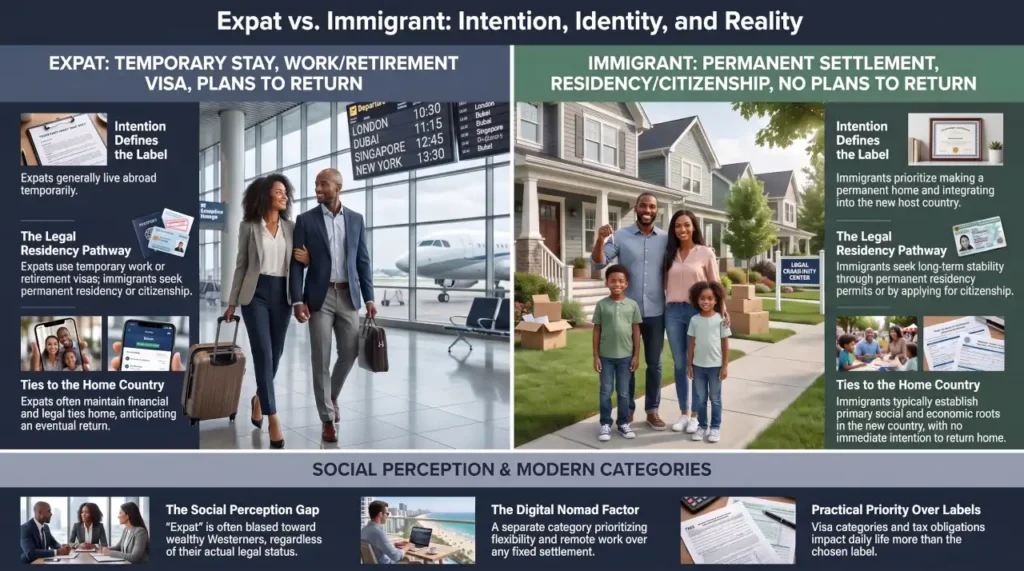
Expat vs Immigrant in One Sentence
An expat is generally someone living abroad temporarily, while an immigrant intends to settle permanently, although everyday use of these terms is also shaped by social, cultural, and historical factors.
Which One Are You?
Ask yourself these three questions:
- Do you plan to return home after a few years?
- Are you working toward permanent residency or citizenship?
- Is your current visa designed for temporary residence or long-term residence?
If your move is temporary, you may identify more closely as an expat. If you’re building a permanent future in another country, immigrant is usually the more accurate description.
So here’s the side-by-side version, because it helps to see it laid out plainly.
An expat is generally thought of as someone living abroad temporarily, often for work, retirement, or a specific chapter of life, with a home country they could return to and sometimes still call “home” in a very literal sense. An immigrant is generally thought of as someone who has moved abroad to build a permanent life, with citizenship or long-term residency as the eventual goal.
On paper, that distinction is about intention and legal pathway. In real life, the words carry a social weight that has almost nothing to do with paperwork. Studies and journalists have pointed out for years that “expat” tends to be reserved for people from wealthy, mostly white, Western countries, while “immigrant” gets applied to people from lower-income countries, regardless of their education, income, or actual immigration status.
A British consultant moving to Nigeria is an expat. A Nigerian consultant moving to Britain is an immigrant. Neither person’s intentions or qualifications explain that gap. Skin color, nationality, and perceived wealth do a lot of the explaining instead.
This isn’t just an internet talking point. Journalist Mawuna Remarque Koutonin argued in The Guardian that the term “expat” often functions more as a social label tied to race, nationality, and class than as a neutral description of someone living abroad. His analysis remains widely referenced because the same patterns continue to appear in media coverage and public discussion today.
None of this means the words are useless. It just means you should use them carefully and know what you actually mean when you reach for one over the other. If you’re describing someone’s legal status, “immigrant” and “expat” aren’t really the right tools anyway; visa category, residency status, and citizenship pathway are the terms that actually matter for taxes, healthcare, and staying on the right side of immigration law.
Immigration authorities generally assess a person’s legal status based on their visa or residence permit rather than whether they describe themselves as an expat or an immigrant. If you’re describing someone’s own sense of identity and plans, then sure, use whichever word feels honest to their situation, and maybe just be aware of the assumptions riding along with it.
What About Nomads?
Digital nomads throw a wrench into this whole conversation, because they don’t fit neatly into either box. A digital nomad is someone who works remotely and moves between countries fairly often, sometimes staying in one place for a few months and then packing up for the next. They’re not exactly expats in the traditional sense, since they usually don’t have one fixed host country they’ve settled into. And they’re definitely not immigrants, since permanent settlement isn’t really the point of the lifestyle at all.
Unlike immigrants, digital nomads typically aren’t pursuing a long-term pathway to permanent residency or citizenship. And unlike many traditional expats, they often don’t remain in one country long enough to establish deep local ties. Their goal is usually flexibility rather than permanent settlement.
If you’re weighing up where you could actually base yourself while working online, it’s worth looking through digital nomad visas, since the requirements, costs, and length of stay vary a lot from one country to the next. For example, our guide to the Thailand Digital Nomad Visa explains who qualifies and what remote workers should know before applying.
The nomad category also complicates the whole expat-versus-immigrant debate in a useful way. It shows that “where you live” and “how long you plan to stay” aren’t the only variables that matter. Purpose matters too.

Expat vs Immigrant: It’s All About Time
If you strip away all the social baggage and just look at the practical core of the distinction, it really does come down to time and intention. That’s the cleanest way to think about it, even if it’s not the whole story.
Time alone doesn’t determine whether someone is an expat or an immigrant. Some expats remain abroad for decades while still intending to return home, whereas others decide within months that they want to settle permanently. In practice, the distinction is less about how long you’ve lived somewhere and more about whether your long-term plans are centred on your home country or your new one.
That question matters for reasons well beyond semantics. It affects how you plan your finances, whether you keep a foot in your home country’s tax and pension systems or start shifting everything to your new country, how you approach language learning, and even how you think about healthcare and long-term care as you get older. Retirees especially should think hard about this distinction, since a retirement visa that assumes you’ll eventually leave can look very different, tax-wise and legally, from a residency path that assumes you’re staying for good.
Also Read:
Health insurance is one of the clearest examples of why this distinction matters in practice. This is often one of the first practical surprises new arrivals encounter because healthcare systems rarely work the same way from one country to another. Someone treating their move as temporary might keep paying into their home country’s health system, or buy short-term international insurance that’s designed to cover a year or two abroad and nothing more.
Someone treating their move as permanent usually needs to think about local health insurance, how it interacts with pre-existing conditions, and whether they’ll qualify for public healthcare once they hit permanent residency. Healthcare eligibility often depends on your residency status rather than simply how long you’ve lived in a country, so reviewing the local rules before relocating is essential. In some countries, eligibility for public healthcare begins only after meeting specific residency or contribution requirements. Get this wrong, in either direction, and you can end up either overpaying for coverage you don’t need or badly underinsured for the years you’re actually planning to stay.
Taxes work the same way. Many countries tax residents differently depending on how long they’ve been there and what kind of visa or status they hold, and some have tax treaties designed specifically to stop people from getting taxed twice on the same income. If you’re not sure whether you’re structuring your finances like a temporary visitor or a long-term resident, that’s usually a sign it’s worth speaking with a qualified cross-border tax adviser or accountant who specialises in international taxation, as tax residency rules vary significantly between countries. The cost of getting this wrong tends to show up years later, in the form of a bill you didn’t see coming.
Common Mistakes People Make
Final Thoughts
At the end of the day, “expat” and “immigrant” describe the same basic act: a person leaving one country and building a life, even a temporary one, in another. The difference people draw between them is partly about genuine differences in intention and legal pathway, and partly about assumptions we’ve inherited that have very little to do with someone’s actual circumstances.
If you’re planning your own move abroad, don’t get too hung up on which word technically applies to you. Once you’ve decided whether you’re relocating temporarily or permanently, the next step is choosing a destination that fits your lifestyle. If Thailand is on your shortlist, our guide to the best places to live in Thailand explores the practical questions worth asking before you move.
Focus on the things that actually govern your day-to-day life: your visa category, your tax obligations in both countries, your healthcare coverage, and your realistic plan for how long you intend to stay. If Mexico is on your shortlist, our guide to the best places to live in Mexico compares some of the most popular destinations for expats before you commit to a move.
Those practical decisions will have a much greater impact on your experience abroad than the label you choose to describe yourself. In the end, your visa, tax obligations, healthcare, and long-term plans are what shape your life abroad—not whether someone calls you an expat or an immigrant.
And if you do use the words, maybe use them a little more consciously. Call yourself whichever one feels honest. Just remember that the person sitting next to you, who left their home country for very similar reasons and with very similar hopes, deserves the same word too.