I still remember the first time I walked down Quinta Avenida with a suitcase in one hand and absolutely no plan in the other. Playa del Carmen has a way of doing that to people. It pulls you in with turquoise water and cheap tacos, and before you know it, you’re googling “how to get a Mexican bank account” at 11pm. If you’ve been going back and forth on whether this Caribbean town is the right move, I’ve put together everything I wish someone had told me before I packed my bags. We’ll cover neighborhoods, money, visas, and the everyday stuff nobody mentions until you’re already there.
Living in Playa del Carmen means enjoying Caribbean beaches, a walkable city, a thriving expat community, and a lifestyle that blends modern conveniences with relaxed coastal living.
Playa del Carmen isn’t the only destination along this stretch of coast worth considering. Some expats end up preferring the bigger city energy of Cancun, the colonial calm of Mérida, or the altitude and culture of Mexico City. Others skip the coast entirely and land in Guadalajara for its tech scene and lower prices. If you’re still weighing your options, our guide to the best Central Mexico cities compares several affordable inland destinations that many expats overlook. But if beaches, cenotes, and a walkable town center are what you’re after, Playa del Carmen is hard to beat. Let’s get into it.
This guide covers neighborhoods, living costs, visas, transportation, healthcare, and everyday life to help you decide whether moving to Playa del Carmen is the right choice.
Also Read: Living in Guadalajara: Costs, Safety & Daily Life
Quick Answer
Living in Playa del Carmen offers expats a beach-focused lifestyle, a large international community, reliable internet, and lower living costs than many North American cities. While housing prices have increased in recent years, the city remains one of Mexico’s most popular destinations for retirees, remote workers, and digital nomads thanks to its walkability, healthcare access, and year-round warm climate.
Key Takeaways
- Playa del Carmen is one of Mexico’s most established expat and digital nomad destinations.
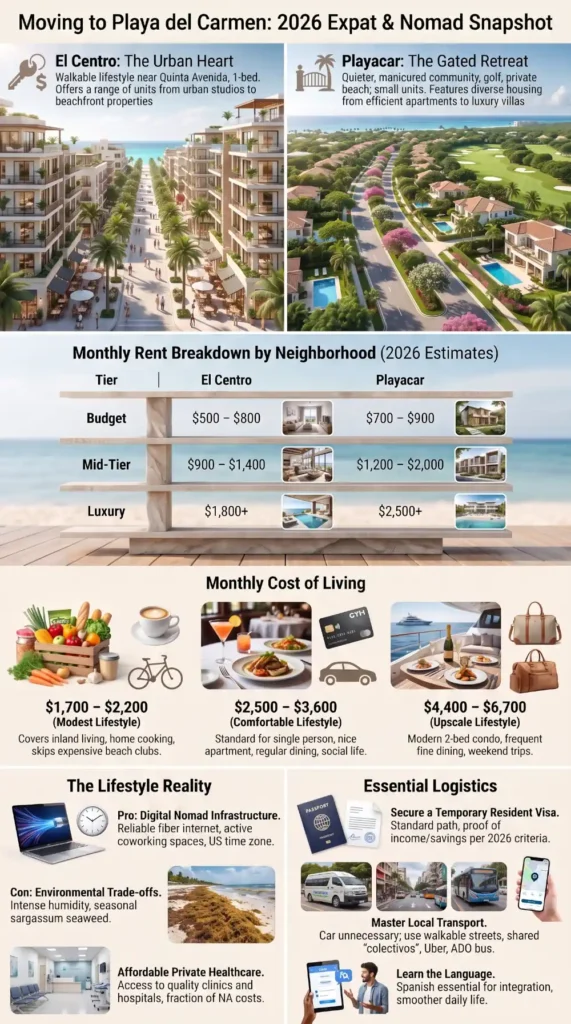
- El Centro suits walkable urban living, while Playacar offers a quieter gated community.
- Monthly living costs generally range from about $1,700 to $3,600 for most expats.
- Most long-term expats apply for Mexico’s Temporary Resident Visa.
- Learning Spanish significantly improves everyday life and integration.
What is it like living in Playa del Carmen?
Living in Playa del Carmen combines Caribbean beaches, modern conveniences, and an active international community. Expats benefit from walkable neighborhoods, reliable internet, affordable private healthcare, and easy access to the rest of the Riviera Maya. The main trade-offs are rising housing costs, year-round humidity, and seasonal sargassum on some beaches.
Best Areas for Long-term Accommodation
Where you live in Playa del Carmen shapes almost everything else about your experience, from your rent to your commute to how often you actually make it to the beach. Two neighborhoods come up again and again when expats talk about settling down here: El Centro and Playacar. They’re both solid choices, but they suit very different lifestyles and budgets.
Tip: If possible, spend a week or two in your preferred neighborhood before signing a long-term lease. Streets only a few blocks apart can differ noticeably in terms of noise, traffic, and tourist activity.
El Centro (The Center)
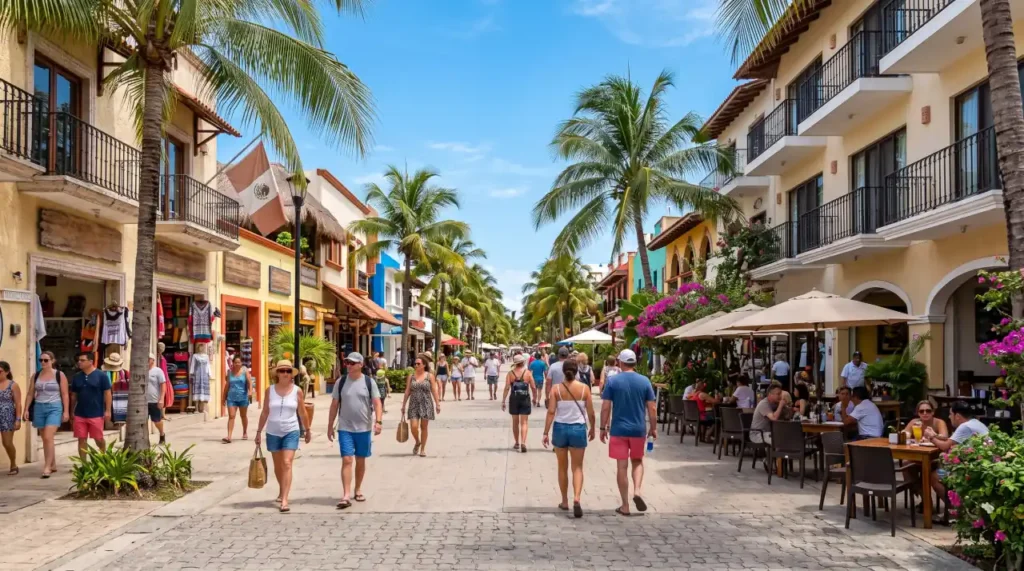
El Centro is the beating heart of Playa. This is where Quinta Avenida runs, packed with restaurants, coffee shops, yoga studios, and enough happy hours to keep your social calendar full without ever needing a car. It’s loud, it’s touristy in patches, and it’s also genuinely fun to live in if you like being close to everything.
Playacar
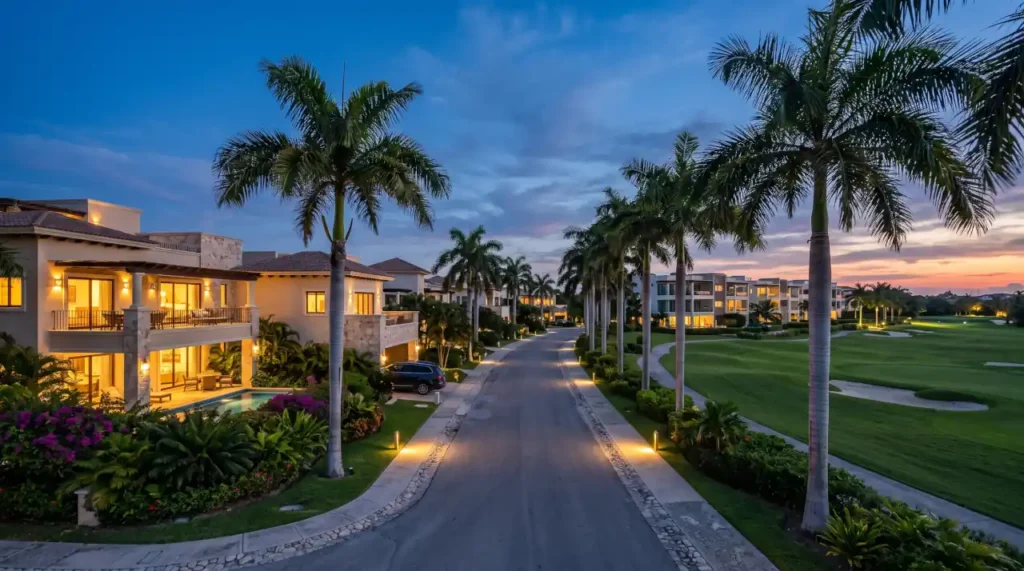
Just south of El Centro, across from the main plaza, sits Playacar, a gated, master-planned community with its own golf course, private beach access, and noticeably quieter streets. It feels more suburban, more manicured, and honestly a bit more like a resort than a neighborhood, which is exactly why a lot of families and retirees gravitate here.
Quality of Life & Cost of Living
Here’s the honest answer: Playa del Carmen is no longer the dirt-cheap backpacker town it was a decade ago, but it’s still considerably more affordable than most cities expats are coming from. A single person living comfortably, with a nice apartment, regular meals out, and a normal social life, can expect to spend somewhere between $2,500 and $3,600 a month. If you’re cooking at home more, living a few blocks inland, and skipping the beach clubs, that number drops to around $1,700 to $2,200. On the upscale end, with a modern two-bedroom, frequent dining out, and weekend cenote trips, budget for $4,400 to $6,700.
Rent is usually your biggest expense, often eating up 35 to 45 percent of a monthly budget, simply because tourist-zone pricing bleeds into residential rents. Groceries and eating out remain reasonably priced, especially if you shop at local markets and Mexican grocery chains like Chedraui instead of the imported-goods aisle at the international supermarkets.
A casual lunch at a local spot might run you 100 to 150 pesos, while a nicer dinner on Quinta Avenue can easily double that. Many long-term expats also open a Mexican bank account after settling in, making it easier to pay rent, utilities, and other recurring local expenses.
Utility costs can also increase during the hottest months, as running air conditioning for much of the day is often unavoidable.
Quality of life is where Playa really earns its reputation. You get warm weather nearly year-round, fast fiber internet in most residential buildings, decent private healthcare at a fraction of US or Canadian prices, and a genuinely international community. Many expats also appreciate the shorter wait times and easier access to private clinics compared with many healthcare systems in North America.
Private hospitals and clinics throughout Playa del Carmen provide routine medical care, while more specialized treatment is also available in nearby Cancún when needed. The trade-offs are real too: humidity that never fully lets up, occasional sargassum seaweed on the beaches during certain months, and prices that have crept up noticeably in the last few years as more remote workers move in.
Visa Options for Expats
Most people start in Playa del Carmen the easy way: as a tourist. Citizens of the US, Canada, and the EU typically get up to 180 days on entry, which is plenty of time to test the waters before committing to anything official. A lot of digital nomads spend their first few months this way, working remotely on a tourist stay while they decide if the lifestyle actually fits.
If you’re ready to make it more permanent, the Temporary Resident visa is the standard path. As financial requirements for Mexico’s Temporary Resident Visa are updated periodically and may vary slightly between consulates, always verify the latest income and savings thresholds before applying. According to Mexperience’s guide to Mexico’s 2026 residency financial criteria, applicants generally need to demonstrate qualifying monthly income or savings that meet the current government thresholds.
Mexico doesn’t currently run a separate, dedicated visa branded specifically as a “digital nomad visa” the way some countries do. Instead, remote workers typically qualify through the same Temporary Resident income route. If you want a broader comparison of how different countries structure their remote-work visas, our guide to the digital nomad visa landscape breaks down the options side by side.
One thing worth flagging: Mexican consulates apply their own exchange rates and sometimes their own interpretation of the requirements, so the numbers you see online can shift slightly depending on where you apply. Always double-check current figures directly with your nearest consulate before you start gathering documents. If you’re planning to live in Mexico long term, it’s also worth understanding whether your residency status creates local tax obligations or reporting requirements.
A Digital Nomad’s Paradise & Making Friends
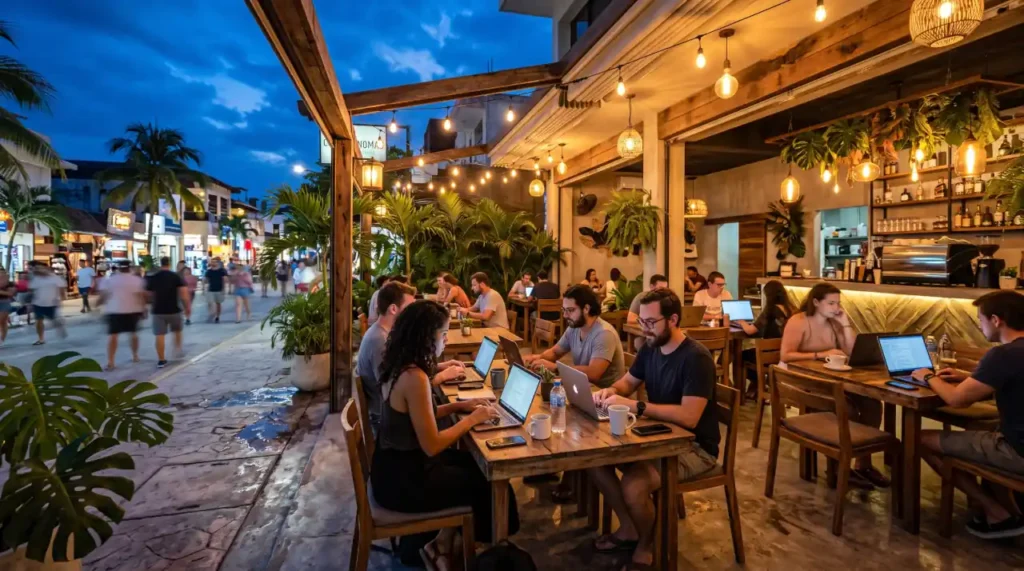
Playa del Carmen has quietly become one of the more established digital nomad hubs in Mexico, right up there with Mexico City and Oaxaca. Coworking spaces are easy to find, fiber internet is standard in most newer buildings, and the time zone lines up conveniently with US business hours, which matters a lot if you’re still working for a company back home.
Making friends here is genuinely easier than in a lot of expat destinations, mostly because the community expects it. Facebook groups for Playa del Carmen expats are active and full of meetup announcements, from beach volleyball to language exchanges to Sunday brunch crawls.
Coworking spaces double as social hubs, since a lot of remote workers show up not just for the wifi but for the chance to talk to another human between Zoom calls. If you’re the type who makes friends easily at a hostel, you’ll do just fine here. If you’re more reserved, the coworking and language-class route tends to work better than trying to make friends purely through nightlife.
The expat population skews younger and more transient than places like Lake Chapala or San Miguel de Allende, which means the social scene turns over regularly. That’s a blessing and a curse. You’ll meet interesting people constantly, but you’ll also say goodbye to a lot of them within a year or two as they move on to the next spot.
Getting Around Playa del Carmen
The good news is you probably don’t need a car. El Centro and the neighborhoods immediately around it are walkable, and colectivos, the shared vans that run along the main highway, are a cheap and surprisingly efficient way to get around town or up to Cancun. A colectivo ride within town rarely costs more than a few pesos, and even longer trips up the coast stay under 100 pesos.
Taxis are everywhere but negotiate or confirm the price before you get in, since rates aren’t always metered the way you’d expect. Uber operates in Playa del Carmen and is generally cheaper and more predictable than flagging a cab, especially for airport runs. If you do want your own wheels, renting a scooter or small car is common for weekend trips to cenotes or nearby towns, though local driving habits take some getting used to.
For anything farther afield, like Tulum, Cancun’s airport, or the ferry docks to the islands, the ADO bus system is comfortable, reliable, and inexpensive. Cancún International Airport is about an hour away by road, giving residents convenient access to domestic and international flights across North America and beyond. Most long-term residents end up with a simple rhythm: walk or colectivo for daily life, Uber for convenience, and a rental car only when the plan involves cenote-hopping.
If you plan to explore the Riviera Maya regularly, renting a car for weekend trips is usually more practical than owning one full-time.
Local Culture & Food
Playa’s food scene is one of its biggest draws, and it’s more varied than people expect. Yes, you’ll find plenty of tacos, and yes, they’re excellent, but you’ll also stumble into Argentine steakhouses, Italian trattorias, French bakeries, and a genuinely impressive seafood scene thanks to the Caribbean right on the doorstep. Cochinita pibil, a slow-roasted pork dish specific to the Yucatán region, is worth seeking out at a proper local spot rather than a tourist-facing restaurant on Quinta.
Street food is where the real culture lives, though. Like anywhere, choose busy food stalls with high turnover to enjoy the freshest meals. Marquesitas, a crispy rolled crepe usually filled with cheese and Nutella, are a local specialty you’ll see sold from carts around town. Grab one, find a bench near the plaza, and just watch the town move for a while.
Culturally, Playa sits at an interesting crossroads. It’s shaped by Mayan heritage, Yucatecan tradition, and decades of international tourism, which means it can feel less distinctly Mexican than inland cities. Annual celebrations such as Día de los Muertos and Semana Santa also give expats an opportunity to experience local traditions beyond the tourist areas. Many expats balance that by pairing their time in Playa with Spanish classes or day trips into the Yucatán interior, where traditions feel less diluted by the tourist economy.
Weather-wise, the region has a pretty clear best window for visiting or moving, and if you’re planning your relocation around comfortable temperatures and lower humidity, our guide to the best time to visit Mexico is worth a read before you book flights.
Attractions & Activities for Expats in Playa del Carmen
One of the underrated perks of living here, rather than just visiting, is that you actually have time to do the things tourists rush through in a week.
Learning Spanish
Learning Spanish is one of the best investments you can make, both for daily life and for genuinely connecting with the local community rather than staying inside the expat bubble. Several language schools in El Centro offer group classes, private tutoring, or exchange meetups where you trade English conversation for Spanish practice over coffee.
Yoga Classes
Yoga studios are everywhere, from beachfront sunrise sessions to studio classes tucked into quieter side streets. It’s become such a fixture of the wellness-focused expat crowd that you’ll rarely go more than a block without spotting a yoga mat rolled under someone’s arm.
Water Activities
Water sports are a huge part of the appeal. Snorkeling, diving, paddleboarding, and kite surfing are all easily accessible, and the reef just offshore means you don’t have to travel far for genuinely good diving conditions.
Eco-Park
Visits, like Xcaret or Xel-Há, are a regular weekend outing for expats with visiting family or anyone wanting a full day of ziplines, underground rivers, and wildlife exhibits. They’re touristy, sure, but they’re touristy for a reason.
Beaches
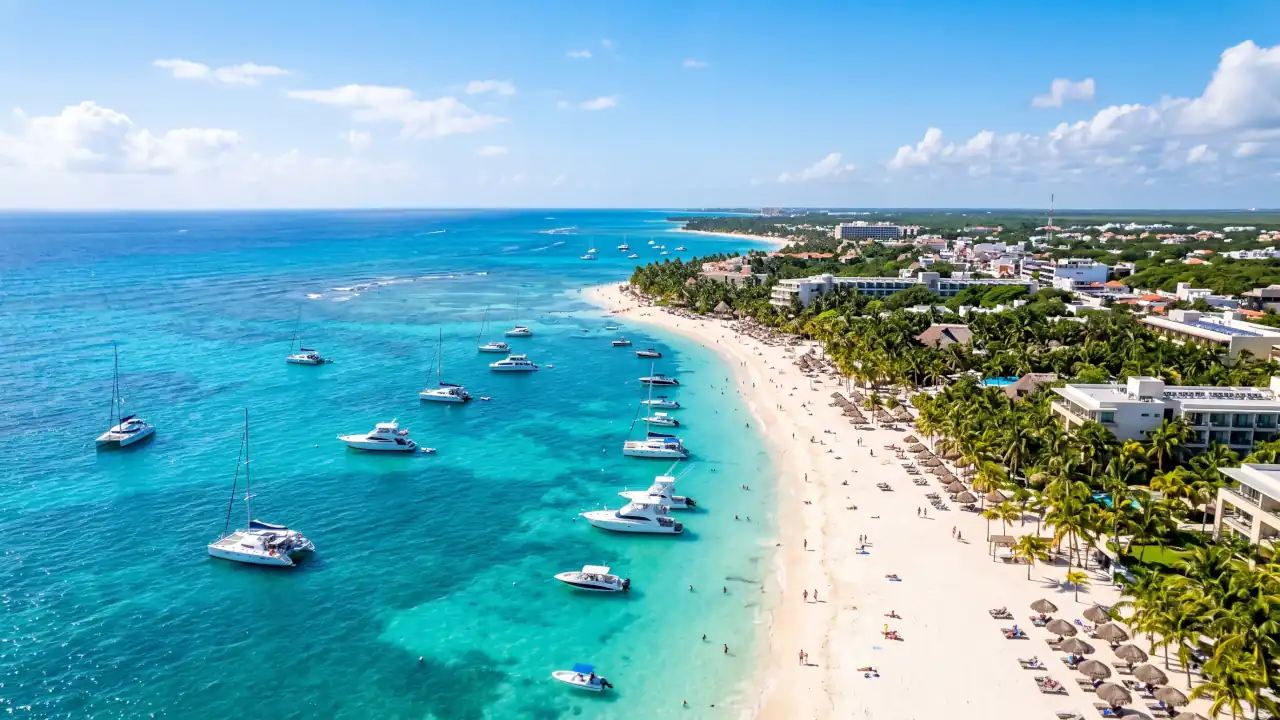
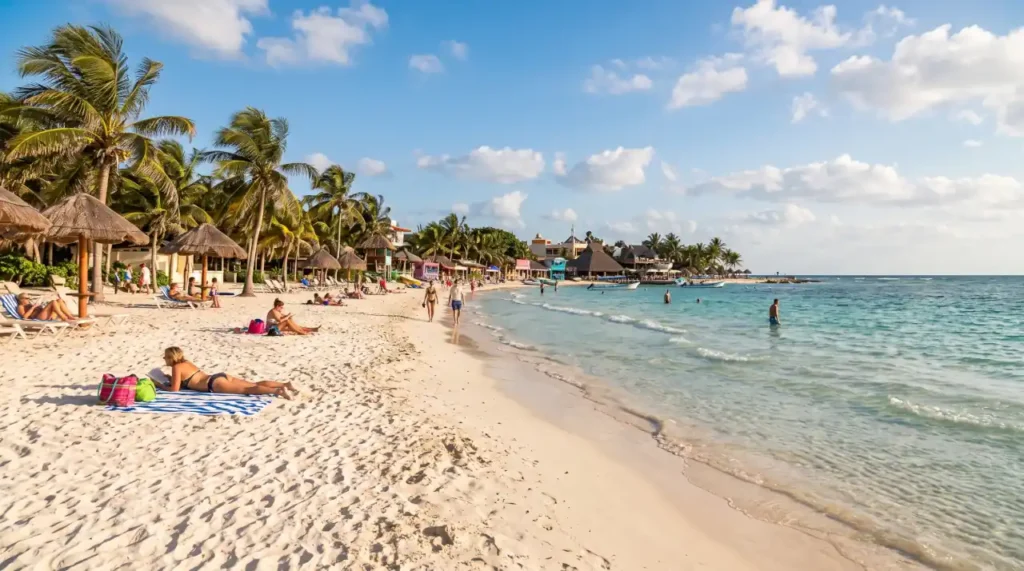
Beaches in and around Playa del Carmen range from the lively, beach-club-lined stretch near Centro to quieter spots just a short drive north or south. Popular choices include Mamitas Beach for a lively atmosphere and Punta Esmeralda for a quieter local feel. Locals tend to have a favorite low-key beach they’ll only share once they trust you.
Cenotes
Cenotes are natural limestone sinkholes filled with impossibly clear freshwater that are scattered throughout the region, making them some of the best places to swim in the Yucatán Peninsula. Many are a short drive inland and rarely crowded on weekdays. Cenote Azul and Dos Ojos are two of the region’s best-known options for swimming and snorkeling.
Exploring the Yucatán Peninsula
Living in Playa del Carmen provides easy access to the wider Yucatán Peninsula, with the city serving as a convenient base for weekend trips to ruins, colonial towns, and smaller beach communities. If you want a broader sense of where else in the region people are choosing to live, our guide to places to live in the Yucatán Peninsula covers the alternatives.
Paradise Islands
The islands off the coast of Playa del Carmen make easy day trips or weekend getaways, each offering a different experience from life on the mainland. Whether you’re looking for world-class diving, laid-back beaches, or a quiet escape into nature, these nearby islands are well worth exploring.
Cozumel
Just a short ferry ride from Playa del Carmen, Cozumel is renowned for its crystal-clear waters and some of the best scuba diving and snorkeling in the Caribbean. It’s a favorite among divers, but even non-divers enjoy its quieter beaches, waterfront restaurants, and relaxed island atmosphere.
Isla Mujeres
Located off the coast of Cancún, Isla Mujeres offers a slower pace than the Riviera Maya’s busiest resorts. Visitors come for its calm turquoise waters, beautiful beaches, and easygoing vibe, making it an excellent choice for a day trip or a peaceful weekend escape.
Isla Holbox
Although it takes a little longer to reach, Isla Holbox rewards visitors with a completely different atmosphere. The island is known for its car-free streets, colorful murals, abundant wildlife, and relaxed pace, offering a welcome break from the busier tourist destinations along Mexico’s Caribbean coast.
My Motivation for Moving to Playa del Carmen
Every expat has their own version of this story, but mine started with wanting fewer gray months and a lower cost of living without sacrificing the conveniences I was used to. Playa offered a rare combination: warm weather almost year-round, a genuinely international community so I wouldn’t feel isolated, and a cost structure that let my money stretch further without moving somewhere completely off the grid. The beach access sealed it, honestly. There’s something about being able to end a workday with a walk on the sand that resets your whole outlook.
Seven Things to Know Before Moving to Playa del Carmen
- Prices have risen noticeably in the past few years, so the “dirt cheap Mexico” reputation doesn’t fully apply anymore, especially in tourist-heavy zones.
- Sargassum seaweed season, usually mid-year, can affect certain beaches, so don’t judge the whole coastline by a bad week.
- Humidity is constant and intense for a good chunk of the year, which surprises people coming from drier climates.
- Petty theft and ATM scams are the most common safety concerns, so use normal city precautions and avoid displaying valuables.
- Getting genuinely fluent in Spanish, or at least conversational, makes a bigger difference here than in more heavily English-speaking expat hubs like parts of Mexico City.
- Hurricane season officially runs from June through November, so it’s worth understanding local weather alerts and preparing for occasional tropical storms.
- The rainy season generally runs from late spring through autumn, bringing short but often heavy tropical downpours that usually pass quickly.
Will You Try Living in Playa del Carmen?
If you’ve read this far, you’re probably already picturing yourself on a balcony somewhere off Quinta Avenida with a coffee in hand. That’s not a bad instinct. Playa isn’t perfect, no place is, but it offers a rare mix of beach lifestyle, established infrastructure, and a community that makes the transition easier than starting from scratch somewhere less traveled. The question isn’t really whether Playa can work for you. It’s whether you’re ready for the version of life it offers: warm, social, a little chaotic, and genuinely rewarding if you lean into it.
Also Read: 7 Best Places to Live in the Yucatan Peninsula in 2026
Final Thoughts
Playa del Carmen rewards people who come with realistic expectations. It’s not the cheapest town in Mexico anymore, and it’s not the most authentically local either, but it delivers on lifestyle in a way that’s hard to match elsewhere on the coast. Whether you land in the walkable buzz of El Centro or the gated calm of Playacar, you’re signing up for beach access, a built-in community, and a pace of life that’s noticeably slower than wherever you’re coming from. Do your homework on the visa process, budget honestly, and give yourself a real trial period before committing long-term.
For many expats, the biggest advantage isn’t simply the beaches—it’s the balance between lifestyle, infrastructure, affordability, and community. Spending a month or two in Playa del Carmen before relocating permanently can help you confirm that the pace, climate, and neighborhood you’ve chosen match your expectations.