So you’ve been looking at living in Mexico City or maybe scrolling through photos of Merida and thinking about a move south. But somewhere along the way, Guadalajara keeps popping up in your feed. Many people eventually discover Guadalajara while comparing Mexico’s most popular cities for expats.
As Mexico’s second-largest city, Guadalajara has earned a reputation as one of the country’s most livable destinations for expats and remote workers. In this guide, you’ll learn what living in Guadalajara is really like for expats, digital nomads, and long-term residents, including what to expect from the cost of living, safety, healthcare, and everyday life. Whether you’re relocating permanently or planning an extended stay, this Guadalajara expat guide covers everything you need to know before making the move.
Also Read: Living in Mérida: Costs, Neighborhoods, Pros and Cons Explained
Quick Answer
Guadalajara is one of Mexico’s most popular cities for expats and digital nomads thanks to its relatively affordable cost of living, strong healthcare, reliable internet, and vibrant cultural scene. While safety varies by neighborhood, many newcomers find areas like Americana, Providencia, and Zapopan comfortable places to live with sensible precautions.
Key Takeaways
- Guadalajara offers a lower cost of living than Mexico City while maintaining excellent amenities.
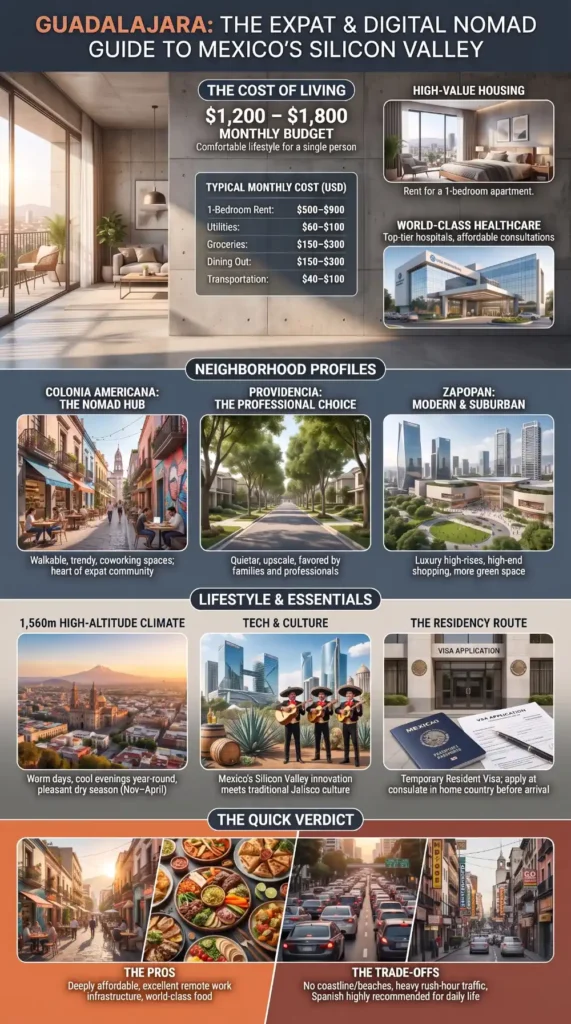
- Most expats spend around $1,200–1,800/month living comfortably.
- Popular neighborhoods include Americana, Providencia, Centro Histórico, and Zapopan.
- Learning basic Spanish makes daily life significantly easier.
- Safety depends heavily on neighborhood choice and situational awareness.
Living in Guadalajara: Things to Consider
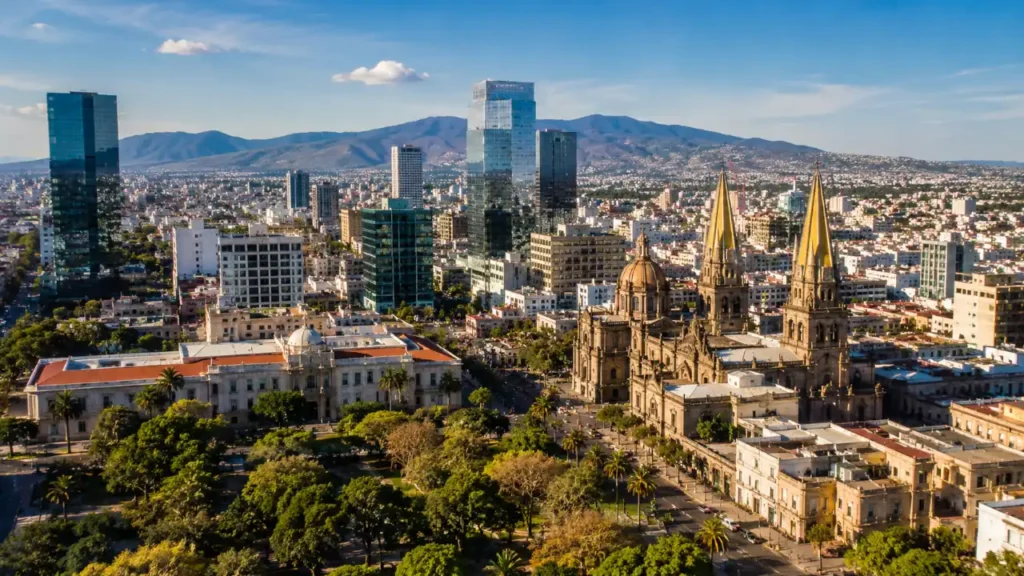
Before you start packing boxes, it helps to know what kind of city you’re moving into. Guadalajara isn’t a beach town, and it’s not a sleepy colonial pueblo either. It’s a sprawling metro area of around five million people, spread across Guadalajara proper and neighboring municipalities like Zapopan, Tlaquepaque, and Tonalá. Think of it as one big city made up of several distinct personalities.
This is Jalisco’s capital, and Jalisco is the birthplace of tequila and mariachi, so you’re moving somewhere with real cultural weight, not a diluted version made for tourists. Guadalajara is widely recognized as one of Mexico’s leading technology hubs, attracting multinational companies, startups, and software firms. The city’s growing innovation ecosystem has earned it the nickname “Mexico’s Silicon Valley,” contributing to a thriving community of entrepreneurs and remote workers. According to the State of Jalisco’s economic development agency, the region is home to hundreds of technology companies and major international manufacturers.
What you won’t get is a coastline. If palm trees and ocean breeze are non-negotiable for you, Guadalajara isn’t your city. But if you want walkable neighborhoods, an outstanding food scene featuring everything from traditional birria and tortas ahogadas to modern cafés and international restaurants, world-class healthcare, and a lower cost of living than Mexico City without sacrificing amenities, this place holds up extremely well.
The climate is mild for most of the year, the airport connects easily to the US and beyond, and the pace of life sits somewhere between the intensity of CDMX and the slower rhythm of smaller Mexican towns.
One more thing worth knowing upfront: Guadalajara attracts a different crowd than places like Puerto Vallarta or San Miguel de Allende. You’ll meet fewer retirees chasing sunsets and more young professionals, remote workers, and students. That shapes the social scene, the rental market, and even the type of restaurants and bars you’ll find around town.
Is Guadalajara Safe for Expats and Nomads?
This is usually the first question anyone asks, and it deserves an honest answer rather than a sales pitch. Guadalajara, like most large Mexican cities, has areas that are very safe and areas you should avoid, and the two can sit surprisingly close together.
The neighborhoods where expats and digital nomads tend to cluster, like Colonia Americana, Providencia, and parts of Zapopan, feel comfortable and low-key most of the time. People walk their dogs at night, families sit outside cafes, and daily life looks pretty ordinary. Petty crime like phone snatching or pickpocketing is the more realistic concern in these areas, not violent crime aimed at foreigners. Basic precautions go a long way here: don’t flash expensive jewelry or electronics, use ride-hailing apps instead of hailing a taxi off the street, and avoid walking alone late at night in unfamiliar areas.
That said, Jalisco does have a cartel presence, and some outlying parts of the metro area or state see higher rates of organized crime. This violence is rarely random or aimed at tourists and expats, and it’s mostly concentrated in areas most newcomers would never have a reason to visit. Still, it’s worth checking your home country’s official travel advisory before you go, since these get updated regularly and give you the most current read on regional risk. Before relocating, it’s worth reviewing the latest U.S. Department of State Travel Advisory for Mexico, which provides state-specific safety guidance, including information for Jalisco.
In practice, most expats living in Guadalajara describe it as feeling no more dangerous than a mid-sized American city, and in some cases safer. The key is doing your homework on specific neighborhoods before you sign a lease, staying aware of your surroundings, and treating it the same way you’d treat any unfamiliar big city.
Do You Need to Speak Spanish to Live in Guadalajara?
You can absolutely get by without fluent Spanish, especially in the expat-heavy pockets of the city. Coworking spaces, trendy cafes, and international grocery stores in Americana or Providencia often have staff who speak at least some English. Uber drivers, restaurant menus, and apartment listings in those areas frequently cater to foreigners too.
But here’s the honest truth: Guadalajara has noticeably less English floating around than Mexico City or the beach resorts. Step outside the popular expat bubbles and you’ll find that basic Spanish makes an enormous difference, whether you’re dealing with a landlord, visiting the doctor, or just trying to order food at a local market stall. Government offices, in particular, rarely have English-speaking staff, so if you’re handling visa paperwork or dealing with utility companies, you’ll want either decent Spanish or a translator app on hand.
A practical approach is to arrive with at least conversational basics and commit to learning more once you’re settled. Locals genuinely appreciate the effort, even a clumsy attempt, and it opens doors socially that English alone never will. Language schools and exchange meetups are everywhere in the city, so there’s no shortage of ways to improve once you land. Even learning enough Spanish to handle shopping, transportation, medical appointments, and rental conversations can make daily life considerably easier and help you integrate into the local community more quickly.
What is the Cost of Living Like in Guadalajara?
This is where Guadalajara really earns its reputation. Compared to Mexico City, and especially compared to US or European cities, your money goes noticeably further here. If you’re still deciding where to settle, it’s also worth comparing Guadalajara with other affordable destinations in this guide to Central Mexico cities where expats can live comfortably on around $1,500 a month.
For rent, a one-bedroom apartment in a popular central neighborhood typically runs between $500 and $900 a month, depending on the building, furnishings, and exact location. Head slightly outside the most in-demand pockets and you can find comparable places for less. A basic budget studio might come in under $500, while a renovated apartment with modern finishes in Americana or Providencia can climb toward the top of that range or beyond, especially if it’s furnished and move-in ready.
Rental prices have increased in recent years, particularly in neighborhoods popular with international residents and remote workers, so expect seasonal fluctuations and higher prices for furnished apartments.
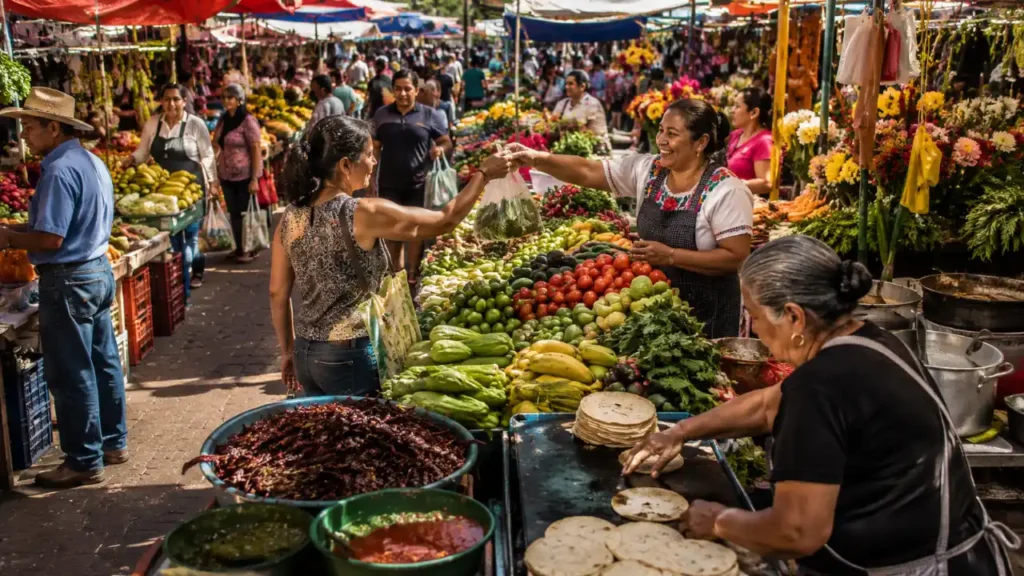
Groceries are cheap if you shop like a local. Buying produce at neighborhood markets (tianguis) instead of imported goods at upscale supermarkets keeps your food bill low. A single person can comfortably cover groceries for somewhere between $150 and $300 a month depending on how much you cook versus eat out. Eating out is also gentle on the wallet outside of the trendiest spots. A casual meal at a local restaurant might cost $4 to $8, while a nice dinner at a well-reviewed spot in Americana could run $15 to $30 per person.
Utilities are usually low too. Electricity bills arrive every two months from CFE, and a typical household relying on fans rather than heavy air conditioning might pay somewhere in the $25 to $45 range per billing cycle. Water, gas, and basic internet round out to a modest monthly total, often well under $100 combined for a one-bedroom apartment.
Put it all together, and a comfortable single-person budget in Guadalajara, including a decent one-bedroom apartment, groceries, some dining out, transportation, and entertainment, typically lands somewhere between $1,200 and $1,800 a month. Couples can live well on somewhere around $2,000 to $2,800, again depending heavily on lifestyle and neighborhood. That’s considerably less than the cost of maintaining a similar lifestyle in many major U.S. cities, which is exactly why so many remote workers and retirees are making the move.
Healthcare deserves a mention here too, since it’s one of the city’s biggest draws. Guadalajara is home to some of Mexico’s highest-rated private hospitals, including Hospital San Javier and Hospital Puerta de Hierro. Private consultations are generally affordable compared with the United States and Canada, although costs vary by specialist. Many long-term expats choose private health insurance to reduce costs for major medical treatment while paying routine consultations out of pocket.
Typical Monthly Living Costs in Guadalajara
| Expense | Typical Monthly Cost |
| 1-bedroom rent | $500–900 |
| Utilities | $60–100 |
| Groceries | $150–300 |
| Dining out | $150–300 |
| Transportation | $40–100 |
| Comfortable monthly budget | $1,200–1,800 |
What is the Climate Like in Guadalajara?
Guadalajara sits at a high altitude, approximately 1,560 meters (5,120 feet) above sea level, which gives it one of the more pleasant climates in Mexico. You get warm days and cool evenings for most of the year rather than the heavy humidity you’d find on the coast.
The dry season runs from roughly November through April, and this stretch is genuinely lovely. Days are sunny and mild, nights cool down enough that you’ll want a light jacket, and rain is rare. Temperatures during these months typically hover in the mid-70s to low 80s Fahrenheit during the day.
Then comes the rainy season, from around May through October, when afternoon storms roll through fairly predictably. Mornings are usually clear, and the rain tends to arrive later in the day, so it doesn’t necessarily ruin your plans if you time things right. Humidity climbs during this stretch, and temperatures can feel warmer as a result, though it rarely gets unbearably hot the way it does in coastal cities.
If you’re the type who wants to plan a trip or a permanent move around ideal weather, it’s worth reading up on the best time to visit Mexico more broadly, since the sweet spot for Guadalajara lines up closely with the sweet spot for much of the country. Winter and early spring tend to be the crowd favorite, both for comfort and for the number of local festivals happening around that time.
Is it Easy to Get Visas for Mexico?
The good news is that Mexico makes the early stages fairly painless. Citizens of many countries—including the United States, Canada, the United Kingdom, and much of Europe—can usually enter Mexico without applying for a visa in advance for tourism or business visits. The exact length of stay is determined by Mexican immigration authorities upon arrival and should not be assumed to be a guaranteed 180 days.
If you want to stay longer or work remotely on a semi-permanent basis, the Temporary Resident Visa is the route most expats take. Mexico doesn’t currently offer a dedicated digital nomad visa, but the Temporary Resident Visa effectively fills that role, since it allows you to live in the country while working for employers or clients based elsewhere. Financial requirements for the Temporary Resident Visa are updated periodically and vary slightly between Mexican consulates, so applicants should always verify the latest requirements with their local Mexican consulate before applying.
This visa is usually issued for one year and can be renewed annually for up to four years, after which you become eligible to apply for permanent residency if you want to stay indefinitely. The application process starts at a Mexican consulate in your home country, not once you’ve already arrived, so plan ahead if this is the path you’re considering. If you’re weighing Mexico against other countries that offer more formal remote-work visas, it’s worth browsing this breakdown of freelance and digital nomad visa options to see how Mexico’s approach compares.
Bureaucracy in Mexico can move slowly, and paperwork requirements shift from consulate to consulate, so patience and a folder full of documents go a long way. Most expats say the process, while occasionally frustrating, is manageable without hiring a lawyer, though some choose to use an immigration consultant anyway just to avoid headaches.
How to Find an Apartment
Apartment hunting in Guadalajara works a bit differently depending on whether you’re looking short-term or long-term. For your first month or two, most people book something through Airbnb or a similar platform, both to have a soft landing and to scope out neighborhoods in person before committing.
Once you know where you want to live, Facebook groups become surprisingly useful. Many landlords also advertise through local real estate agencies, which can be particularly helpful for newcomers who don’t yet have a Mexican guarantor or are unfamiliar with local rental practices. Search for expat and rental groups focused on Guadalajara or specific neighborhoods like Americana or Zapopan, and you’ll find listings posted directly by landlords or other expats subletting their places. Local sites like Vivanuncios and Inmuebles24 are also worth browsing, and a local real estate agent can help if your Spanish isn’t quite ready for lease negotiations yet.
A few practical notes: many landlords ask for a Mexican guarantor or a larger security deposit from foreigners who can’t provide one, so be ready to negotiate or offer several months of rent upfront instead. Always view a place in person or through a trusted video call before wiring any money, since rental scams targeting foreigners do exist. And don’t be shy about asking directly whether the building has reliable water pressure and consistent internet speed, since these vary more than you’d expect even within the same neighborhood.
Best Neighborhoods for Expats and Digital Nomads in Guadalajara
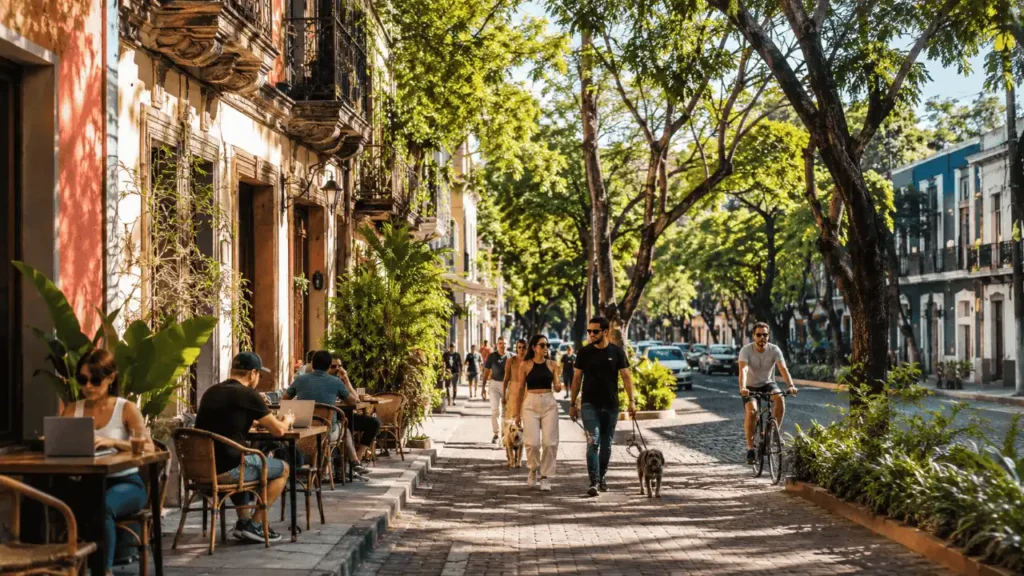
Where you land shapes almost everything about your experience here, from your commute to your social life. These four areas consistently come up as the top picks for foreigners. If you’re also considering the capital, our comparison of the best Mexico City neighborhoods for expats highlights how different areas compare in terms of cost, safety, and lifestyle.
Colonia Americana
This is ground zero for the expat and digital nomad crowd, and it’s easy to see why. Americana is walkable, packed with specialty coffee shops and coworking spaces, and centered around Avenida Chapultepec, which stays lively well into the evening. The architecture mixes art deco mansions with modern apartment blocks, giving the neighborhood a distinct, photogenic character. The tradeoff is that it’s gotten noticeably more expensive and gentrified over the past few years.
Providencia
Providencia has a more residential, established feel compared to the buzz of Americana. It’s popular with families and professionals, both Mexican and foreign, and it offers a good mix of leafy streets, shopping centers, and quieter cafes. It sits close enough to the action that you’re never far from Americana, but the pace here is noticeably calmer.
Centro Historico
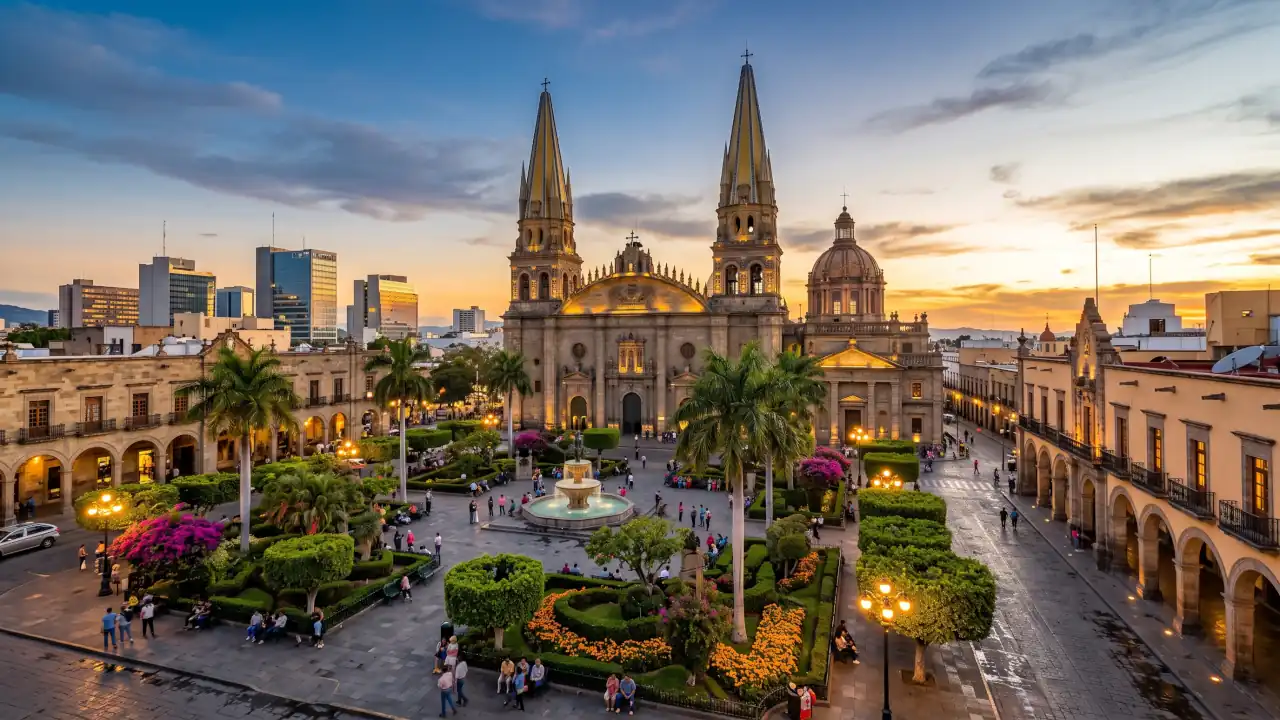
If you want to be surrounded by cathedrals, plazas, and the historic pulse of the city, Centro Historico delivers. This is the oldest part of Guadalajara, packed with colonial architecture, museums, and the kind of street life that makes a city feel alive. It’s not where most digital nomads choose to settle long-term, since it’s busier and noisier, but it’s a fantastic option if you want to be in the thick of things and don’t mind trading some quiet for character.
Zapopan
Technically its own municipality, Zapopan has become a favorite among expats who want more space, greenery, and a slightly suburban feel without giving up access to the city. Areas like Puerta de Hierro and Andares offer upscale shopping malls, modern high-rises, and a genuinely relaxed vibe. It’s a longer trip into the heart of Guadalajara, but many residents consider that a fair trade for the extra space and lower noise levels.
How to Get Around in Guadalajara
Guadalajara’s public transportation has improved a lot in recent years, and getting around without a car is entirely doable, especially if you live in one of the central expat neighborhoods.
The Mi Macro Periférico and Mi Macro Calzada bus rapid transit lines cover major routes efficiently and cheaply, often costing less than a dollar per ride. The city also has a light rail system (Tren Ligero) with three lines connecting different parts of the metro area, which is a reliable option if your route lines up with a station.
For everything else, Uber and DiDi are widely used, affordable, and generally considered safer than hailing a taxi off the street, especially at night. Most residents use a mix of public transit and rideshare services rather than relying exclusively on one option, especially when traveling across different municipalities.
Many expats in Americana or Providencia find they can walk or bike to most of their daily needs, thanks to how dense and walkable those neighborhoods are. The city’s MiBici bike-share program is another affordable option if you plan to cycle regularly around central neighborhoods. If you settle further out in parts of Zapopan, you’ll likely lean more heavily on rideshares or a car, since distances stretch out and public transit coverage thins a bit.
Traffic can get heavy during rush hour, particularly on major routes connecting Zapopan with central Guadalajara, so factor that into your commute expectations if you’re working fixed hours. If you’re arriving through Guadalajara International Airport for the first time, official airport taxis or authorized airport transportation are often the easiest option into the city, as rideshare pickup locations and procedures can occasionally change. Once you’re settled, Uber and DiDi remain the most convenient options for getting around.
What to Do in and Around Guadalajara
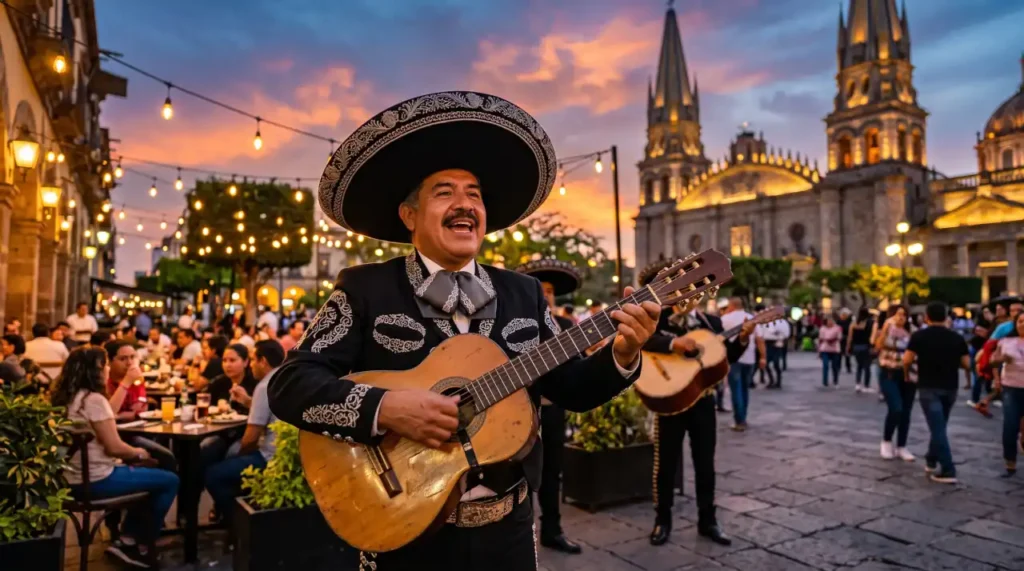
There’s genuinely a lot to keep you busy here, and it goes well beyond the usual tourist checklist. The historic center alone could occupy a weekend, with its cathedrals, government palace murals, and lively plazas. Mercado San Juan de Dios, one of Latin America’s largest indoor markets, is worth a visit just to see the scale of it, even if you’re not buying anything.
If you’re looking for green space, Bosque Los Colomos is one of Guadalajara’s most popular urban parks, with walking trails, gardens, and picnic areas that offer a break from the city’s busy streets.
Tlaquepaque and Tonalá, both just outside the city center, are known for artisan crafts, pottery, and a slower, more traditional atmosphere that makes for an easy day trip. If you want a taste of where tequila actually comes from, the town of Tequila itself sits about an hour outside the city and offers distillery tours through a landscape of blue agave fields that’s genuinely stunning. It’s one of the easiest and most rewarding day trips from Guadalajara, whether you’re interested in history, local culture, or tequila production.
Also Read: Living in Playa del Carmen: The Complete Expat Guide to Costs, Safety & Lifestyle (2026)
Lake Chapala, Mexico’s largest freshwater lake, is another popular day trip from Guadalajara, offering lakeside towns, waterfront restaurants, and a slower pace of life just over an hour from the city.
Food and nightlife in Guadalajara hold their own against much bigger cities. Americana and Chapultepec are packed with bars, live music venues, and restaurants covering everything from traditional Jalisco cuisine to modern fusion spots. For a broader rundown of specific attractions and day trips, this guide to things to do in and around Guadalajara covers the details in far more depth.
Is Living in Guadalajara for You?
Guadalajara tends to suit a specific kind of person well. If you’re a remote worker who wants strong internet, a real community of other digital nomads, and a lower cost of living than Mexico City without sacrificing amenities, this city checks a lot of boxes. It also works well for young professionals drawn to the tech scene, and for anyone who wants big-city conveniences paired with a slightly slower, more manageable pace than a mega-city like CDMX.
It’s less obviously suited to retirees chasing beach views, since there’s no coastline here, and it may feel like a lot of city for anyone craving a truly quiet, small-town pace of life. If living near the Caribbean coast is higher on your priority list, you may also want to compare life in Guadalajara with living in Cancun, where the lifestyle revolves much more around beaches and tourism. If you thrive on walkability, cafe culture, and a growing international community, though, Guadalajara delivers on nearly every front.
Guadalajara Pros & Cons
Final Thoughts
Guadalajara isn’t trying to be Mexico City, and it isn’t trying to be a beach resort either. It’s carved out its own identity as a livable, culturally rich, increasingly international city that happens to be a lot easier on your budget than most comparable places in North America. The tradeoffs are real: you’ll want at least some Spanish, you’ll need to be thoughtful about which neighborhoods you choose, and you should stay informed about safety conditions rather than assume everything is uniformly fine.
But for the right person, especially remote workers, young professionals, and anyone drawn to an authentic slice of Mexican culture, Guadalajara offers a rare combination of affordability, infrastructure, and character. If you’re considering a permanent move, spending a few weeks in the city before signing a long-term lease can help you evaluate neighborhoods, commuting, and daily life firsthand. It’s worth a serious look—and even more importantly, a visit—because no article can fully replace experiencing the city for yourself.