Pandharpur: Spiritual Heart of Maharashtra
Step onto the Sacred Banks of the Chandrabhaga: Discover Pandharpur, Maharashtra’s Eternal Pilgrimage Heartbeat.
🔴 Brief Introduction: The Spiritual Epicentre of Maharashtra
Nestled on the crescent-shaped banks of the Bhima River (Revered as Chandrabhaga) in Maharashtra’s Solapur district, Pandharpur isn’t just a town—it’s a living, breathing testament to eight centuries of unwavering devotion. Home to the iconic Shri Vitthal-Rukmini Temple, this sacred city draws over a million pilgrims annually, transforming into a vortex of spirituality during the legendary Ashadhi Ekadashi and Kartiki Ekadashi festivals. Imagine a place where the rhythmic chants of “Vithoba Mauli!” (Mother Vithoba) echo through ancient stone pathways, where the air thrums with Kirtans (Devotional Songs), and where the very soil seems imbued with the legacy of saints like Dnyaneshwar, Tukaram, and Namdev. For Marathis, Pandharpur is “Dakshin Kashi” — the Southern Varanasi — a title that speaks volumes about its spiritual gravitas.
➤ A Tapestry Woven in Time: From Hoysala Kings to Bhakti Saints
Pandharpur’s history whispers from 516 CE Copper Plates from the Rashtrakuta era, but its transformative moment arrived in the 12th–13th centuries. Legend credits Pundalik, a devotee whose filial piety moved Lord Krishna to stand eternally on a brick (Viṭ) as Vitthala (Vithoba)—waiting for Pundalik to finish caring for his parents. The temple’s core structure was commissioned by Hoysala King Vishnuvardhana (1108–1152 CE), with later inscriptions confirming royal patronage. Tragedy struck when Afzal Khan, the Adilshahi General, ransacked the town in the 17th century. Yet, like a phoenix, Pandharpur rose under the Maratha Peshwas and nobles like the Scindias and Holkars, who rebuilt the temple and revitalised the pilgrimage. This resilience mirrors the Bhakti movement itself—rooted in inclusivity, social reform, and direct communion with the divine, bypassing rigid hierarchies.

➤ Architectural Poetry in Stone: The Vitthal Temple Complex
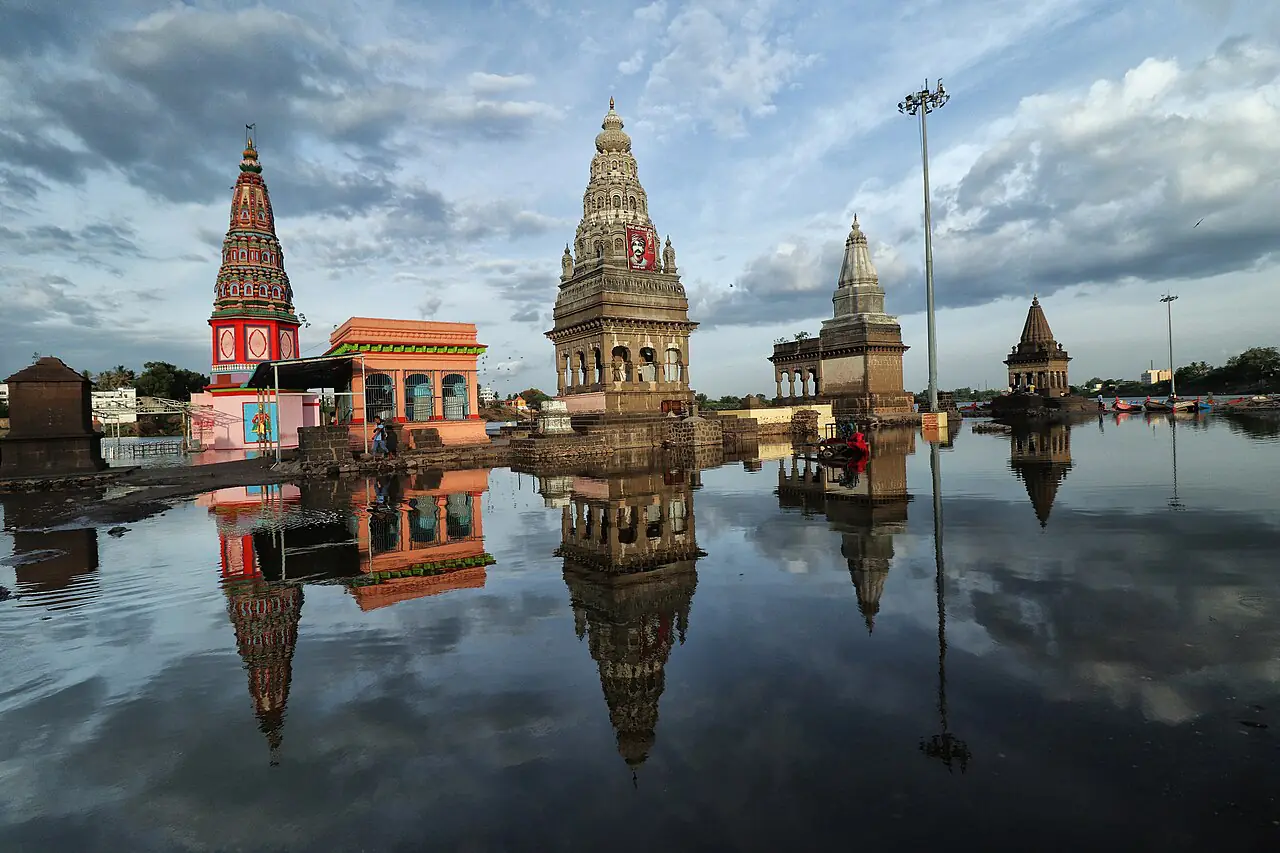
The Vitthal Temple is Deccan Architecture incarnate—a fusion of Hoysala groundwork with later Maratha and Islamic flourishes. Enter through the Mahadwar Gate, where the Sant Namdev Payari (Step) symbolises the Saint’s Eternal Vigil. The complex unfolds like a spiritual labyrinth:
⦿ Mukha Darshan Mandap: A hall for distant viewing of Vithoba’s Face.
⦿ Padha Darshan Queue: Leads devotees to touch the Deity’s Lotus Feet.
⦿ Secondary Shrines: Dedicated to Rukmini, Satyabhama, Narasimha and Garuda.
⦿ Rangshala Courtyard: Where devotees reenact Krishna’s Ras Leela Dances.
The temple made history in 2014 by appointing India’s first female and non-Brahmin priests — a revolutionary step echoing the Bhakti ethos of equality.
➤ Beyond the Temple: Rivers, Villages, and Agrarian Rhythms
The Chandrabhaga River isn’t just water—it’s the ritual lifeblood. Pilgrims immerse themselves at Chakratirtha Ghat, believing its waters cleanse sins. Pandharpur Tehsil sprawls across 1,293 km² with 102 Villages, from the populous Karkamb (17,456 residents) to the historic Kasegaon, whose Deshmukhs once held temple keys. Life here orbits agriculture: Monsoon Rains signal sowing seasons, freeing farmers for Pilgrimages. As local farmer Rajendra Khedkar shares, “The Wari is our annual recharge — we walk with our gods so our fields may flourish”.
Also Read
Exploring Solapur – Unravel the Legacy of India’s “City of Martyrs” and Textile Heartland
➤ When to Walk with the Saints: Seasons & Festivals
➙ Peak Season (October–February): Cool (10–28°C), bustling with Kartik Ekadashi (November) Pilgrims.
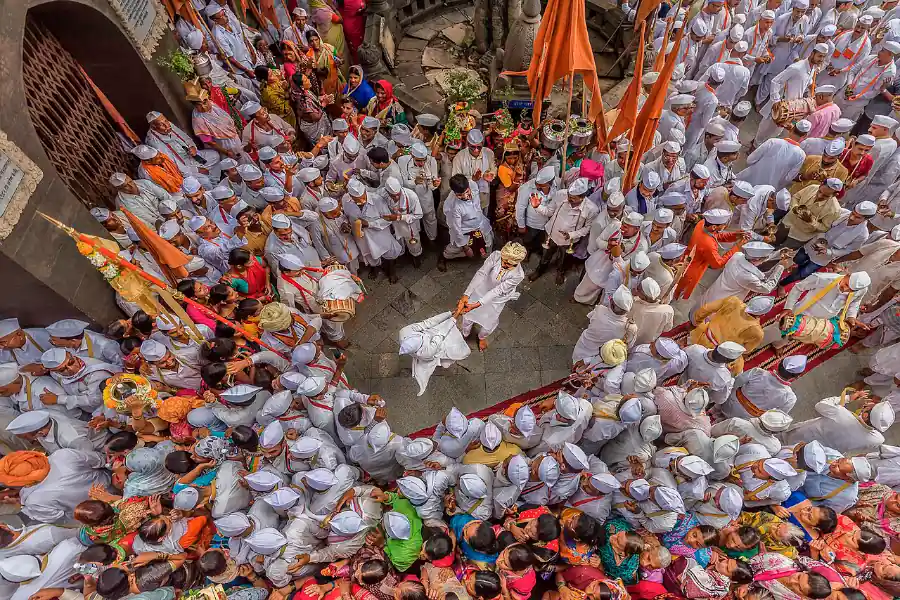
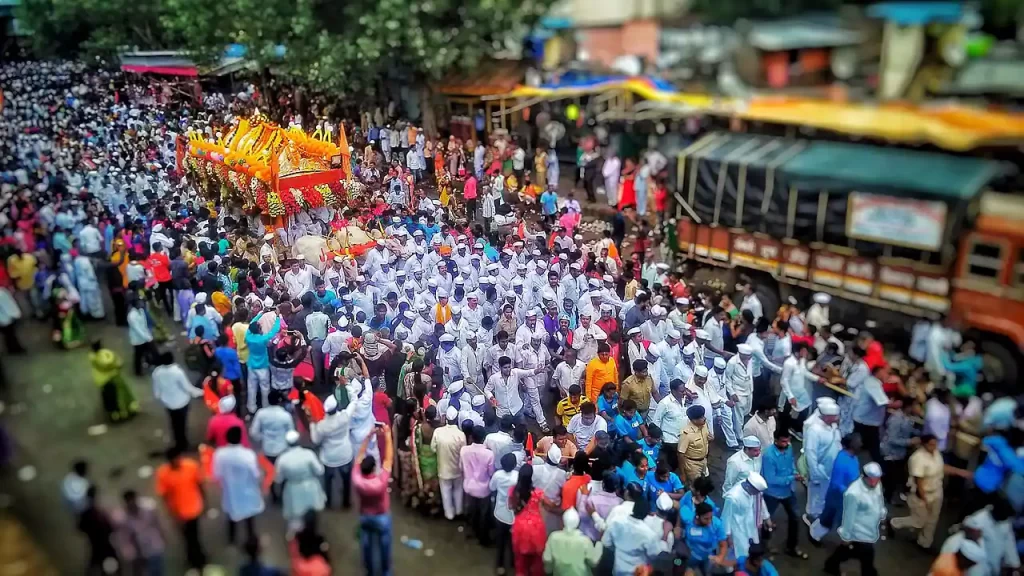
➙ Monsoon Magic (July–September): Lush landscapes; Ashadhi Ekadashi (July) sees the Wari Procession — 250,000+ Warkaris walking 21 days carrying saints’ Palkis (Palanquins) from Alandi/Dehu.
➙ Off-Season (March–June): Scorching (25–40°C), but Budget-friendly.
🟢 Section-by-section Brief Description
➨ Detailed Historical Timeline & Cultural Analysis
| Era | Key Events | Cultural Impact |
| 516 CE | First recorded mention in Rashtrakuta Inscriptions | Establishes Pandharpur as Ancient Spiritual Hub |
| 1108-1152 | Hoysala King Vishnuvardhana builds core Vitthal Temple | Fusion of Karnataka-Maharashtra Architectural Styles |
| 13th C. | Saints Dnyaneshwar & Namdev popularise Vithoba Worship; Dnyaneshwar’s Ovi references Pilgrimage | Bhakti movement democratises devotion, uses Marathi over Sanskrit |
| 17th C. | Afzal Khan destroys town; Maratha Peshwas rebuild Temple | Symbolises Hindu resilience; Scindias systematise Wari with Palkis & Dindis |
| 2014 | Temple appoints women & non-Brahmin Priests | Modernises 900-year-old Institution, Aligns with Bhakti’s Egalitarian Roots |
Granular Insight: The Dindi Processions — Groups of 50-500 pilgrims — are microcosms of community. Each Dindi has leaders (Mukhyas), Musicians, Medics and Cooks. Ashadhi Wari sees ~330 Dindis for Tukaram and 250 for Dnyaneshwar, creating a mobile city chanting Abhangas (Devotional Poetry).
➤ Travel Essentials: Sections Expanded
➨ How to Reach
⦿ By Road: Well-connected via NH 65. Distances: Mumbai (360 km), Pune (210 km), Solapur (76 km).
➨ MSRTC Buses from Major Cities
⦿ By Rail: Pandharpur Station (TER) links to Solapur (2 hrs). Direct trains from Mumbai/Pune.
⦿ By Air: Nearest airports: Solapur (85 km), Pune (200 km). Pre-book taxis.
➨ Best Places to Visit
⦿ Vitthal-Rukmini Temple: Attend Kakad Aarti (Dawn Ritual). Touch Vithoba’s Feet (Padha Darshan).
⦿ Chandrabhaga River Ghats: Ritual dip at Mahadwar Ghat; sunset Puja.
⦿ Pundalik Temple: Where Lord Krishna waited — stone brick marks the spot.
⦿ Nannaj Bustard Sanctuary (45 km): Spot critically endangered Great Indian Bustards.
⦿ Saints’ Samadhis: Chokhamela’s (Dalit Saint) Shrine near Temple Entrance.
➨ Weather & Best Time
| Month | Avg. Temp (°C) | Weather Experience |
| June-July | 24-34°C | Ashadhi Ekadashi: Humid, Transformative Energy; witness Wari’s climax |
| October-February | 17-31°C | Ideal for sightseeing; Kartik Ekadashi (November) less crowded than Ashadhi Ekadashi |
| March-May | 26-42°C | Intense heat; visit early morning/late evening. Hydrate! |
➨ Local Markets & Handicrafts
⦿ Tulsi Vrindavan Stalls: Miniature shrines for home altars.
⦿ Pandharpuri Chadars: Silk ritual cloths embroidered with Vitthal Motifs.
⦿ Food Bazaars near Mahadwar: Try Puran Poli (Sweet Flatbread), Bhakri (Millet Bread) & Jaggery Tea.
➨ Cultural Itinerary: Monsoon Magic (5 Days)
⦿ Day 1: Arrive Solapur; Drive to Pandharpur. Evening Darshan.
⦿ Day 2: Pre-dawn Aarti; Explore Ghats. Interview Warkaris: “We walk to shed ego, not miles”.
⦿ Day 3: Village tour — Kasegaon (Historical Deshmukh Estates) & Bhose (Agricultural Hub).
⦿ Day 4: Nannaj Sanctuary; local potter workshop in Wakhari.
⦿ Day 5: Participate in Community Kitchen (Annadana); Depart.
➨ Demographics & Economy
⦿ Population: 98,923 (town); 442,368 (Tehsil).
⦿ Languages: Marathi (Official), Kannada, Hindi.
⦿ Economy: Pilgrimage tourism (75%), Agriculture (Sugarcane, Millets), Handicrafts.
⦿ Notable People: Saint Chokhamela (14th-c. poet), Haibatravbaba Arphalkar (modernized Wari).
🟣 Section-by-section Detailed Description
🌄 The Soul of Maharashtra: Pandharpur – Where Devotion Meets History, Culture, and Divine Rivers
🌍 1. Geographical and Spiritual Epicentre
Nestled at 17°40′40″N 75°19′40″E in Maharashtra’s Solapur district, Pandharpur sprawls across 20.2 km² along the crescent-shaped banks of the Bhima River—revered as the Chandrabhaga for its moon-like curve. At an elevation of 450 meters, this town is more than a location; it’s Maharashtra’s Spiritual Heartbeat, drawing over 1 Million Pilgrims Annually during festivals like Ashadhi Ekadashi. Known as “Dakshin Kashi” (Southern Varanasi), its aura blends sacred geography with Agrarian Rhythms, where Sugarcane fields fade into Ancient Temple spires.
⏳ 2. Ancient Origins and Mythic Roots
Pandharpur’s history whispers from 516 CE Rashtrakuta-era Copper Plates, but its legends are timeless. One tale speaks of the demon Dindirava, whose defeat by Lord Vishnu (as Prince Mallikarjuna) led to the area’s ancient names: Dindiravana (Dindirava’s Forest) and Lohadanda Kshetra (Land of the Iron Club). Another legend recounts how Rukmini, Lord Krishna’s consort, meditated here after a divine quarrel, drawing Lord Krishna to Pandharpur — explaining their separate temples today. The town’s modern identity, however, hinges on Pundalik, the devotee who made Krishna stand on a Brick (Viṭ), birthing the name “Vitthala”.
🏰 3. Dynastic Legacy and Temple Evolution
The Yadava Dynasty laid Pandharpur’s Architectural Cornerstone in 1189 CE, commissioning the Vitthal-Rukmini Temple. Hoysala King Vishnuvardhana (1108–1152 CE) expanded it, fusing Karnataka’s sculptural finesse with Maharashtra’s Devotional Ethos. The temple faced ruin in the 17th century when Adilshahi General Afzal Khan ransacked the town, but it rose anew under Maratha Peshwas and nobles like the Scindias and Holkars, who rebuilt its sanctum and systematised pilgrim rituals.
📜 4. Bhakti Movement: Poetry in Motion
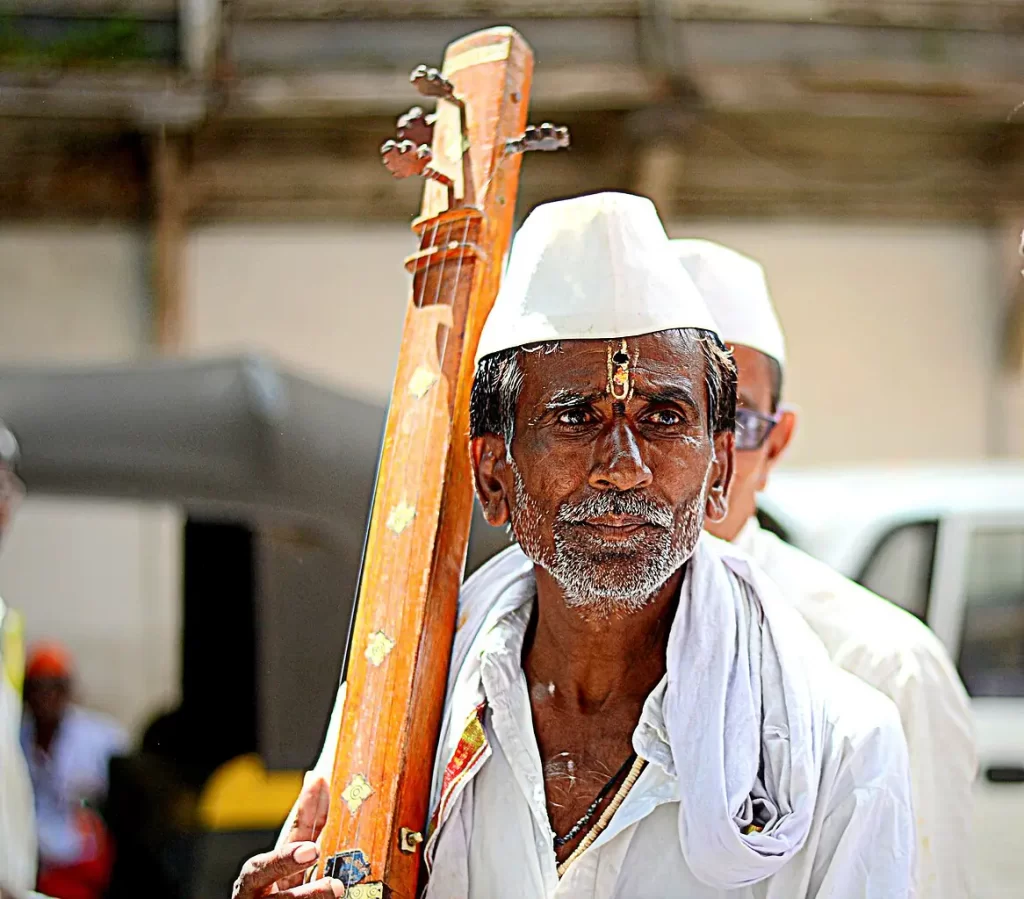
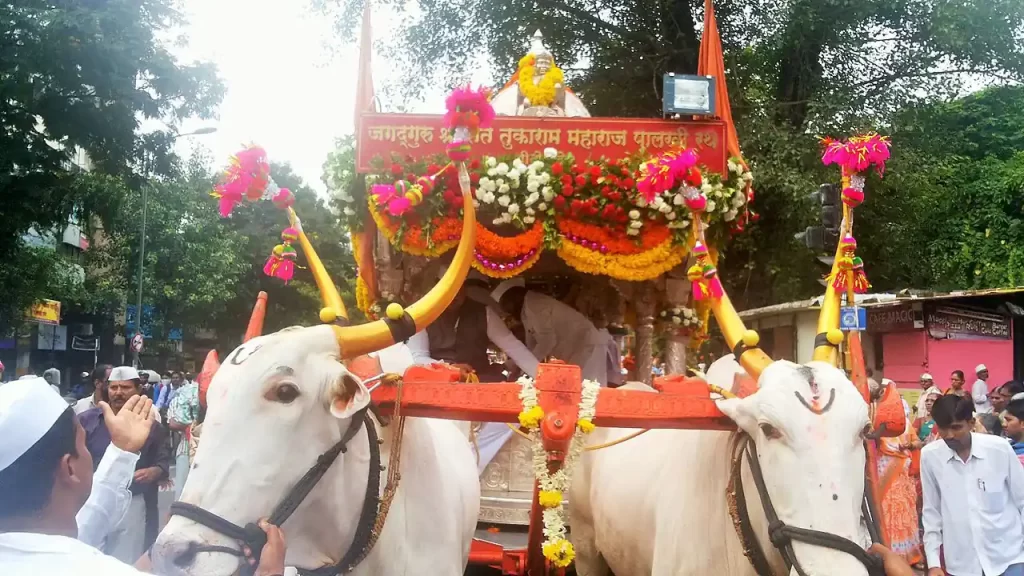
Between the 13th–17th centuries, Pandharpur became the cradle of Maharashtra’s Bhakti Movement. Saints like Dnyaneshwar, Namdev, Tukaram and Chokhamela (a Dalit Poet) composed Abhangas (Devotional Songs) in Marathi, democratising spirituality beyond Sanskrit elites. Dnyaneshwar’s Pilgrimage with parents in the 13th century birthed the Wari Tradition — a 21-day, 250-km walk from Alandi/Dehu to Pandharpur, now drawing 500,000+ pilgrims twice yearly. This “Marching City” of saffron-clad devotees, singing and carrying saints’ Palkhis (Palanquins), embodies Bhakti’s core: Equality, Community and Ecstatic Surrender.

⛩️ 5. Architectural Grandeur of the Vitthal Complex
➨ The Vitthal Temple is a Deccan Architectural Symphony:
➙ Hoysala Foundations: Square plan, five-story Shikhara (Spire), Black Stone Idol of Lord Vitthal, Arms Akimbo, on a Brick Platform.
➙ Sacred Thresholds: Enter through Mahadwar Gate, where Sant Namdev Payari (a step marking the Saint’s Samadhi) sets the devotional tone.
➙ Ritual Spaces: Mukha Darshan Mandap (Distant Viewing), Solkhamb Hall (16 Pillars, one Gold-plated), and Rangshala Courtyard for dance reenactments of Krishna’s Ras Leela.
➙ Egalitarian Milestone: In 2014, the temple appointed India’s first female and non-Brahmin Priests, honouring Bhakti’s anti-caste ethos.
🧑🤝🧑 6. Sociocultural Fabric and Economy
Pandharpur Tehsil spans 1,293 km² with 102 Villages, from the bustling Karkamb (Pop. 17,456) to historic Kasegaon, whose Deshmukh landlords once held temple keys. The town’s population (98,923 in 2011) thrives on Spiritual Tourism (75% of Economy), Agriculture (Sugarcane, Millets) and Handicrafts like Pandharpuri Chadars (Ritual Cloths). Marathi is the lingua franca, but Kannada and Hindi echo in markets like Mahadwar, where Pilgrims buy Tulsi Vrindavan shrines and savour Puran Poli (Sweet Flatbread).
☔ 7. Seasonal Rhythms and Climate Nuances
➨ Life here syncs with Monsoons and Festivals:
➙ Ashadhi Ekadashi (June–July): Peak Pilgrimage amid 24–34°C humidity; the Wari’s climax sees devotees wade into the Chandrabhaga at Chakratirtha Ghat, believing its waters wash sins.
➙ Kartiki Ekadashi (November): Cooler (17–28°C), Post-monsoon serenity; 300,000+ Pilgrims celebrate harvests.
➙ Summer (March–May): Scorching 26–42°C; locals retreat to shaded Mathas (Rest Houses) like Sant Kaikadi Maharaj Math, adorned with Epic Murals.
🚶 8. Living Traditions and Modern Relevance
The Wari isn’t just a Pilgrimage — It’s a Mobile City of Dindis (groups of 50–500 Pilgrims), each with Leaders (Mukhyas), Medics and Cooks. Ashadhi sees 330 Dindis for Tukaram and 250 for Dnyaneshwar, chanting Abhangas while traversing sugarcane belts. Today, this tradition faces modernity: the Maharashtra Government provides Health Camps along routes, while UNESCO considers the Wari for its Intangible Cultural Heritage list. Yet, as farmer Rajendra Khedkar told Pilgrims, “We walk not for miles, but to shed ego” — a testament to Pandharpur’s timeless soul 🌟.
🌾 9. Agrarian Connections and Village Life
Beyond temples, Pandharpur’s hinterland pulses with Agrarian Rhythms. Villages like Bhose and Wakhari depend on Monsoon-fed Crops, Freeing Farmers for Pilgrimages post-sowing. Local potters in Wakhari Craft Ritual Vessels, while weavers near Solapur produce the famed Solapuri Chaddars — India’s first GI-tagged textile. The Chandrabhaga’s seasonal floods are both a lifeline and a challenge, revered in Tukaram’s verse: “The River Mirrors our Devotion — Swelling, Receding, yet Eternal”.
🏛️ 10. Governance and Cultural Stewardship
Administered by the Pandharpur Municipal Council, the town balances heritage with modernity. Projects like waste-to-energy plants reflect sustainability drives, while Dharmshalas (Pilgrim Hostels) preserve medieval hospitality. Notable figures like Haibatravbaba Arphalkar (who organised the Wari in the 1820s) and Saint Chokhamela (Whose Shrine welcomes Dalit Devotees) embody Pandharpur’s spirit: Resilient, Inclusive and Eternally reinvented. As the Skanda Purana declares, “Pandharpur’s merit is tenfold Varanasi’s” — a truth etched in every brick of Vitthal’s abode 🛕.
🕉️ Detailed Historical Facts and Events Timeline: Pandharpur, Solapur District, Maharashtra
🌄 1. Ancient Foundations (516 CE – 10th Century CE): Rashtrakuta Roots & Mythic Origins
Pandharpur’s earliest recorded history surfaces in 516 CE Rashtrakuta-era Copper Plates, naming the area “Pandaraga Vittaga” – later evolving into “Panduranga Vitthala”. Local legends describe the region as “Dindiravana” (Forest of Demon Dindirava) and “Lohadanda Kshetra” (Land of the Iron Club), referencing Lord Vishnu’s victory over the demon Mallikarjuna. Another tale claims Rukmini meditated here after a quarrel with Krishna, drawing him to Pandharpur – explaining their separate shrines. The Pundalik legend crystallised in this era: the devotee’s filial piety compelled Krishna to stand eternally on a brick (Viṭ), birthing the name Vitthala.
⚜️ 2. Temple Genesis & Dynastic Patronage (1189–1310 CE): Yadavas, Hoysalas, and Sacred Architecture
The Yadava Dynasty formally established the Vitthal-Rukmini Temple in 1189 CE, transforming Pandharpur into a Spiritual Nucleus. Hoysala King Vishnuvardhana (1108–1152 CE) expanded the complex, blending Karnataka’s sculptural finesse (evident in the five-story shikhara) with Maharashtra’s Devotional Ethos. Inscriptions confirm royal endowments, including a 1208 CE Stone Slab still embedded near the temple’s Solkhamb Hall. The temple’s layout – with Lord Vitthal’s Black Stone Idol Aarms Akimbo) facing East and Rukmini’s Shrine behind it – solidified during this period.
⚔️ 3. Medieval Turmoil & Bhakti Renaissance (14th–17th Centuries): Invasions and Saint-Poets
The Bahmani Sultanate’s general Afzal Khan ransacked Pandharpur in the 17th century, destroying much of the town. Yet, spiritual resilience flourished through the Bhakti Movement. Saints like Dnyaneshwar (1275–1296 CE) and Namdev (1270–1350 CE) composed Abhangas (Devotional Songs) in Marathi, democratising worship beyond Brahminical rituals. Sant Chokhamela, a 14th-century Dalit Poet, challenged caste barriers, singing: “Vitthal accepts none but love”. Their Pilgrimages birthed the Wari Tradition – a 21-day foot journey from Alandi/Dehu carrying saints’ Padukas (Sandals).
🛡️ 4. Maratha Resurrection (1720–1818 CE): Peshwas, Scindias and Ritual Reorganisation
Under Maratha Peshwa rule, the temple was rebuilt using donations from nobles like Malhar Rao Holkar and Mahadji Shinde. The Deshmukhs of Kasegaon (warriors under Shivaji) were entrusted with temple keys, collected daily by priests. In the 1820s, Haibatravbaba Arphalkar and Tukaram’s descendants formalised the Wari, introducing Palkhis (Palanquins) for Saints’ Padukas and organising pilgrims into Dindis (groups of 50–500). This systematised the chaotic processions into a “Mobile City” with Medics, Cooks and Musicians.
🏛️ 5. British Administration (1818–1947): Documentation and Nationalist Fervour
British Gazetteers first documented Pandharpur’s demography in 1851, noting its population as “98% Hindu, sustained by Pilgrimage”. The Solapur District (including Pandharpur) gained independence from British rule for three days (May 9–11, 1930) after Gandhi’s arrest – a rebellion led by Congress leaders like Ramkrishna Jaju. In 1930, Solapur became India’s first municipality to hoist the National Flag – an act of defiance met with Martial law.
🚶 6. Wari Evolution & Social Reform (1950–2010): Modernising Tradition
Post-1947, the Maharashtra government integrated healthcare into the Wari, setting up Medical camps along the 250-km route. In 1970, the “Ringan” horse ritual was formalised in Akluj, symbolising Krishna’s playful races. A landmark shift occurred in 2014 when the temple appointed India’s first female and non-Brahmin Priests – a nod to Bhakti saints’ egalitarian ideals.
🌐 7. Contemporary Recognition (2015–Present): UNESCO Bids and Infrastructure
Pandharpur’s annual pilgrim count crossed 1 Million in 2015, straining infrastructure. In 2021, Maharashtra nominated the Wari for UNESCO Intangible Cultural Heritage status, highlighting its cross-caste unity. The 2025 Ashadhi Ekadashi (July 6) expects 500,000+ Pilgrims, with the Palkhi departing Dehu on June 18 and Alandi on June 19.
📜 Granular Timeline of Key Events
| Era | Year/Period | Event | Impact |
| Ancient | 516 CE | First mention in Rashtrakuta copper plates as “Pandaraga Vittaga” | Establishes Pandharpur’s antiquity as a spiritual site |
| Medieval | 1189 CE | Yadava dynasty constructs Vitthal Temple’s core | Institutionalises Vithoba Worship |
| Medieval | 1208 CE | Stone slab inscription installed in Solkhamb Hall | Confirms Hoysala-Yadava Patronage |
| Bhakti Era | 1275–1296 CE | Sant Dnyaneshwar composes Dnyaneshwari; initiates Wari | Democratizes spirituality via Marathi texts |
| Maratha Revival | 1750’s | Shinde/Holkar nobles rebuild Temple after Afzal Khan’s destruction | Restores Pilgrimage Economy |
| Colonial | 1820’s | Haibatravbaba Arphalkar organizes Wari into Palkhis & Dindis | Systematises Mass Pilgrimage |
| Modern | 2014 | Temple appoints women/non-Brahmin Priests | Reaffirms Bhakti’s anti-caste legacy |
🧩 Cultural & Architectural Granularities
➙ Temple Complex Layout: Enter through Mahadwar Gate (East), step on Namdev Payari (Saint’s Samadhi), pass through Mukti Mandap, Solkhamb Hall (16 Pillars, one Gold-plated) and reach Garbhagriha – where devotees touch Lord Vitthal’s Feet (Padsparsh Darshan).
➙ Wari Logistics: Each Dindi has a leader (Mukhya), Treasurer, Medics and Tutari (Trumpet) players. The 2025 procession includes 330 Dindis for Saint Tukaram and 250 for Saint Dnyaneshwar.
➙ Economic Impact: Pilgrim tourism generates 75% of Pandharpur’s revenue, supporting Tulsi Vrindavan Artisans and Pandharpuri Chadar Weavers.
Pandharpur’s history is not a linear chronicle but a Living Tapestry – where Rashtrakuta stones, Bhakti Hymns and Warkaris’ footsteps intertwine across centuries. As Sant Tukaram wrote: “Pandhari is where the soul’s river meets Lord Vitthal’s ocean”. 🌊✨

🏰 Architectural Marvels of Pandharpur: Stone Poetry of Devotion
⛩️ 1. Vitthal-Rukmini Temple: Hoysala-Maratha Fusion Masterpiece
The Shri Vitthal-Rukmini Temple (13th century) stands as Pandharpur’s architectural soul, blending Hoysala Groundwork with Maratha Reinterpretations. Its five-story Shikhara (Spire) follows classic Deccan Square-plan Geometry, while the sanctum houses the iconic Black Stone Idol of Lord Vitthal (Arms Akimbo, Standing on a Brick), facing East toward the Chandrabhaga River. The complex unfolds through sacred thresholds:
➙ Mahadwar Gate: Eastern entry with Sant Namdev Payari (Step-Samadhi), where Pilgrims bow before entering.
➙ Solkhamb Hall: Features 16 intricately carved Pillars — one gold-plated — with inscriptions dating to 1208 CE confirming Yadava dynasty patronage.
➙ Rangshala Courtyard: Open-air theatre for Ras Leela performances, where devotees reenact Krishna’s divine dances.
➙ Garbhagriha (Sanctum): Unique dual shrines—Vitthal’s portico-fronted space allows Padha Darshan (Foot-touching), while Rukmini’s smaller shrine stands behind, symbolising marital unity yet spatial separation reflecting local legends.
🔨 2. Sacred Brick & Threshold Science
The temple’s ritual axis centers on the “Viṭ” (Brick) beneath Vitthal’s feet—a core element in Pandharpur’s identity. This brick is replicated in miniature Tulsi Vrindavan shrines sold at Mahadwar Bazaar. The complex employs Vastu Shastra principles:
➙ Cardinal Gate Deities: East (Saraswati), South (Siddheshvar), West (Bhuvaneshvar), North (Mahishasurmardini).
➙ Circumambulation Paths: Three-tiered Pradakshina routes for graded access — Outer for Masses, Inner for Devotees, Innermost for Priests.
🌊 3. Riverfront Architecture: Ghats as Ritual Stages
The Chandrabhaga River’s crescent shape dictated Pandharpur’s urban form. Its 48 Ghats serve as spiritual theatres:
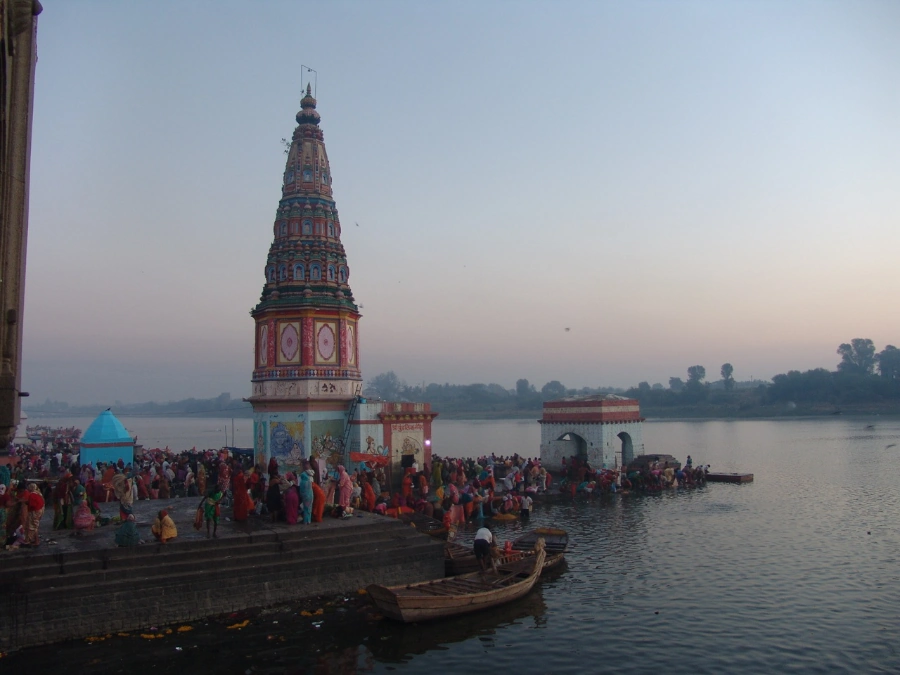
➙ Chakratirtha Ghat: Primary ritual site with pyramidal steps for mass immersions during Ekadashi. Features the Pundalik Temple where Krishna awaited Pundalik—marked by a stone brick.
➙ Padma Tirtha & Kundal Tirtha: Secondary Kunds (Tanks) with corbel-led steps and Deepastambhas (Lamp Pillars) for evening Aarti.
➙ Vishnupad Temple: Open-air hall on the riverbank with 16 carved pillars displaying Lord Krishna’s lore. Houses a sacred rock with Lord Krishna’s Lotus Footprints and cow hoof-prints—an alternative for Pilgrims unable to visit Gaya.
🛕 4. Hemadpanthi Marvels: Satellite Shrines
Pandharpur’s periphery showcases 12th-century Hemadpanthi style (named after Minister Hemadri):
➙ Bhagwant Temple: Only Vishnu temple in India with Four Directional Doorways. Eastern gate features Black Stone Vishnu holding Chakra-Gadha-Shankh (Discus-Mace-Conch).
➙ Pundalik Temple: Five-story Pagoda Spire with stepped eaves and wood-carved Toranas (Arches) depicting Bhakti Saints. Established 1249 CE.
➙ Gopalkrishna Temple: Fort-like structure atop Govardhan Hill with Underground Meditation Chambers linked to Krishna legends.
⚔️ 5. Defensive Hybrids: Bhuikot Fort’s Layers
The 14th-century Bhuikot Fort (45km west) reveals evolving Military-dynastic styles:
➙ Bahmani Foundations: Rusticated basalt walls with Arrow-slit Windows and Chattris (Domed Turrets).
➙ Mughal Additions: Aurangzeb’s Diwan-e-Aam (Public Court) with Jali screens and Persian calligraphy friezes.
➙ Maratha Modifications: Bajirao II’s Ganesh Darwaza gate with Garuda motifs—blending Islamic Arches with Hindu Iconography.
☸️ 6. Jain & Syncretic Wonders
➙ Shri Dahigaun Tirth: Jain pilgrimage site housing a 244-cm Black Idol of Mahavira in Padmasana (Lotus Pose), carved from single basalt block (15th century).
➙ Asar Mahal: Former Adilshahi courthouse with Triple-tank system — Central square reservoir (15ft deep) flanked by ceremonial pools. Features wooden ceilings with lotus medallions and hidden zenana passages.
➙ Siddheshwar Temple: Lake-centered shrine with three submerged gateways — Devotees wade waist-deep to access the Shiva-Vishnu syncretic idol.
🏺 7. Craftsmanship in Detail: Carvings to Color
➙ Sculptural Narratives: Lord Vitthal Temple’s Mandapa Ceilings feature Dasavatara (Lord Vishnu’s Incarnations) reliefs. Hoysala-era Friezes show Bhakti saints composing Abhangas.
➙ Ritual Objects: Artisans near Kambar Talao Lake craft Pandharpuri Chadars — Silk ritual cloths with Zari-thread Vitthal motifs.
➙ Painting Traditions: Matha (Monastery) walls like Sant Kaikadi Maharaj Math have Mahabharata frescoes using Vegetable Dyes — Ocher for Land, Indigo for Water.
♻️ 8. Living Heritage: Modern Interventions
➙ 2014 Priesthood Revolution: First appointment of female and non-Brahmin priests — Architecturally enabled by adding a side entrance to the formerly restricted Garbhagriha.
➙ ISKCON Temple: Modern complex (1980s) blending Maratha Sabha Mandap (Assembly Hall) with Bengali Chala Roofs. Houses a Cow Sanctuary using recycled brick.
➙ Eco-Ghat Initiatives: Post-2020, Permeable Laterite Blocks replace concrete on ghats to reduce river erosion while maintaining ritual function.
📜 9. Water Systems: Ritual Hydrology
The Chandrabhaga’s seasonal flow shaped sacred infrastructure:
➙ Kambar Talao Lake: British-era tank (1842) with Lotus-shaped Embankments. Originally designed for ritual cleansing before Temple Entry.
➙ Ekrukh Hipparga Tank: Step-well system with symmetrical Vedi (Altars) for monsoon Pujas, fed by 12 rainwater channels.
🕉️ 10. Cosmic Geometry: Pandharpur as Mandala
Ancient texts position Pandharpur as a Cosmic Diagram:
➙ Skanda Purana: Describes town as “Threefold Holier than Kashi” with concentric ritual zones — Riverfront (Outer), Temple Plaza (Middle), Sanctum (Core).
➙ Axis Mundi Alignment: Lord Vitthal’s spire aligns with Solstice Sunrise, Casting Shadows that touch Rukmini’s Shrine on Kartik Ekadashi.
✨ Architectural Legacy: Pandharpur’s stones breathe devotion — from Hoysala star-shaped plinths to Warkari Dindi camps transforming riverbanks into temporary cities. As Ar. Chinar Balsaraf notes: “The Chandrabhaga isn’t just water—it’s liquid Architecture guiding Pilgrims toward transcendence”.
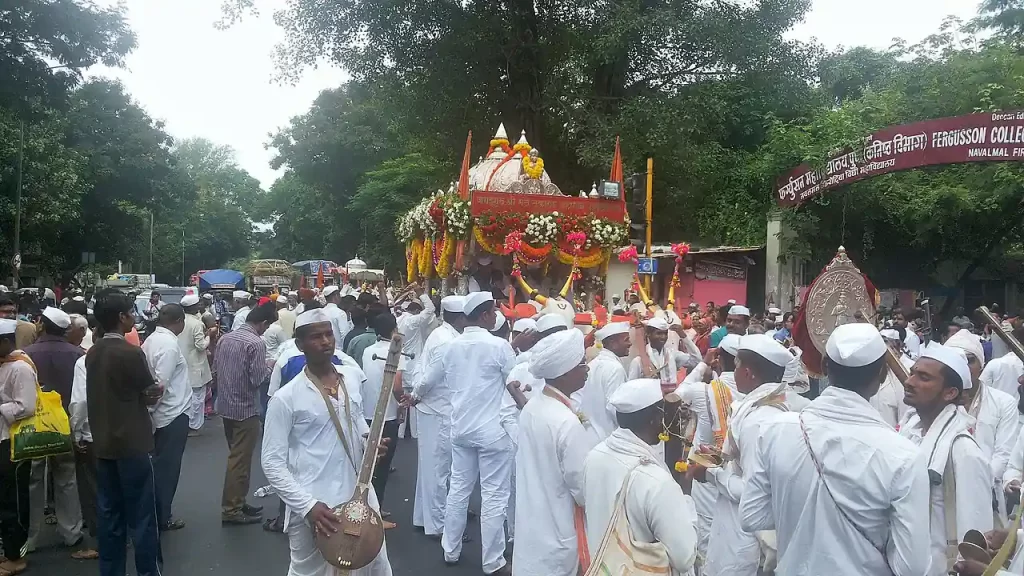
🚆 How to Reach Pandharpur, Solapur District, Maharashtra: Granular Travel Guide
🌍 1. National Connectivity Overview
Pandharpur sits at the crossroads of Maharashtra’s spiritual and transport networks, with Solapur (76 km) and Pune (210 km) as primary transit hubs. The town lacks an airport but connects seamlessly via Rail, Road and Air-Rail combos from major Indian cities. Key highways like NH 65 link it to Mumbai (360 km), Hyderabad (385 km), and Bengaluru (650 km), while the Pandharpur Railway Station (Station Code: PV) serves 20+ daily trains.
✈️ 2. By Air: Nearest Airports & Transfers
⦿ Pune Airport (PNQ – 200 km): Best for Western/North India travellers.
⦿ Flight Time: Delhi (2h), Kolkata (2.5h), Bengaluru (1.5h).
➙ Transfer to Pandharpur:
⦿ Bus: MSRTC buses every 30 mins (4h 8m, ₹2113)
⦿ Train: Pune Junction – Pandharpur Express (3x weekly, 4h 35m, ₹170–₹260)
➙ Solapur Airport (SSE – 85 km): Limited Flights from Mumbai (4x weekly).
➙ Transfer: Taxis (1.5h, ₹1500–₹2000) or Bus (2h, ₹200)
🚂 3. By Train: Routes, Fares & Key Junctions
Pandharpur Station (PV) connects via Kurduvadi Junction (KWV), 40km away. Top routes:
➙ Mumbai ➸ Pandharpur: Dadar-Pandharpur Express (3x weekly, 8h 55m; Sleeper ₹23–₹28, AC ₹65–₹460)
➙ Goa ➸ Pandharpur:
⦿ Fastest: Flight to Pune + train (5h 40m, ₹6,707)
⦿ Cheapest: Train via Belgaum (8h 25m, ₹340)
➙ Hyderabad ➸ Pandharpur: Direct buses (8h) or train via Solapur (7h 30m)
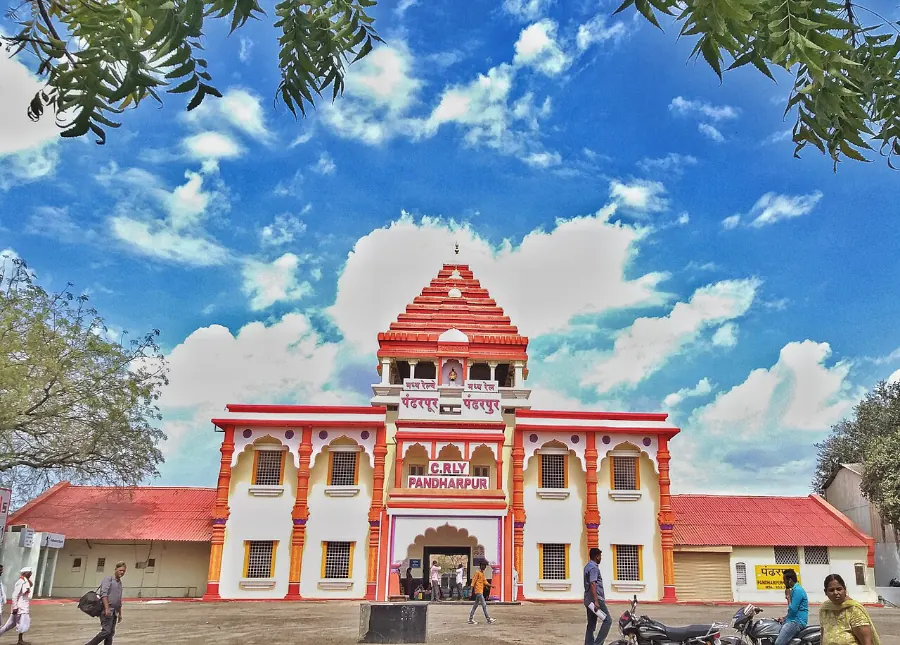
🚌 4. By Road: Highways, Bus Operators & Driving Tips
⦿ From Mumbai: NH 60 via Pune (360 km, 9h). MSRTC buses every hour (₹616)
⦿ From Goa: NH 748 (373 km, 9h 30m). KSRTC Volvo Buses (₹625)
⦿ From Bengaluru: NH 50 (650 km, 12h). Overnight Sleeper Buses (₹1,200–₹1,800)
Pro Tip: Avoid monsoon night drives (July-September) – Chandrabhaga River crossings get risky!
🚲 5. Eco-Friendly & Spiritual Routes: Cycling Pilgrimages
➙ Pandharpur Cycle Wari: Annual event (June-July) with routes from Alandi (250 km, 3 days) and Dehu (200 km, 2 days). 2025 saw 5,000+ cyclists cover 400–450 km from Karnataka/Madhya Pradesh.
➙ Rental Bikes: Uber Auto/Pedal bikes available locally (₹50–₹100/hr)
🚕 6. Local Transport in Pandharpur
⦿ Auto-Rickshaws: Uber Auto app-enabled (₹30 base + ₹15/km)
⦿ Taxis: Prepaid from Railway Station (₹200 to Vitthal Temple)
⦿ Cycle Rickshaws: Ideal for ghat-hopping (₹20–₹50/short ride)
⏱️ 7. Travel Time & Cost Matrix
| Origin | Fastest Route | Duration | Cost (₹) | Best For |
| Mumbai | Flight to Pune + Bus | 6h | 6,000+ | Business Travellers |
| Delhi | Flight to Pune + Train | 8h | 8,500+ | Families |
| Hyderabad | Direct Bus | 8h | 900+ | Groups |
| Bengaluru | Overnight Bus | 10h | 1,500+ | Solo Travellers |
| Goa | Train via Miraj | 9h 20m | 500+ | Budget Pilgrims |
🌦️ 8. Seasonal Travel Advisories
➙ Peak (June-July/November): Book trains 120 days ahead for Ekadashi festivals. Ghats overflow with 500k+ Pilgrims.
➙ Monsoon (July-September): Trains delayed by 1–3h; Buses reroute if Chandrabhaga floods. Pack rain gear!
➙ Summer (April-May): AC buses/trains recommended (day temps: 40°C+).
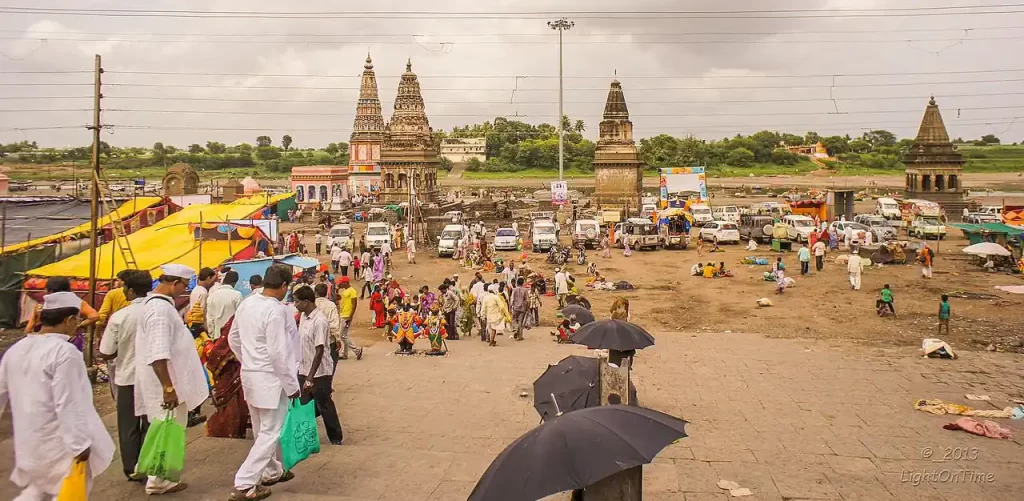
🚉 9. Regional Connectivity from Maharashtra Cities
⦿ Solapur ➸ Pandharpur: Local trains hourly (1h 15m, ₹11–₹70)
⦿ Kolhapur ➸ Pandharpur: Direct buses (4h, ₹299) or train via Kurduvadi (5h 40m)
⦿ Nashik ➸ Pandharpur: Bus via Pune (10h) or train to Dadar + transfer (14h)
♿ 10. Accessibility & Special Needs
⦿ Trains: Pune-Pandharpur Express has wheelchair ramps & priority seating.
⦿ Temples: Vitthal Temple offers free palanquins (Doli) for elderly pilgrims.
⦿ Buses: MSRTC Shivneri AC buses have hydraulic lifts (book via “Shri Sai” app).
💡 Pro Tip: For Ashadhi Ekadashi (July 2025), reserve Dharmshala Beds 6 months early! Use MSRTC’s “Palkhi Special” Buses from Pune/Mumbai with GPS tracking.
🗺️ Insider’s Route Map
⦿ From South India: Goa ➸ Miraj (train 5h 50m) ➸ Pandharpur (train 3h 30m)
⦿ From West India: Mumbai ➸ Dadar (local) ➸ Pandharpur Express (8h 55m)
⦿ From North India: Delhi ➸ Pune (flight 2h) ➸ Kurduvadi (train 4h) ➸ PV (local train 40m)
Pandharpur’s transport web weaves modernity with tradition—whether you’re cycling with Warkaris or boarding a Pune-bound Volvo. As local taxi driver Ramesh Patil says: “All routes here lead to Vithoba’s feet!” 🙏
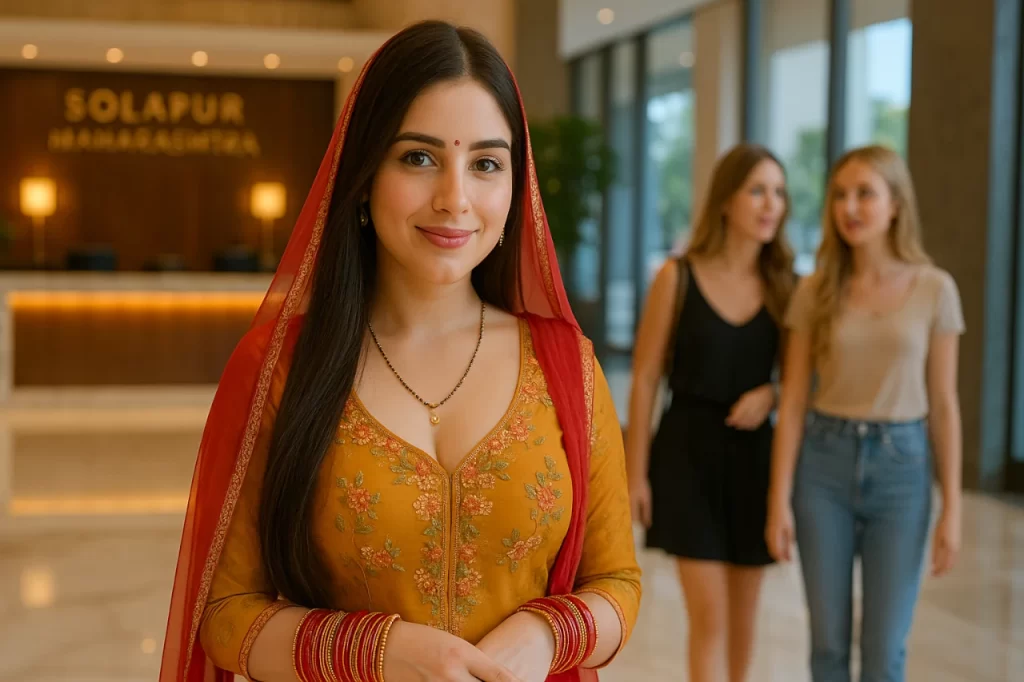
🛎️ Where to Stay in Pandharpur: Granular Guide to Luxury, Budget & Spiritual Stays
🏨 1. Luxury & Premium Hotels (Limited Options)
Pandharpur’s spiritual focus means true 5-star hotels are absent, but these premium options blend comfort with location:
➨ Hotel SP Majestic (Isbavi):
⦿ Rates: ₹2,500–₹4,200/night (AC rooms)
⦿ Facilities: 24-hour Room Service, Restaurant, CCTV Security
⦿ Food: On-site multi-cuisine restaurant (No Alcohol)
⦿ Check-in: 12 PM | Distance to Temple: 1.8 km
➨ Trimurti Deluxe Lodging (Bhosale Nagar):
⦿ Rates: ₹5,900–₹7,000/night (Peak Season)
⦿ Facilities: AC Rooms, Attached Bathrooms, 24-hour Hot Water
⦿ Food: Breakfast included; lunch/dinner at adjacent pure-veg eateries
⦿ Check-in: 2 PM | Perk: 6-minute walk to Vitthal Temple
➨ Shiva Farm Stay (Karkamb):
⦿ Rates: ₹18,700/night (Entire Farmhouse, Sleeps 8)
⦿ Facilities: Private Pool, Kitchen, Gardens
⦿ Food: Self-catering; Grocery Delivery Available
⦿ Check-in: Flexible | Distance: 26 km from Temple (Peaceful Retreat)
🛏️ 2. Budget Hotels (₹850–₹2,000/Night)
🚶 Temple-Proximity Cluster (Bhosale Nagar/Chouphala)
➨ Prabhu Residency:
⦿ Rates: ₹1,999/night (₹1,499 with discounts)
⦿ Facilities: Fireplace (Winter), Free Wi-Fi, Attached Bathrooms
⦿ Food: No in-house meals; 5-min walk to Misal Pav stalls
⦿ Check-in: 12 PM | Location: 940m from temple
➨ Mangal Lodges (Chouphala):
⦿ Rates: ₹1,999/night
⦿ Perk: 1-minute walk to Temple’s Western Gate
⦿ Check-in: 11 AM | Note: Basic fan rooms; shared bathrooms
🚉 Transport-Hub Cluster (Near Station/Bus Stand)
➨ Balaji Lodging (Pundlik Nagar):
⦿ Rates: ₹1,100–₹1,500/night
⦿ Facilities: 24-hour Room Service, Luggage Storage
⦿ Food: Home-cooked Meals (₹100/plate) on request
⦿ Check-in: 24-hour | Location: 200m from Railway Station
➨ Hotel Sayba Classic (June Pat):
⦿ Rates: ₹2,000/night
⦿ Facilities: AC, CCTV, kids’ play area
⦿ Food: Breakfast included; rooftop café with river views
⦿ Check-in: 1 PM | Distance: 8-min walk to temple
🕉️ 3. Dharamshalas & Temple-Affiliated Stays (₹300–₹2,000)
🏛️ Temple-Trust Bhakta Niwas
➨ Shri Vitthal Rukmini Bhakta Nivas:
⦿ Rates: ₹1,400 (non-AC) – ₹2,000 (8-bed dorm)
⦿ Facilities: Hot water (5–8 AM), Lifts, CCTV, Parking
⦿ Food: Full-board meals (₹150/meal) at Community Dining
⦿ Check-in: 12 PM | Perk: 750m from Temple
➨ Vedanta Videocon Bhakta Niwas:
⦿ Rates: ₹499–₹800/bed (Dormitory)
⦿ Facilities: Shared Kitchens, Prayer Halls
⦿ Food: Self-cooking only; groceries near gate
⦿ Check-in: 10 AM | Rule: Mandatory ID proof
☸️ ISKCON Spiritual Stays
➨ ISKCON Chandrabhaga Guest House:
⦿ Rates: ₹924 (non-AC) – ₹1,501 (AC with Breakfast)
⦿ Facilities: River-view Lounge, Kirtan Hall, Caretaker
⦿ Food: Govinda’s Restaurant (₹100/meal; Jain options)
⦿ Check-in: 12 PM | Perk: Chandrabhaga ghat access
➨ ISKCON Jagannath Bhakt Niwas:
⦿ Rates: ₹1,700/night (AC)
⦿ Facilities: Meditation Room, Wheelchair Access
⦿ Food: Free Breakfast; Paid Lunch/Dinner
⦿ Check-in: 2 PM | Location: Near Life Line Hospital
🧘 Community Ashrams & Bhavans
➨ Raja Pandharinath Bhakt Niwas (Chouphala):
⦿ Rates: ₹569/night (Cottage-style)
⦿ Facilities: Shared Kitchen, Courtyard
⦿ Food: Community Annadana (Free Meals during Festivals)
⦿ Check-in: Flexible | Perk: 5-min walk to Temple
➨ Maheshwari Bhakta Niwas:
⦿ Rates: ₹300/bed (dorm)
⦿ Facilities: Hot water buckets (₹10), ceiling fans
⦿ Food: No Meals; use Temple Prasad Kitchens
⦿ Check-in: 11 AM | Location: Near Dwarkadhish Temple
🍽️ 4. Food Facilities & Dining Insights
➙ Temple-Affiliated Stays: Offer Satvik Meals (No Onion/Garlic) at fixed times – e.g., ISKCON’s Govinda’s Restaurant (7–9 PM Dinner).
➙ Budget Hotels: Rarely include Meals; cluster near Station Road for Puran Poli (Sweet Flatbread) at ₹50/Piece.
➙ Luxury Hotels: Multi-cuisine Vegetarian Menus – Hotel SP Majestic’s Thali (₹200) features Solapur’s Jowar Bhakri.
⏰ 5. Check-in Policies & Strategic Timing
| Property Type | Standard Check-in | Peak-Season Flexibility | ID Proof Required |
| Luxury Hotels | 12 PM–2 PM | Delayed till 4 PM | Yes (Aadhar/PAN) |
| Budget Lodges | 24-hour | No changes | Yes (Aadhar/PAN) |
| Dharamshalas | 10 AM–11 AM | Strictly Enforced | Compulsory (with photo) |
💡 Pro Tip: During Ashadhi Ekadashi, Dharamshalas open check-in at 5 AM for early Pilgrims.
📍 6. Location Intelligence: Where to Book Based on Itinerary
⦿ For Temple Focus: Chouphala/Bhosale Nagar (Raja Pandharinath Bhakt Niwas, Trimurti Lodging).
⦿ For Transport Access: Pundlik Nagar (Balaji Lodging – 200m from Station).
⦿ For Spiritual Retreats: ISKCON Properties (Riverside Serenity + Daily Kirtans).
⦿ For Groups/Families: Shri Vitthal Rukmini’s 8-bed rooms (₹2,000/Room).
🎯 7. Booking Pro Tips
⦿ Advance Window: 6 months for Ekadashi dates (July/November); 3 days otherwise.
⦿ Discounts: Use code “TRIPBACKHOME” on MakeMyTrip for 40% off Budget Stays.
⦿ Avoid: Last-minute Bookings during Kartiki Ekadashi – Prices Surge 200%.
🌦️ 8. Seasonal Price Variations (Per Night)
| Season | Budget Hotel | Dharamshala | Premium Stay |
| Off-season | ₹850–₹1,200 | ₹300–₹600 | ₹2,000–₹3,000 |
| Ekadashi Festival | ₹3,500–₹5,000 | ₹1,000–₹1,500 | ₹7,000 Plus |
🛎️ 9. Unique Stays with Cultural Immersion
⦿ Radhesham Bhakt Niwas: Offers Kirtan Sessions + ₹569/Night Rooms with kids’ play zones.
⦿ Sant Gulabrao Maharaj Bhakti Dham: Free Pravachan (Discourses); ₹400/Bed.
⦿ Laxman Baug Devasthan: Heritage Mansion with Courtyards; ₹700/bed (Shared Baths).
✅ 10. Critical Amenities Checklist
⦿ Wi-Fi: Only at Premium Hotels (SP Majestic, Zip by Spree).
⦿ Hot Water: Bucket system in Dharamshalas (Morning only); Geysers in Hotels.
⦿ Parking: ₹100/day at Temple Niwas; free at ISKCON.
⦿ Accessibility: Ramps/lifts only at Shri Vitthal Rukmini Bhakta Nivas.
🌟 Final Insight: For a seamless Pandharpur experience, Combine Stays – 2 nights in temple Dharamshalas for Spirituality + 1 Night in farm stay (Karkamb) for rural tranquility. As local priest Devendra Patil notes: “Vithoba’s Darshan begins where the Chandrabhaga’s waters meet – but it deepens where Pilgrims rest their feet among fellow devotees”.

🌄 Best Places to Visit in and near Pandharpur: Spiritual, Historical & Natural Wonders
⛩️ 1. Core Pilgrimage Circuit: Temples of Divine Resonance
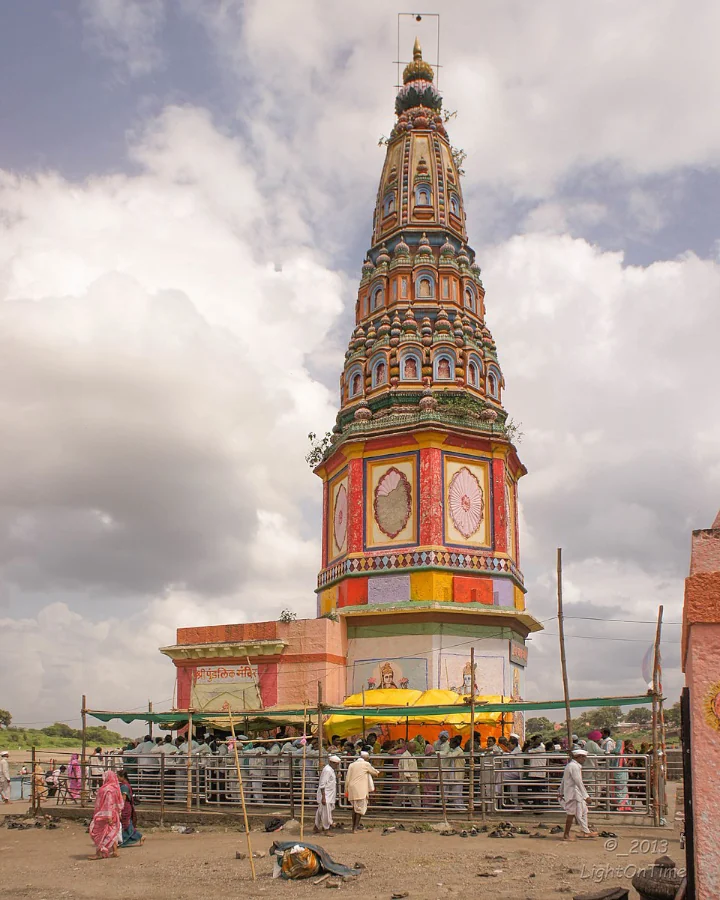
➙ Shri Vitthal-Rukmini Temple: The spiritual epicentre of Pandharpur, dating to the 12th century Yadava dynasty. Its Hoysala-Maratha Hybrid Architecture features the Solkhamb Hall (16 Pillars, one Gold-plated) and the Padsparsh Darshan ritual where devotees touch Vitthal’s feet — a Unique Privilege. Open 4 AM – 11 PM, it draws 500,000+ Pilgrims during Ashadhi Ekadashi. The temple complex includes 27 subsidiary shrines like Garud Mandir, Radhika Mandir and Sant Namdev Payari (Step-Samadhi).
➙ Pundalik Temple: On the Chandrabhaga riverbank, this 5-story Pagoda-style Shrine marks where Lord Krishna awaited devotee Pundalik. The Stone Brick Platform symbolises Lord Krishna’s eternal vigil. Attend the Mahashivratri festival for vibrant processions.
➙ ISKCON Pandharpur: Established 1980s, this riverside complex features Bengali-style Chala Roofs, daily Kirtans and a Goshala (Cow Sanctuary). The Radha-Pandharinath Deities receive elaborate Rajbhog offerings. Timings: 4 AM – 1 PM, 2–8 PM.
🌊 2. Riverfront Sacred Sites: Ghats & Water Rituals
➙ Chandrabhaga River Ghats: 48 Ghats line the crescent-shaped Bhima River, with Chakratirtha as the primary ritual dip site. At Sunrise, Pilgrims perform “Nirmalya Snan” (Offering Immersion) while chanting Abhangas.
➙ Vishnupad Temple: An Open-Air Hall on the riverbank supported by 16 Carved Pillars depicting Lord Krishna’s lore. Its sacred rock bears Lord Krishna’s Lotus Footprints and Cow Hoof-Prints — considered equivalent to Gaya’s Vishnupad for ancestral rites.
🏞️ 3. Nearby Villages & Cultural Hubs
➙ Gopalpur (2 km): Home to Shri Gopalkrishna Temple atop Govardhan Hill. The Fort-like structure has Underground Meditation Chambers linked to Krishna’s Govardhan Leela. Pilgrims grind grain in the Temple’s Jata (Grinding Stone) for Blessings.
➙ Mangalwedha (25 km): Birthplace of Sant Damaji (14th-century Bhakti Saint). Visit the Damaji Math to see his Padukas (Sandals) and attend Folk-art Performances during Palakhi processions.
➙ Velapur (32 km): A Hemandpathi-style Temple with Four Directional Doorways. The Black-Stone Lord Vishnu Idol holds Chakra-Gadha-Shankh (Discus/Mace/Conch). Reach via local train from Pandharpur Station.
🦜 4. Wildlife & Nature Sanctuaries
➙ Nannaj Great Indian Bustard Sanctuary (45 km): 8,500 km² Habitat for the critically endangered Great Indian Bustard (Maldhok). Best viewing: July–September when 200+ species migrate here. Guided tours at 6 AM.
➙ Bhigwan Bird Sanctuary (106 km): Ujani Dam Backwaters host 10,000+ Flamingos (November–March). Take Boat Tours (₹500/Person) to spot Pelicans, Siberian Cranes and Black-Tailed Godwits.
➙ Kambar Talao Lake: British-era tank (1842) with lotus-shaped embankments. Once filled with pink lotuses; now ideal for evening Birdwatching (Egrets, Kingfishers).
🏰 5. Historical Forts & Palaces
➙ Bhuikot Fort (45 km): 14th-century Bahmani stronghold later occupied by Aurangzeb. Features Mughal Jali Screens, Maratha Garuda Motifs and a 15-ft-deep Moat. Climb the bastions for Solapur skyline views.
➙ Naldurg Fort (116 km): India’s largest Moat Fort with Nar-Madi Waterfalls. The “Male and Female” cascades peak during monsoon (July–September). Explore underground granaries and Bajirao II’s Darbar Hall.
➙ Asar Mahal: Former Adilshahi courthouse with Triple-tank system—central reservoir (15 ft deep) flanked by ceremonial pools. The Wooden Ceilings have lotus medallions and hidden Zenana Passages.
🛕 6. Extended Pilgrimage Excursions (100–200 km)
➙ Tulja Bhavani Temple (114 km): Shakti Peetha revered by Chhatrapati Shivaji. The Black-Stone Bhavani Idol wears Golden Nath (Nose Ring) gifted by Shivaji. Timings: 4 AM – 10 PM.
➙ Akkalkot Swami Samarth Temple (119 km): Shrine of the 19th-century saint Swami Samarth. Devotees seek “Udi” (Sacred Ash) for Healing. The Banyan Tree courtyard hosts all-night Bhajans.
➙ Jejuri Khandoba Temple (159 km): Turmeric-smeared Hilltop Shrine dedicated to warrior-god Khandoba. During Sonyachi Jejuri (November), devotees hurl Turmeric Powder, turning the complex golden.
🌿 7. Serene Spiritual Mathas & Gardens
➙ Sant Kaikadi Maharaj Math: North of town, this modern complex has Epic Frescoes of Mahabharata scenes using vegetable dyes. Allow 2+ hours to explore its Meditation Gardens.
➙ Ram Baag & Laxman Baag: Twin Gardens on Solapur Road with Century-old Banyans, Tukaram-Inspired Poetry Plaques and stone Dindi Shelters for Pilgrim groups.
➙ Gujarathi Devsthan: Cross the river to this white-Marble Complex housing Shrinathji. The “Annakut” festival (November) features 1,008-dish offerings.
🎭 8. Cultural & Community Spaces
➙ Pandharpur Market (Mahadwar Bazaar): Buy Pandharpuri Chadars (Silk Ritual Cloths), Tulsi Vrindavan mini-shrines and Jaggery-coated Puran Poli. Opens 5 AM for Pilgrim supplies.
➙ Siddheshwar Temple (Solapur, 72 km): Lake-centered 12th-century shrine with three submerged gateways. Wade waist-deep to touch the Shiva-Vishnu syncretic idol during Maha Shivratri.
⛰️ 9. Scenic Hill Stations & Waterfalls
➙ Lonavala (273 km): Sahyadri Mountain Retreat with Rajmachi Fort treks and Chikki (Jaggery-nut Brittle) shops. Monsoon (July–September) highlights Bhushi Dam overflows.
➙ Vajrai Waterfall (200 km): India’s tallest Plunge Waterfall (1,840 ft). Trek through Koyna Rainforest to see Orchids and Giant Malabar Squirrels.
🎪 10. Festivals & Immersive Experiences
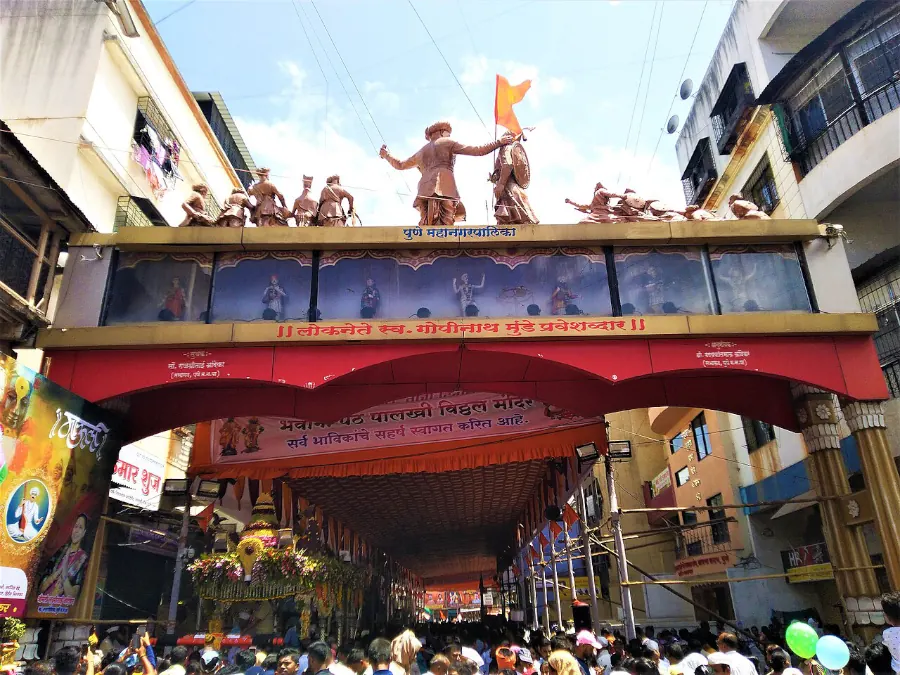
➙ Ashadhi/Kartiki Ekadashi: Join 500,000+ Pilgrims for the Wari Procession climax at Vitthal Temple. Dindi groups sing Tukaram’s Abhangas while carrying Saints’ Palkhis.
➙ Velapur Temple Festival (February): Firewalking rituals and Pandavani Folk Dances celebrating local harvests.
➙ ISKCON Chandrabhaga Aarti: Sunset lamp ceremonies with devotional songs in Marathi-Sanskrit fusion. Participate in “Nagarsankirtan” (Street Chanting).
🌟 Final Insight: Pandharpur transcends conventional tourism—it’s where Stone Deities Breathe, Rivers Absolve Sins and Centuries-old festivals pulse with living devotion. As local priest Devendra Patil reflects: “Vithoba’s miracles aren’t in grand visions, but in the blistered feet of Warkaris, the shared Puran Poli at Mathas and the silence that follows a million voices chanting ‘Panduranga!'”.
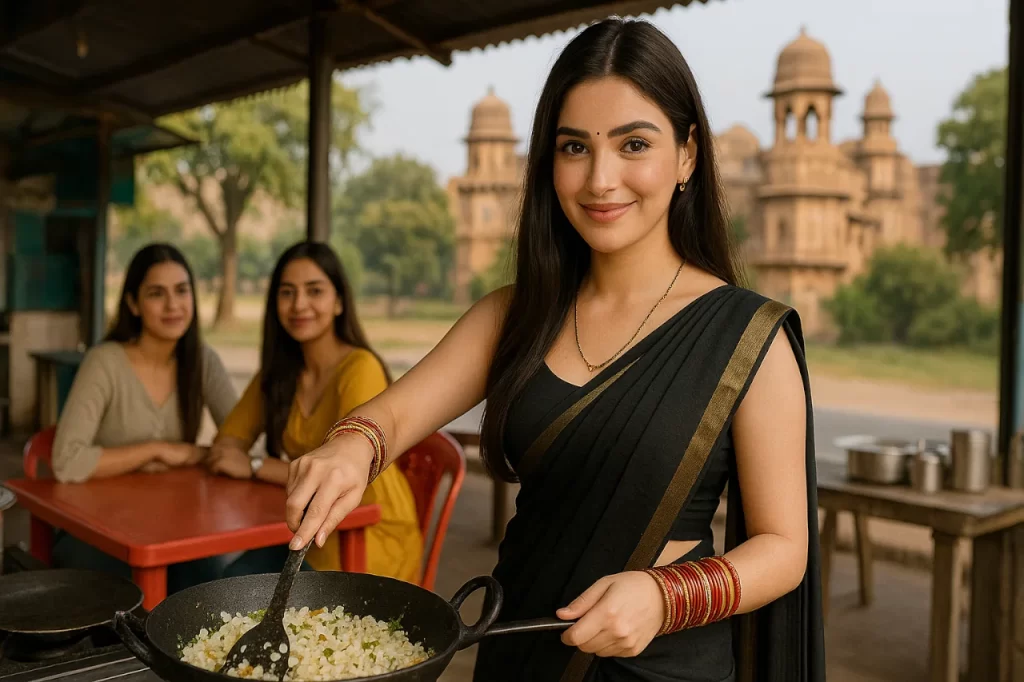
🍛 Best Places for Authentic Local Food in Pandharpur: A Culinary Pilgrimage
🛕 1. Temple-Affiliated Eateries: Prasadam & Satvik Feasts
➙ Vitthal Temple Prasadam Halls: Experience Free Community Meals (Annadana) during festivals like Ashadhi Ekadashi, serving 25,000+ Pilgrims daily. The “Mahaprasad” Thali features Varan Bhat (Lentil-Rice), Puran Poli (Sweet Flatbread) and Amti (Spicy Lentil Stew) cooked in temple kitchens using traditional Jata (Grinding Stones).
➙ ISKCON Govinda’s Restaurant: Offers Satvik Meals (No Onion/Garlic) like Rajbhog Thali (₹100) with Shrikhand, Sabudana Khichdi and Tulsi Tea. Timings: 7–10 AM, 12–3 PM, 7–9 PM.
🪑 2. Budget Family Restaurants: Maharashtrian Comfort Food
➙ Panchvati Restaurant: Famous for “Pandharpuri Thali” (₹180) with 12 items: Zunka Bhakri (Spiced Chickpea Flour with Millet Bread), Solkadhi (Kokum-Coconut Drink) and Bharli Vangi (Stuffed Eggplant).
➙ Tuljaee Khanaval: Serves rustic Malvani-style Biryani (₹120) with Kokum-infused Chicken or Jackfruit, Paired with Taak (Spiced Buttermilk).
➙ Hotel Mahavir Rasoi: Thalipeeth (Multi-Grain Pancakes, ₹50) with Thecha (Green Chili Chutney) and Mattha (Fermented Cumin Drink).
🥘 3. Street Food Hotspots: Chandrabhaga Ghat Zones
➨ Mahadwar Bazaar Stalls:
⦿ Dabeli: Spicy potato-stuffed buns with tamarind chutney (₹30).
⦿ Pav Bhaji: Buttery vegetable mash with local Pav (₹100–₹130) at Annapurna Snack Bar.
⦿ Bhel Puri: Puffed Rice with Raw Mango and Date Chutney (₹49).
➙ Chakratirtha Ghat Vendors: Steamed Pithla Bhakri (Gram Flour Curry with Millet Bread) served on banana leaves (₹40).
🍦 4. Iconic Drink & Dessert Corners
➨ Annapurna Coldrinks & Snaks Bar:
➙ Mastani: Thick Milkshakes topped with Ice cream – try Pista Deluxe (₹99) or Mawa Mastani (₹109) loaded with Khoya.
➙ Thandai Milkshake: Saffron-cardamom cold drink (₹89), ideal for Summers.
➨ Kaka Halwai Sweet Centre: Puran Poli Ladoo (Jaggery-Chickpea Balls, ₹300/kg) and Gulachi Poli (Ghee-roasted Puran Poli, ₹40/piece).
☕ 5. South Indian Spiritual Fuel
➨ Idli Express:
⦿ Ghee Podi Idli (₹60): Steamed Rice Cakes with Chili-lentil Powder and clarified Butter.
⦿ Filter Coffee: Served in Steel Tumblers (₹20), brewed with local Solapur Coffee Beans.
➙ Balaji Idli Gruh: Sambar Vada (Crispy Lentil Donuts in Tangy Soup, ₹75).
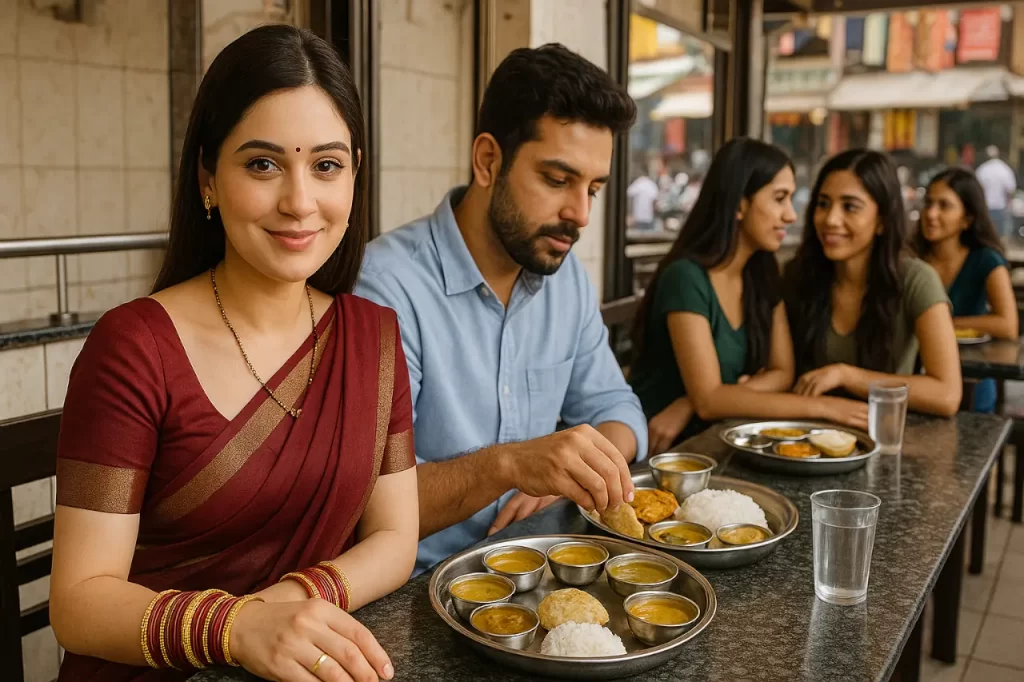
🍛 6. Festival-Special Pop-Ups
➨ During Ashadhi Ekadashi (July 2025):
➙ Wari Dindi Camps: Palkhi processions serve “Warkari Pak” – Pithla, Jowar Roti and Gulab Jamun made in community cauldrons.
➙ Velapur Village Huts: Ukdiche Modak (Steamed Rice Dumplings with Coconut-Jaggery, ₹50/Plate) near Pundalik Temple.
🥛 7. Dairy Delights & Cold Treats
➙ Gujarathi Devsthan Dairy: Fresh Shrikhand (Strained Yogurt with Saffron, ₹100/kg) and Aamras (Mango Pulp, ₹80/cup) sold near Laxman Baug.
➙ Cafe Mexico: Kesar Pista Kulfi (₹50) on Solapur Road, hand-churned in Matkas.
🌿 8. Farm-to-Table Experiences
➨ Shiva Farm Stay (Karkamb): Organic Meals using farm-grown Millets and Vegetables:
⦿ Bajra Khichdi (Pearl Millet Porridge with Ghee)
⦿ Shevga Chi Bhaji (Drumstick Curry)
⦿ Advance Booking required (₹250/meal)
🥤 9. Local Beverage Traditions
➙ Tapti Sharbat Stall: Solapuri Sugarcane Juice (₹30) with Ginger-Lemon, pressed in wooden crushers.
➙ Bhima Riverbank Chaiwallas: Adrak Chai (Ginger Tea, ₹15) served with Poha (Flattened Rice) at Sunrise.
🍽️ 10. Cultural Dining Etiquette & Tips
➙ Seating Styles: Cross-legged on floor mats at temple Bhojanalayas; tables at Hotels like SP Majestic.
➙ Must-Try Combo: Bhakarwadi (Spicy Rolls) + Thandai at Annapurna Snack Bar.
➙ Avoid: Non-vegetarian food near temple zones (frowned upon spiritually).
🌟 Final Bite: Pandharpur’s cuisine is Devotion Served on a Plate – where Puran Poli mirrors the sweetness of Bhakti Poetry and shared Thalis embody community equality. As Warkari Pilgrim Sunita Deshpande notes: “Eating Temple Prasad isn’t feeding the stomach; it’s feeding the soul’s hunger for Vithoba’s grace”. 🙏✨
Pro Tip: For Festival Meals, join ISKCON’s “Prasad Seva” (Food Volunteering) – Chop Vegetables or Serve Thalis to Pilgrims!
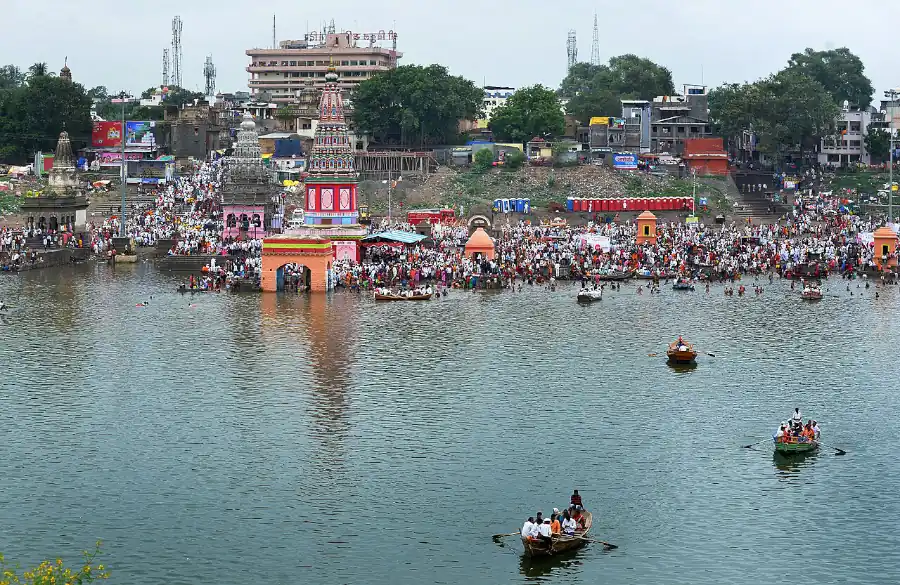
🌦️ Climatic Conditions in Pandharpur: Granular Seasonal Analysis
🌡️ 1. Annual Temperature Profile: Extreme Diurnal Ranges
Pandharpur experiences a Tropical Savanna Climate with three distinct seasons. Annual temperatures swing dramatically from 63°F (17°C) to 103°F (39°C), rarely dropping below 58°F (14°C) or exceeding 107°F (42°C). The hottest month is April (Avg. high 102°F/39°C), while December (Avg. low 64°F/18°C) is the coldest. Intense solar radiation creates large diurnal ranges – up to 16°C (29°F) in Summer – causing pre-dawn chills even in peak heat.
➨ Monthly Temperature Averages (°F):
| Month | Avg High | Avg Low | Record Extremes |
| April | 102°F | 79°F | 114°F (1939) |
| May | 101°F | 79°F | 111°F |
| December | 86°F | 64°F | 39°F (1945) |
☀️ 2. Summer (March-May): Blazing Heat & Pre-Monsoon Relief
March-May brings oppressive heat with peak temperatures in April-May exceeding 100°F (38°C) daily. Relative humidity plunges to 20-25% by afternoon, creating arid conditions. Relief comes via:
➙ Afternoon Thunderstorms: Locally called “Mango showers”, these dust-laden squalls occur 3–5 times monthly, dropping brief rain (Avg. 4mm in April).
➙ Cooling winds: Westerlies at 10-15 mph accelerate in May, though they feel like “Hair Dryer Blasts”.
🌧️ 3. Monsoon (June-September): Torrential Rains & 95% Humidity
➨ The Southwest Monsoon arrives in early June, triggering:
➙ Rainfall Surge: From 151mm in June to 202mm in July – Pandharpur’s wettest month .
➙ Humidity Extremes: Dew points soar to 77°F (25°C), creating 95% muggy conditions in July.
➙ Cloud Dominance: 87% cloud cover in July reduces temperatures to 87°F (31°C) but intensifies “Sweat Bath” discomfort.
➨ Monsoon Rainfall Distribution:
➙ Core Monsoon (June-September): Contributes 74% of annual rainfall (Avg. 584mm).
➙ Peak Intensity: September averages 4.2 inches (106mm) – Highest Monthly Accumulation.
➙ Extreme Events: Historic 24-hour record: 251.5mm (9.9 inches) on Sept 7, 1895.
❄️ 4. Winter (October-February): Mild Days & Chilly Nights
➨ October-February offers dry, pleasant weather:
➙ Daytime Temps: Range from 82-89°F (28-32°C) in October to 86°F (30°C) in December.
➙ Nighttime Chill: December lows average 64°F (18°C), but can plunge to 39°F (4°C) – requiring light woollens.
➙ Sky Clarity: 77% clear skies in February – ideal for temple visits and river ghat photography.
💨 5. Wind Patterns: Monsoon Surges & Dust Storms
➙ June-August: Southwest Winds dominate at 10-20 mph, peaking at 31.9 km/h (20 mph) during storms.
➙ March-May: Variable dusty westerlies trigger Haboobs (Dust Storms) 2-3 times monthly.
➙ October-December: Northwest Breezes at 5-8 mph carry pollen from Sugarcane fields.
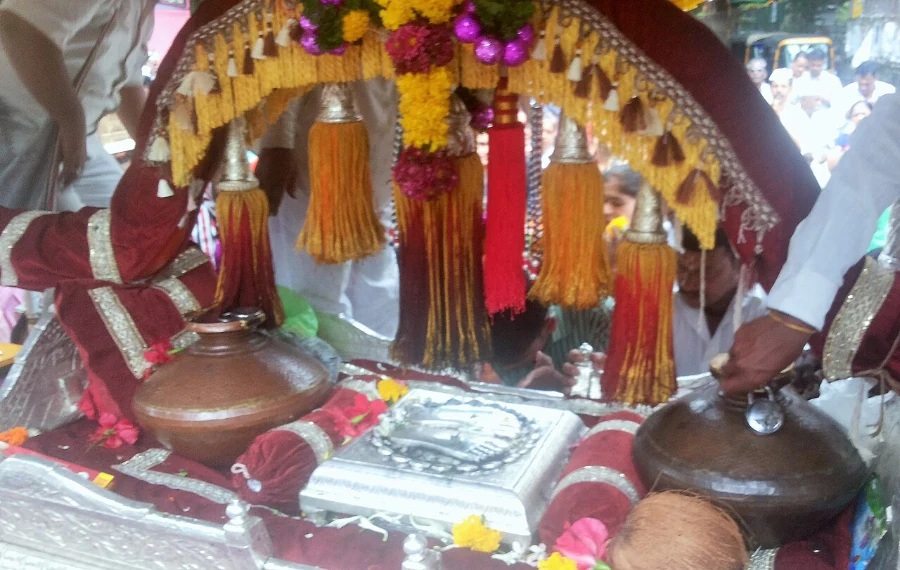
🌫️ 6. Humidity & Muggy Days: 6 Months of Discomfort
➨ The “Muggy Season” (April 25 – November 13) sees:
⦿ July Peak: 29.2 days/month feel oppressive.
⦿ Winter Relief: Only 0.7 muggy days in February.
⦿ Dew Point Shifts: From comfortable 60°F (15°C) in January to swampy 75°F (24°C) in July.
🌞 7. Solar & Lunar Cycles: Ritual Timing Influencers
➙ Daylight Hours: Vary from 11h 04m (December 21) to 13h 11m (June 21) – affecting Pilgrimage schedules.
➙ Sacred Windows: Pre-dawn Kakad Aarti timed with 5:52 AM June Sunrise; Moonlit Palkhi Processions planned around full moons.
⛈️ 8. Extreme Weather Risks
⦿ Flooding: Chandrabhaga River swells in July-August, submerging ghats like Chakratirtha.
⦿ Heatwaves: May temperatures exceeding 111°F (44°C) necessitate pilgrim hydration camps.
⦿ Hailstorms: Rare April ice pellets damage mango crops in villages like Karkamb.
🌾 9. Agricultural & Cultural Adaptations
➙ Crop Cycles: Millet sowing synchronised with June Monsoon Onset; Sugarcane Harvest in winter.
➙ Festival Timing: Ashadhi Ekadashi (June-July) embraces rains; Kartiki Ekadashi (November) leverages cool clarity.
➙ Clothing: Pilgrims switch from Cotton Saffron Robes (Summer) to Woollen Shawls (December Nights).
📆 10. Climate-Responsive Travel Planning
➙ Best Months: October-February for Temple visits (Avg. 75°F/24°C); July-September for lush landscapes but with rain gear.
➙ Avoid: Mid-May (Pre-monsoon furnace) and July 10-25 (Peak Flood Risk).
➙ Pilgrim Microclimate: Temple queues offer shade, but river ghats feel 10°F warmer due to water vapour.
🌦️ Final Insight: Pandharpur’s climate is a Devotional Barometer – where summer heat tests faith, monsoons embody purification, and winter’s clarity reveals Vitthal’s spire against cobalt skies. As farmer Rajendra Khedkar observes: “We plant crops when Chandrabhaga swells, but plant prayers when the first cool wind blows from the Bhuleshwar hills”.
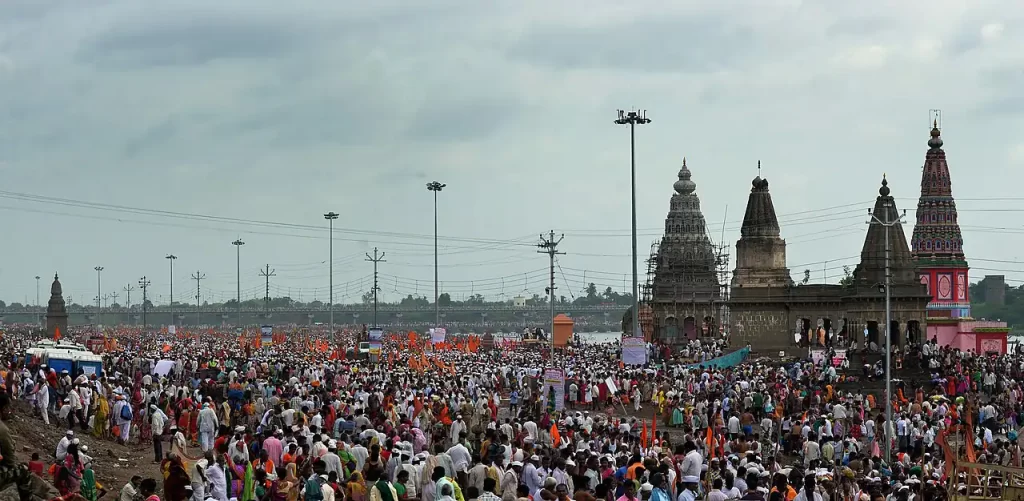
🧑👩👧👦 Sociodemographic Mosaic of Pandharpur: Castes, Languages & Community Dynamics
📊 1. Population Structure & Growth
As per the 2011 Census, Pandharpur town had a population of 98,923 (50,645 males ♂️, 48,278 females ♀️), with a healthy sex ratio of 953 females per 1,000 males – higher than Maharashtra’s average of 929. The child population (0–6 years) stood at 11,151 (11.27% of total), with a child sex ratio of 894. Projections indicate robust growth:
⦿ 2025 Estimated Population: 142,000 (+43.5% since 2011)
⦿ 2031 Forecast: 166,000
The Pandharpur Tehsil (Covering 102 Villages) reported 442,368 residents in 2011, with rural areas (343,445) dominating urban zones (98,923). Population density is 176/km² in the tehsil versus 31,076/km² in the town core – reflecting intense urban crowding.
⛪ 2. Religious Composition & Pilgrimage Impact
➨ Pandharpur is a Hindu-majority town (89.61%), but hosts diverse faiths:
| Religion | Percentage | Key Communities/Features |
| Hindu | 89.61% | Warkari Pilgrims, Temple Priests, Agriculturalists |
| Muslim | 7.32% | Konkani Traders, Sufi Dargah Caretakers near Chakratirtha Ghat |
| Buddhist | 1.16% | Navayana Buddhists (Ambedkar followers) |
| Jain | 1.51% | Traders in Gemstones and Textiles |
| Others | 0.22% | Sikhs, Christians, Parsis |
The Vitthal Temple drives Seasonal Demographic Shifts: Over 1 Million Pilgrims visit during Ashadhi Ekadashi, temporarily altering religious ratios. Syncretic practices exist, like Muslim vendors selling Puja items at Mahadwar Bazaar and Hindus maintaining Sufi shrines like Hazrat Shah Zahur Dargah.
👨👩👧👦 3. Caste Dynamics & Social Hierarchy
Pandharpur’s caste landscape blends Traditional Hierarchies and Bhakti-led Egalitarianism:
➨ Scheduled Castes (SC): 12,211 (12.34% of town). Dominant groups:
⦿ Mahars (legacy of Saint Chokhamela): Work in leather-craft and Temple Sanitation
⦿ Mangs: Traditional rope-makers and Agricultural labourers
➙ Scheduled Tribes (ST): 5,410 (5.47%). Primarily Dhangars (Shepherd Community) from villages like Karkamb
➨ Other Backward Classes (OBC): ~60% of rural tehsil. Includes:
⦿ Marathas: Landowners and political leaders
⦿ Vanis: Traders controlling grain markets
➨ Forward Castes:
⦿ Brahmins (5%): Temple Priests (Badves), though 2014 reforms enabled non-Brahmin priests
⦿ CKPs: Administrators and educators
🗣️ 4. Linguistic Diversity
Marathi is the official language (73.13% speakers), but Pilgrimage traffic fosters Multilingualism:
⦿ Kannada (9.28%): Spoken by Karnataka-origin communities like Lambani artisans
⦿ Hindi (5.17%): Used by North Indian shopkeepers near temples
⦿ Urdu (4.33%): Concentrated in Muslim neighbourhoods like Isbavi
⦿ Telugu/Tamil (3.09%): Southern pilgrims and flower vendors
➙ Unique Dialect: Pandharpuri Marathi blends Kannada loanwords (e.g., “Lambi” for Riverbank) and Bhakti-era Archaisms from Tukaram’s Abhangas.
💼 5. Economic Structure & Livelihoods
The economy pivots on Pilgrimage Tourism (75% Urban Income) and Agriculture:
➙ Agriculture (Tehsil): Employs 42% Workforce. Key Crops: Sugarcane (River Plains), Millet (Upland), and Onions (Exported to Pune)
➙ Pilgrim Services: 28% Urban Jobs – Pandits, Palki Bearers, Prasadam Cooks
➙ Handicrafts: Pandharpuri Chadars (Vitthal-themed Silk Cloths), Tulsi Vrindavan Mini-shrines
➙ Informal Sector: 30,855 Workers; 92.43% “Main Workers”, 7.57% Marginal labourers
👉 Notable Disparity: Male workforce participation (49.7%) doubles female (24.1%), reflecting traditional gender roles.
🌾 6. Rural vs. Urban Sociography
Rural Pandharpur Tehsil (102 Villages) contrasts sharply with the Temple Town:
| Parameter | Rural (343,445 People) | Urban (98,923 People) |
| Dominant Castes | Dhangars (ST), Mali (OBC) | Brahmins, Vanis (OBC) |
| Primary Economy | Rainfed Agriculture | Pilgrim Services, Retail |
| Female Workforce | 33% (Farm Labor) | 18% (Service Sector) |
| Literacy Rate | 68.2% | 86.65% |
Largest Village: Karkamb (Pop. 17,456), known for Sugarcane Co-ops and the Deshmukh Clan – Historically Temple key-keepers.
🕰️ 7. Historical Evolution & Social Reform
➨ Pandharpur’s demography was shaped by:
➙ Medieval Era: Deshmukhs of Kasegaon (Maratha warriors) managed temple keys; Saint Chokhamela (14th century) empowered Dalits through Bhakti Poetry
➙ Colonial Period: 1902 Plague killed 30% Population, leading to migrant influx from Bijapur
➙ Post-Independence: Land Reforms (1950s) redistributed Inam lands from Brahmins to OBCs; 2014 priesthood revolution appointed non-Brahmin priests
➙ Ambedkarite Movement: 1956 Buddhist conversions drew 5,000+ Dalits; now 1.16% Buddhist Population
🔄 8. Contemporary Shifts & Challenges
➙ Education: 86.65% literacy (91.78% Male, 81.32% Female) – fuelled by Vitthal Rukmini Sanskrit School (Est. 1892) and ISKCON-run colleges
➙ Gender Dynamics: Rising Female Entrepreneurship (e.g., Tulsi Vrindavan Co-ops), but low Political Representation (only 2/33 ward councillors female)
➙ Caste Mobility: SC/ST’s dominate Beedi-rolling and Brick Kiln Industries; OBC Marathas control Sugar Co-ops
➙ Pilgrim Economy: 75% shops in Mahadwar Bazaar owned by Kannada-speaking Vanis; 22% by Muslims specialising in Puja items
🌟 Cultural Synthesis: Pandharpur embodies Maharashtra’s soul – where Warkari Bhakti dismantles caste barriers at Lord Vitthal’s Feet, yet Village Hierarchies Persist in Sugarcane Fields. As scholar Ramchandra Dhere notes: “The Chandrabhaga’s waters carry both Temple flowers and factory runoff – Mirroring a society in flux”.
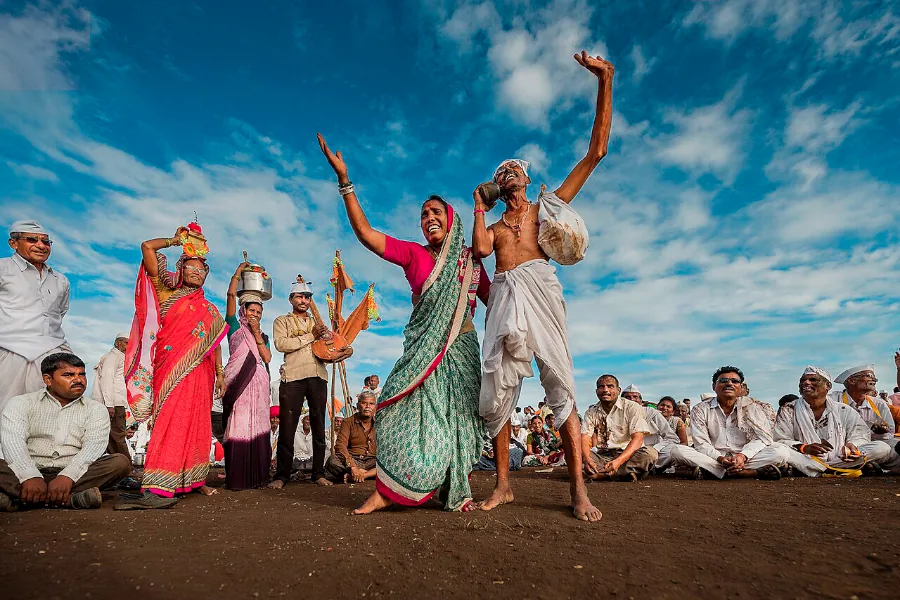
🌟 Notable Figures of Pandharpur: Spiritual Pioneers, Social Reformers & Cultural Stewards
🕉️ 1. Bhakti Saints: The Pillars of Varkari Tradition
➙ Sant Pundalik (12th century CE): Revered as the “Adi Varkari” (First Pilgrim), his devotion to parents led Lord Krishna to stand eternally on a brick as Vitthala. He established Pandharpur as “Paundarika Kshetra” and rejected caste-based worship, emphasising Bhakti over ritual.
➙ Sant Dnyaneshwar (1275–1296 CE): Authored “Dnyaneshwari” – a Marathi commentary on the Bhagavad Gita that democratised spirituality. Initiated the Ashadhi Wari Pilgrimage from Alandi to Pandharpur with Siblings, carrying Palkhis of Saints.
➙ Sant Tukaram (1608–1650 CE): Composed 4,500+ Abhangas (Devotional Songs) challenging Brahminical hegemony. His Palkhi procession from Dehu was formalised by his son Narayan Maharaj in 1685.
➙ Sant Chokhamela (14th Century): Dalit Saint whose verses like “Lord Vitthal accepts only love, not caste” critiqued Social Hierarchies. His Samadhi faces Lord Vitthal’s sanctum – a symbolic defiance of untouchability.
👑 2. Temple Custodians & Royal Patrons
➙ Bhillama V (Yadava King, 12th century): Funded the first Vitthal Temple structure in 1189 CE, Establishing Pandharpur as a Royal Pilgrimage Site.
➙ Deshmukhs of Kasegaon: Maratha Warriors entrusted with the Temple keys during Chhatrapati Shivaji Maharaj’s reign. Priests daily collected keys from their Kasegaon Estate (17 km away) – a tradition lasting until British rule.
➙ Haibatravbaba Arphalkar (19th Century): Scindia courtier who systematised the Wari in the 1820s, creating Dindis (Pilgrim Groups) and introducing horse-led Palkhi Processions.
🌿 3. Modern Spiritual Leaders & Social Reformers
➙ Sant Gadge Maharaj (1876–1956): Though not native, his Cleanliness Drives (“Gadge Baba Sanitation Mission”) transformed Pandharpur’s Ghats. Advocated against animal sacrifice in Temple rituals.
➙ Gulabrao Maharaj (1891–1915): Established “Gulabrao Maharaj Math” near Chakratirtha Ghat, offering free meals (Annadana) to Dalit pilgrims barred from Temple Kitchens.
➙ Vitthal Ramji Shinde (1873–1944): Founded the “Depressed Classes Mission” in 1906, opening schools for Dalit children near Vitthal Temple.
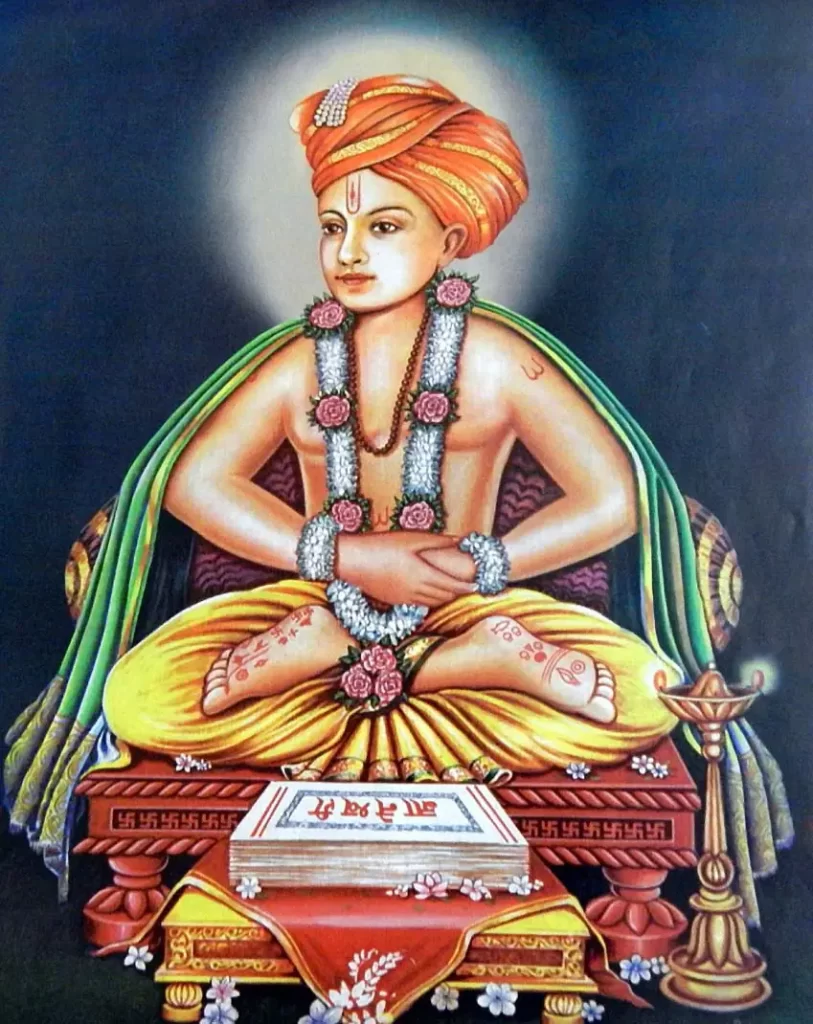
⚖️ 4. Temple Revolutionaries & Administrative Pioneers
➙ The Badve Family (1958): As hereditary temple administrators, they Opened the Sanctum to all castes, allowing Padsparsh Darshan (touching Vitthal’s feet) – a radical move in pre-independence India.
➙ Neelima Khedkar & Sanjay Teli (2014): Appointed as India’s First Female and non-Brahmin Priests at Vitthal Temple, breaking 900 years of tradition.
🎨 5. Cultural Icons & Artists
➙ Soyarabai (Chokhamela’s Wife, 14th Century): Wrote “Soyarabainchi Abhangas” Advocating Women’s spiritual equality. Her verses describe carrying temple flowers secretly as “Caste-Polluted”.
➙ Kanhopatra (15th Century): Devadasi-Poetess whose Samadhi is in the Temple Complex. Her hymn “Vitthal, tear down these walls of shame!” inspired the 2014 Priesthood Reforms.
➙ Laxman Masoji (1920–1990): Master weaver who revived “Pandharpuri Chadars” – Silk ritual cloths with Zari-thread Vitthal motifs. Awarded National Handloom Award (1978).
🏛️ 6. Political Leaders & Freedom Fighters
➙ Ramchandra Dhere (1929–2016): Historian whose “Vitthal: Ek Mahasamanvay” (1972) exposed the Temple’s syncretic roots in Kannada Virasaivism. Won Sahitya Akademi Award (1985).
➙ Jyotirao Phule’s Pandharpur Connection: Though from Pune, he launched the “Satyashodhak Samaj” here in 1875, using Sant Chokhamela’s Poetry to critique Brahminical control of the Temple.
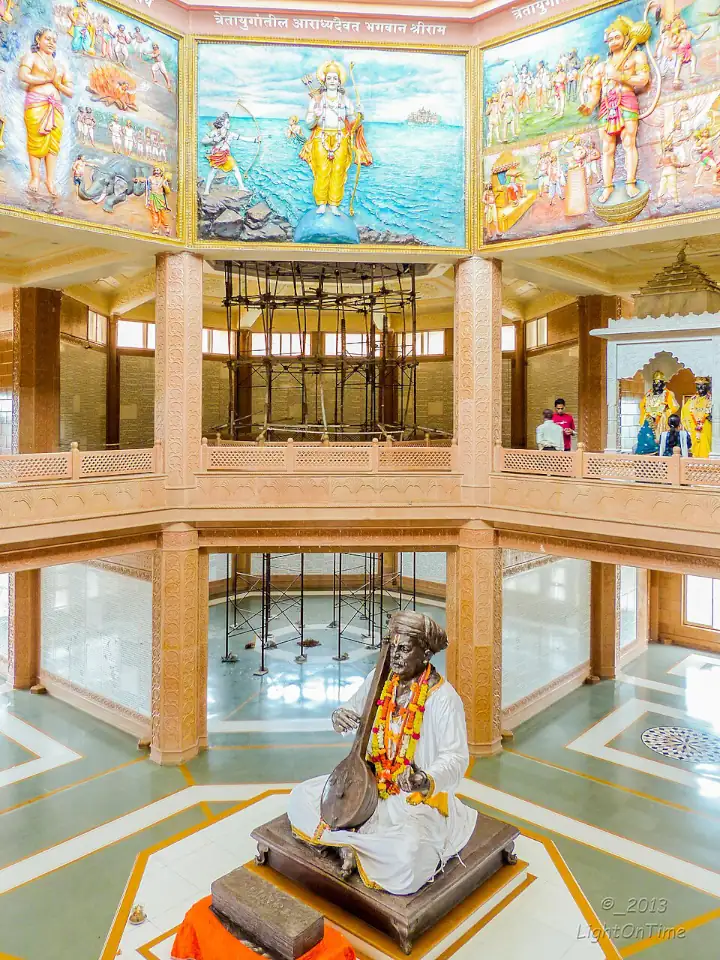
📜 7. Literary & Scholarly Luminaries
➙ Karmamela (Chokhamela’s Son, 14th Century): Wrote “Bhakti Vijaya”, documenting caste oppression. Died clearing temple debris during Bahmani raids – his tools displayed at Kasegaon Deshmukh Museum.
➙ Dr. Shrikant Shinde (b. 1983): Pandharpur-born MP who established the “Vitthal Rukmini Sanskrit University” (2018), offering courses in Bhakti literature and Temple Architecture.
🌾 8. Agricultural & Economic Innovators
➙ Annasaheb Patil (1902–1979): Founded “Pandharpur Sahakari Sakhar Karkhana” (1955), India’s first cooperative sugar mill sourcing cane from 102 villages. Catalysed rural prosperity.
➙ Laxmibai Khedkar (1915–2005): Pioneered Organic Farming near Karkamb using “Vitthal Krishi” – integrating daily Kirtans with sustainable techniques.
🌍 9. Global Ambassadors of Pandharpur Culture
➙ Dr. Vijaya Rajiva (b. 1948): Diaspora scholar whose “Bhakti Beyond Borders” (2001) documented Wari traditions among Tamil and Caribbean communities.
➙ Shri Rang Avadhoot (1898–1968): Carried Vitthal’s Padukas to New York’s Vedanta Society (1965), establishing the first International Varkari Matha.
🌈 10. Contemporary Change-Makers
➙ Meera Shetty (b. 1985): Dalit Entrepreneur behind “Tulsi Vrindavan Collective” – training 200+ women to craft ritual mini-shrines sold globally.
➙ Dr. Anand Teltumbde: Authored “Pandharpur: The Political Economy of Salvation” (2020), analysing caste dynamics in Temple revenue distribution.
✨ Legacy Unbroken: From Pundalik’s Brick to Meera Shetty’s Vrindavans, Pandharpur’s luminaries embody “Wari is not a walk; it’s the soul’s revolt against injustice” – as Sant Tukaram wrote in his Abhanga 1,274. Their work continues in every Pilgrim’s chant of “Vitthal Mauli!”.
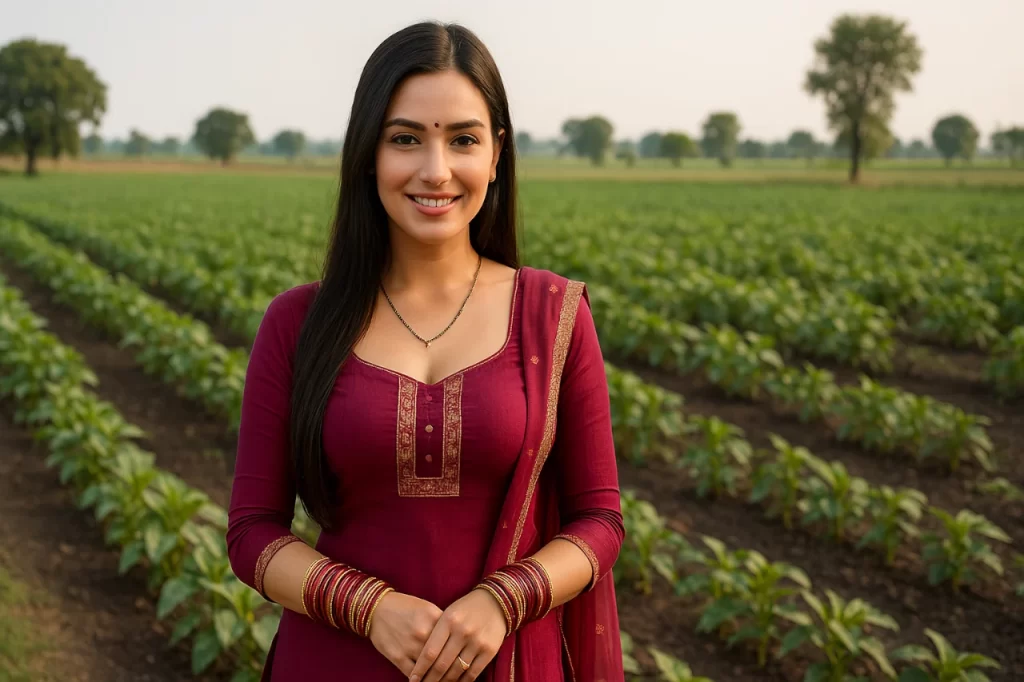
🏭 Industrial Development in Pandharpur Region: Tradition, Transition & Transformation
🚶♂️ 1. Pilgrimage-Driven Economy: The ₹300 Crore Spiritual Industry
The Ashadhi/Kartiki Ekadashi festivals catalyse Pandharpur’s largest informal Industry, generating ₹300+ crore annually through:
➙ Seasonal Employment: 25,000+ jobs as Palkhi Bearers, Prasad Cooks and Medical Camp staff.
➙ Supply Chains: 400+ Dindi (Pilgrim Groups) procure local produce for community kitchens – mobilising ₹120 crore in food services alone.
➙ Handicraft Sales: Mahadwar Bazaar sells 500,000+ Solapuri Chadars (GI-tagged Cotton Towels) and Tulsi Vrindavan Shrines during peak seasons.
🧵 2. Textile Legacy: From Power Looms to GI Tags
Solapur district dominates Maharashtra’s Textile Sector, with Pandharpur contributing through:
➙ Solapuri Chadars: 200+ power loom units near Kambar Talao Lake produce these iconic towels. Export declined 40% due to synthetics but revived post-GI tag (2018).
➙ Handloom Clusters: Padmashali weavers in Velapur village create Vitthal-themed silk ritual cloths using 12th-century Jaala techniques.
➙ Industrial Scale: Solapur district hosts Asia’s largest Spinning Mill (2.2 lakh spindles) supplying yarn to Pandharpur’s Handlooms.
🌾 3. Agricultural Processing: Sugar, Millet & Pomegranates
Pandharpur Tehsil’s farms feed 3 major Industries:
➙ Sugar Cooperatives: Pandharpur Sahakari Sakhar Karkhana (Est. 1955) processes 1 million MT cane/year from 102 village.
➙ Millet Milling: Units in Karkamb produce Bhakri (Flatbread) flour for Temple Prasad, using drought-resistant Jowar (Sorghum).
➙ Pomegranate Units: National Research Centre on Pomegranate (NRCP) in Solapur supports 60+ Pandharpur farmers with processing tech for juice and Anardana (Dried seeds).
⚡ 4. Renewable Energy & Waste Management
➙ Waste-to-Energy Plant: Solapur’s 10 MW Plant processes 500 TPD Garbage, Including Pilgrim waste from Pandharpur.
➙ Solar Ghats: Chandrabhaga riverfront installed 500 kW Solar Panels powering temple lights – reducing diesel use by 70%.
🏗️ 5. Infrastructure & Corridor Development
The Pandharpur Temple Corridor Project (Approved 2025) aims to:
⦿ Relocate 120 shops from Chouphala to create Pilgrim Plazas.
⦿ Build Disaster-resistant Ghats with Permeable laterite blocks to reduce erosion.
⦿ Develop Annadana Bhavans (Community Kitchens) serving 100,000 Meals/day.
🚧 6. Industrial Challenges & Opportunities
| Sector | Challenge | Emerging Solution |
| Textiles | Power loom obsolescence | MIDC’s ₹200 crore Tech Upgrade Fund |
| Agriculture | Monsoon-dependent Cane Supply | Micro-irrigation Projects (Bhima-Ujjani Canal) |
| Pilgrim Services | Seasonal Unemployment | Year-round Spiritual Tourism Packages |
📈 7. Future Projects & Economic Vision
➙ Spiritual SEZ: Proposed “Bhakti Valley” near Mangalwedha with Meditation Resorts, Abhanga recording studios.
➙ Hyperloop Connectivity: Pune-Pandharpur route (2030) to cut travel time from 4hrs to 45 min.
➙ GI Expansion: Applying for “Pandharpuri Puran Poli” GI tag to boost local bakeries.
🌟 Conclusion: Pandharpur’s Industry thrives where faith meets economics – from handlooms weaving devotion into cloth to Sugar Mills sweetening the lives of 102 villages. As the Warkaris sing:
“Vitthal’s Brick is our first Industry; the walking Pilgrim, its greatest machine.” 🛤️🙏
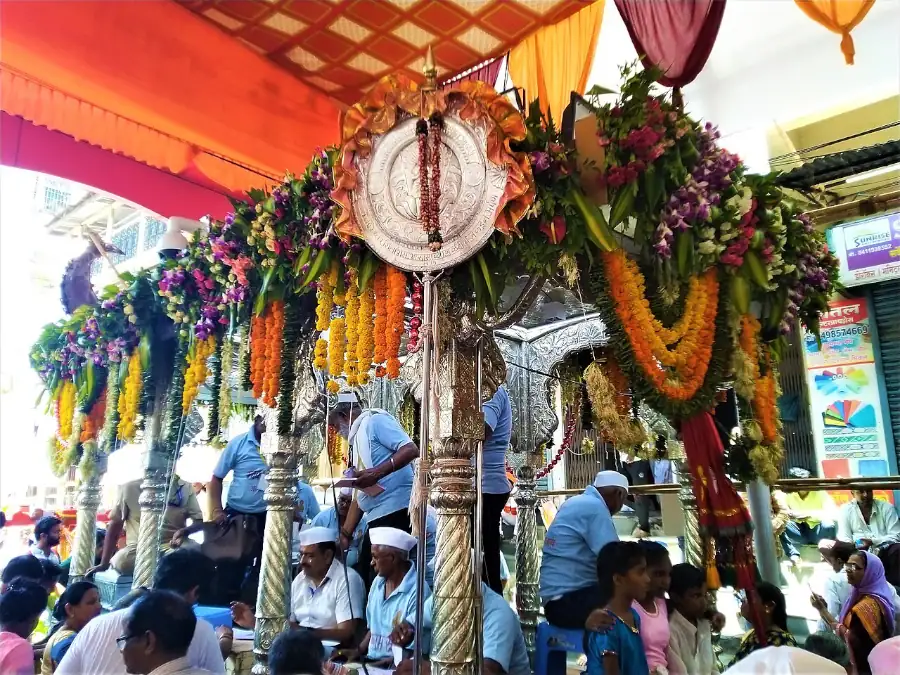
🌾 Granular Profile of Pandharpur’s Key Villages: Culture, Economy & Pilgrimage Hubs
🏙️ 1. Karkamb: The Agrarian Powerhouse
➙ Population: 17,456 (Largest village in Pandharpur Tehsil)
➙ Economy: Dominated by Sugarcane Cooperatives (Supplying Pandharpur Sahakari Sakhar Karkhana) and Dairy units (1,200+ cattle farms).
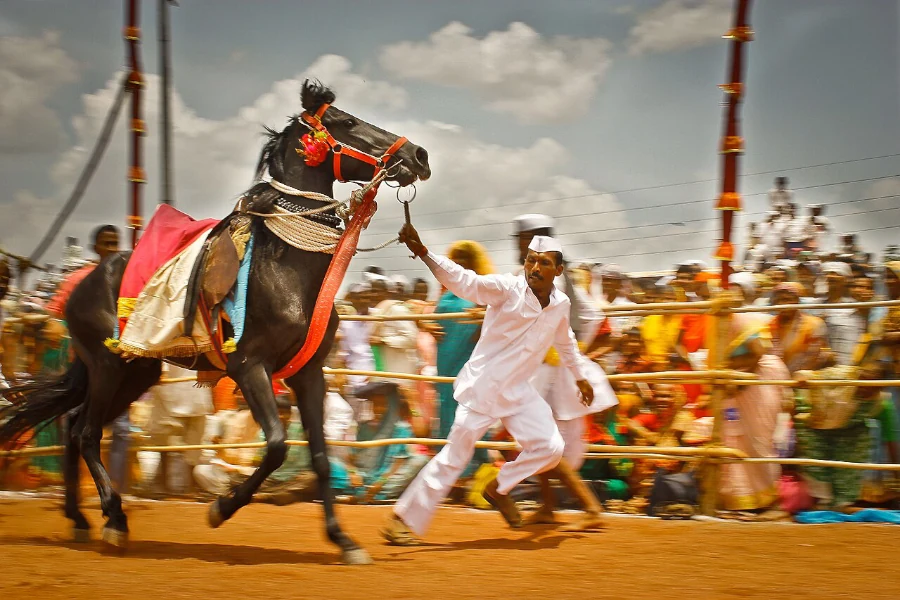
➙ Culture: Hosts the “Ringan Festival” during Wari (June 27), where sacred horses race to honour Sant Tukaram.
➙ Notable Feature: Deshmukh clan estates – descendants of Maratha warriors who managed temple keys for Chhatrapati Shivaji Maharaj.
⛩️ 2. Kasegaon: Temple Custodians & Spiritual Stewards
➙ Population: 16,197
➙ Historical Role: Deshmukh families safeguarded Vitthal Temple keys for centuries; priests collected them daily until British rule.
➙ Agriculture: Major Onion Exporter (200+ acres); supplies Prasad Onions to Pandharpur Temple Kitchens.
➙ Demographics: 73.01% literacy; sex ratio 922 (Above Tehsil Average).
🚜 3. Bhose: Water Warriors & Millet Innovators
➙ Population: 9,408
➙ Water Management: Community-owned Percolation Tanks store monsoon water for drought-resistant Jowar (Sorghum) Farming.
➙ Craft Legacy: Pottery Clusters producing ritual Tulsi Vrundavans (Mini-shrines) sold at Pandharpur’s Mahadwar Bazaar.
➙ Wari Connection: Key halt for Sant Tukaram’s Palkhi (June 30); hosts “Kirtan Nights” in Ancestral Deshmukh Halls.
🚶♂️ 4. Wakhari: The Pilgrim’s Final Stop
➙ Population: 8,029
➙ Pilgrimage Significance: Last major halt before Pandharpur (5 km away). Sant Dnyaneshwar’s Palkhi rests here on July 4 during Wari.
➙ Economy: 80% households run home-stays for Pilgrims; famous for Puran Poli Workshops (₹50/piece).
➙ Unique Trait: “Vitthal Krishi” – farms using devotional songs to boost crop yield, inspired by Saint Tukaram.
🏡 5. Takli: The Temple’s Shadow Village
➙ Population: 10,122
➙ Location: 2 km from Vitthal Temple – closest village to Pandharpur.
➨ Economy: Pilgrim services
⦿ Palkhi Bearers: 300+ families
⦿ Flower Garland Weavers: Supplies 60% temple offerings
➙ Demographics: Highest literacy in tehsil (84.77%); balanced Sex Ratio (930)
🎪 6. Bhandi Shegaon: Wari’s Cultural Stage
➙ Population: 5,649
➙ Wari Hub: Hosts both Tukaram & Dnyaneshwar Palkhis (July 2–3). “Dindi Square” features folk dances like Gondhal.
➙ Agriculture: Millet Research Farm testing drought-resistant varieties for semi-arid zones.
🛕 7. Velapur: Hemadpanthi Heritage Village
➙ Location: 32 km NE of Pandharpur
➙ Architecture: 12th-century Hemadpanthi Temple with rare Four-directional Doorways; Black-stone Vishnu Idol.
➙ Festival: Fire-walking ritual (February) honouring local harvest Goddess Devi Bhawani.
💧 8. Chincholi Bhose: Water Conservation Model
➙ Population: 1,297
➙ Water Revolution: “Phad Irrigation” – Community-managed canal system recycling Chandrabhaga floodwaters.
➙ Social Progress: Highest sex ratio in tehsil (977); 80.6% literacy.
🐄 9. Gopalpur: Dairy & Devotion Nexus
➙ Population: 6,918
➙ Landmarks: Gopalkrishna Temple atop Govardhan Hill with Underground Meditation Caves linked to Krishna legends.
➙ Economy: Buffalo Milk Co-op supplying Shrikhand to ISKCON’s Govinda’s Restaurant.
☸️ 10. Dahigaun: Jain Pilgrimage Center
➙ Spiritual Significance: Shri Dahigaun Tirth houses a 244-cm black idol of Mahavira in Padmasana (lotus pose), carved from single basalt (15th Century).
➙ Craft: Sandstone Carving of ritual Ayagapatas (Tablets) for Jain Pilgrims.
📊 Comparative Socio-Economic Snapshot
| Village | Key Strength | Literacy Rate | Unique Identity |
| Karkamb | Sugarcane Co-ops | 77.45% | Ringan Horse Festival |
| Kasegaon | Onion Exports | 73.01% | Temple Key Custodians |
| Bhose | Water Conservation | 76.28% | Ritual Pottery |
| Wakhari | Pilgrim Home-stays | 75.00% (Est.) | Vitthal Krishi Farming |
| Velapur | Heritage Architecture | 75.38% | Fire-walking Rituals |
🌱 Cultural & Agricultural Threads
➙ Shared Festivals: All villages celebrate “Pola” (Bull Worship in August) – Decorated Bulls paraded to honour farm animals.
➙ Crop Patterns: River-proximal villages (Takli, Gopalpur) grow water-intensive Sugarcane; upland villages (Bhose, Chincholi Bhose) focus on Millets and Onions.
➨ Craft Clusters:
⦿ Karkamb: Solapuri Chadar Weaving
⦿ Dahigaun: Jain Ritual Stone Carving
⦿ Wakhari: Puran Poli Sweet Makers
🌟 Village Soul: Pandharpur’s hinterland blends Devotion and Dirt – where every Sugarcane stalk in Karkamb feeds Temple Prasad and Wakhari’s soil absorbs the footsteps of half a million Warkaris. As a Kasegaon elder told pilgrims: “Our fields grow grain, but our hearts grow faith”. 🙏
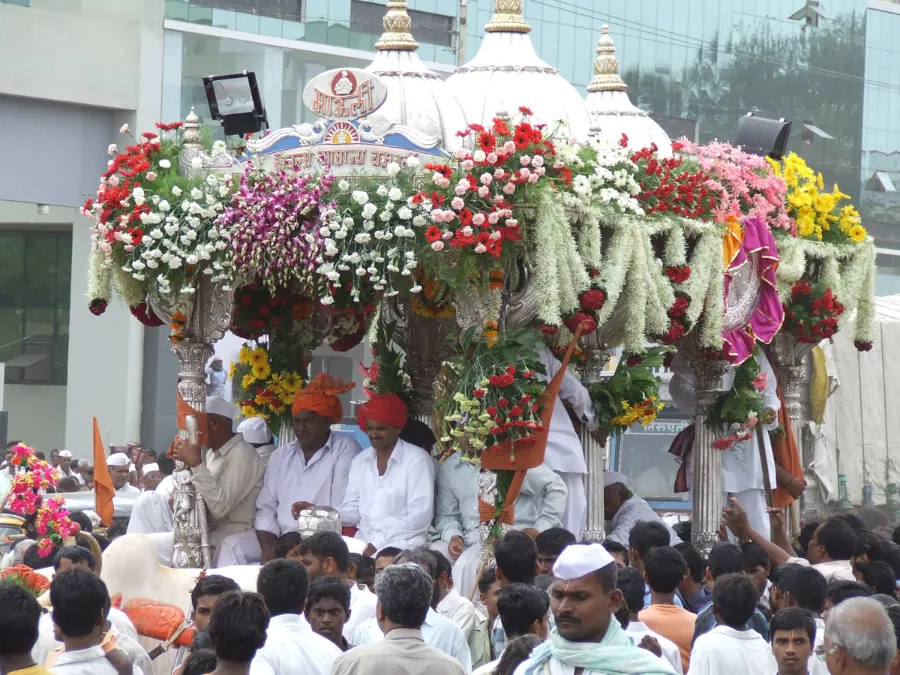
🌄 5-Day Ultimate Pandharpur Itinerary: Spirituality, Culture & Nature
📅 Day 1: Arrival & Spiritual Immersion
➨ Morning (10 AM–1 PM):
➙ Arrive via Pune Airport (200 km) or Solapur Airport (85 km). Transfer to Hotel SP Majestic (₹2,500/night) or ISKCON Guest House (₹924/night).
➙ Ritual Purification: Take a dip at Chakratirtha Ghat – believed to cleanse sins.
➨ Afternoon (2–5 PM):
➙ Lunch: Veg Thali at Shree Rajbhog Restaurant (₹180) – Try Puran Poli and Pithla Bhakri.
➙ Vitthal Temple Darshan: Attend “Maha Aarti” (4 PM). Touch Lord Vitthal’s Feet (Padsparsh Darshan) in the Sanctum.
➨ Evening (6–8 PM):
➙ Pundalik Temple Sunset: Witness lamps floating on Chandrabhaga River. Legend: Krishna waited here for devotee Pundalik.
⛩️ Day 2: Temple Trails & Local Culture
➨ Pre-Dawn (4–7 AM):
➙ Kakad Aarti: Join Priests chanting at Vitthal Temple. Experience Mukha Darshan (viewing Deity’s Face).
➨ Morning (8 AM–12 PM):
🎯 Village Tour: Cycle to Takli Village (2 km):
➙ Watch Garland Weavers craft 5,000+ flower offerings daily.
➙ Participate in "Vitthal Krishi" – farming with devotional songs.
➨ Afternoon (1–4 PM):
➙ Handicraft Workshop: Learn Tulsi Vrindavan making at Bhose Pottery Cluster (₹200/person).
➙ Lunch: Ukdiche Modak (Steamed Dumplings) at Velapur Village Huts (₹50/plate).
➨ Evening (5–8 PM):
🎯 ISKCON Kirtan: Chant “Hare Krishna” with Monks. Dinner at Govinda’s Restaurant (Satvik Thali ₹100).
🚶 Day 3: Pilgrimage Routes & Festive Energy
➨ Morning (6 AM–12 PM):
🎯 Wari Experience (If visiting July/November):
➙ Walk 5 km with Tukaram Palkhi procession from Wakhari Village. Sing Abhangas with 50,000+ Pilgrims.
➙ Non-Festival Alternative: Palkhi Museum in Alandi (65 km) – interactive exhibits on Wari History.
➨ Afternoon (1–4 PM):
➙ Cooking Class: Master Pandharpuri Chadar embroidery with Artisan Laxmi Shetty. Create ritual cloths (₹300/session).
➨ Evening (5–8 PM):
➙ Chandrabhaga Aarti: Float Diyas with wishes. Try Jaggery Tea and Bhakarwadi at Ghat Stalls.
🦜 Day 4: Nature & History Excursion
➨ Morning (5 AM–12 PM):
🎯 Nannaj Bustard Sanctuary (45 km):
➙ 6 AM Safari: Spot Great Indian Bustards (Critically Endangered) + 200+ Bird Species.
➙ Farm Breakfast: Millet Thalipeeth at Sanctuary Café.
➨ Afternoon (1–5 PM):
🎯 Bhuikot Fort (45 km):
➙ Climb 14th-century ramparts with Islamic Jali screens and Maratha Garuda Motifs.
➙ Photography Tip: Capture Nar-Madi Waterfalls during monsoon (July–September).
➨ Evening (6–9 PM):
➙ Dinner with Warkaris: Share Annadana (Community Meal) at Sant Gulabrao Math. Listen to stories of Saint Chokhamela.
🛍️ Day 5: Artisanal Pandharpur & Departure
➨ Morning (7–11 AM):
🎯 Mahadwar Bazaar Hunt:
➙ Buy Solapuri Chadars (GI-tagged Cotton Towels, ₹300/piece).
➙ Taste Pandan (Palm Jaggery) at Kaka Halwai.
➨ Afternoon (12–3 PM):
🎯 Velapur Heritage (32 km):
➙ Explore Hemandpathi-style Temple with Four Directional Doorways. Witness fire-walking rituals (February). ➨ Departure (4 PM):
➙ Transfer to Solapur Airport (85 km). Carry Temple Prasad for journey Blessings.
🌦️ Seasonal Adjustments & Pro Tips
🌧️ Monsoon (July–September):
➙ Swap Day 4 for Naldurg Fort waterfalls – Swim in “Male-Female” cascades.
➙ Pack: Waterproof Footwear + Umbrella!
☁️ Winter (October–February):
➙ Add Kartiki Ekadashi (November) – fewer crowds than Ashadhi.
➙ Stay: Shiva Farm Stay – Bonfires under stars.
☀️ Summer (March–June):
➙ Pre-dawn Temples: Avoid 11 AM–4 PM heat. Hydrate with Solapuri Sugarcane Juice (₹30).
🛎️ Accommodation Guide
| Type | Property | Price/Night | Perks |
| Luxury | Hotel SP Majestic | ₹2,500–₹4,200 | River Views, AC, Restaurant |
| Budget | Raja Pandharinath Bhakt Niwas | ₹ 600 | Cottage-style, near Temple |
| Spiritual Stay | ISKCON Guest House | ₹925–₹1,501 | Free Breakfast, Kirtan Access |
| Farm Experience | Shiva Farm Stay (Karkamb) | ₹ 18,700 | Private Pool, Organic Meals |
🚗 Transport Cheat Sheet
⦿ Auto/Taxi: Uber Auto (₹30 base + ₹15/km).
⦿ Buses: MSRTC “Palkhi Special” from Pune (₹211).
⦿ Bike Rentals: Pedal Bikes near Vitthal Temple (₹50/hour).
🙏 Sacred Etiquette
⦿ Temples: Cover shoulders/knees; remove footwear.
⦿ Ghats: Avoid photography during rituals.
⦿ Wari: Walk silently behind Palkhis; accept free Sharbat (Sherbet).
🌟 Final Insight: “Pandharpur isn’t visited – it’s absorbed. Let the Abhangas in the temple, the jaggery on your tongue, and the Chandrabhaga’s touch become your soul’s souvenirs”. – Local Priest Devendra Patil.
Download: Audiala App for audio-guided temple tours + offline maps.
Emergency: Vitthal Temple Police Control (☎️ 112), Life Line Hospital (☎️ 02186-222666).
FAQs
Can non-Hindus enter Vitthal Temple?
Yes! The temple welcomes all faiths.
How long is the Wari walk from Alandi?
21 days (~250 km). Join for 1-2 days—Dindis welcome newcomers.
Best Vegetarian food in Pandharpur?
Anna Prasad at Temple Kitchens, or local eateries serving Thalipeeth (Spiced Pancakes).
Monsoon Travel Tips?
Carry rain gear, waterproof footwear. Ghats get slippery—walk cautiously!

Conclusion in Brief: The Eternal Call of Vitthal
Pandharpur isn’t merely a destination; it’s an emotion. Whether you’re tracing the architectural genius of Hoysala sculptors, wading into the Chandrabhaga at dawn, or losing yourself in an Abhanga during Wari, this town whispers a timeless truth: divinity lives in devotion, in community, and in the courage to reinvent tradition. As Sant Tukaram wrote, “Pandharpur is where the soul finds its song”.
🌟 Detailed Conclusion: Pandharpur – Where Stone, River and Soul Converge
🛕 1. The Eternal Spiritual Heartbeat
Pandharpur is not merely a destination; it is Maharashtra’s living spiritual epicentre, where devotion has flowed unbroken for eight centuries. The Vitthal Temple stands as both an architectural marvel and a revolutionary symbol – from its Hoysala foundations (1108 CE) to the Groundbreaking Appointment of Female Priests in 2014. Every brick echoes with the chants of 17 Million Annual Pilgrims, transforming this town into a vortex of faith during Ashadhi Ekadashi, when the Chandrabhaga’s waters bear witness to half a million saffron-clad Warkaris.
🌊 2. River of Redemption & Resilience
The Bhima River (Chandrabhaga) is the town’s lifeblood and spiritual anchor:
➙ Ritual Significance: Pilgrims believe a dip at Chakratirtha Ghat absolves sins, mirroring the Bhakti ethos of inner purification.
➙ Ecological Lifeline: Its seasonal floods sustain 102 villages through innovative “Phad Irrigation” in Chincholi Bhose and Millet farms in Bhose.
➙ Climate Challenges: Historic 251.5 mm rainfall (1895) caused devastation, prompting Modern Permeable Ghats to combat erosion.
⚖️ 3. Social Reformation Through Devotion
Pandharpur’s legacy is steeped in Radical Inclusivity:
➙ Sant Chokhamela’s 14th-century verses (“Lord Vitthal accepts only love, not caste”) still inspire Dalit empowerment.
➙ The 2014 Priesthood Revolution shattered 900-year traditions, appointing non-Brahmin priests – a direct echo of Tukaram’s anti-caste Abhangas.
➙ Economic Equity: GI-tagged Solapuri Chadars (₹300/piece) and Tulsi Vrindavan shrines sustain artisan cooperatives like Meera Shetty’s 200-women collective.
🏗️ 4. Architecture: Stone Poetry of Faith
The Vitthal Temple complex is a Deccan symphony:
➙ Sacred Geometry: Five-story Shikhara aligned with Solstice Sunrises; Rangshala Courtyard for Ras Leela Reenactments.
➙ Threshold Science: Three-tiered Pradakshina Paths enabling graded access – outer for masses, innermost for Priests.
➙ Riverfront Ritualism: 48 ghats serving as spiritual theatres, with Vishnupad Temple’s lotus-footprint rock offering ancestral solace.
🌾 5. Agrarian Rhythms & Industrial Shifts
The Hinterland thrives on Devotion-driven Economies:
➙ Sugarcane from Karkamb feeds the Pandharpur Sahakari Sakhar Karkhana (est. 1955), processing 1 Million MT/year.
➙ Pilgrim Services: Generate ₹300+ crore annually, employing 25,000+ as Palkhi bearers, Prasad Cooks, and Garland Weavers.
➙ Green Innovations: Solar-powered Ghats (500 kW) and Waste-to-energy Plants signal sustainable transformation.
🚶 6. The Walking Revolution: Wari’s Living Heritage
The 21-day Wari Pilgrimage is India’s largest Pedestrian Movement:
➙ Logistical Marvel: 330 Dindis for Tukaram, 250 for Dnyaneshwar, each with Medics, Cooks and Tutari Players.
➙ Cultural Impact: UNESCO’s 2021 Nomination for Intangible Cultural Heritage celebrates its cross-caste unity.
➙ Personal Transformation: As Warkari Sunita Deshpande notes, “We walk not for miles, but to shed ego”.
🔮 7. Future Horizons
Pandharpur balances tradition with tomorrow:
➙ Infrastructure: Temple Corridor Project (2025) will modernise pilgrim facilities while preserving heritage.
➙ Connectivity: Proposed Pune-Pandharpur Hyper-loop (2030) aims to cut travel from 4 hours to 45 minutes.
➙ Cultural Preservation: Digitising 30,000+ Abhangas at Vitthal Rukmini Sanskrit University.
✨ Final Reverence: The Soul’s Hometown
To visit Pandharpur is to witness Stone Deities Breathing and Rivers Absolving Sins. It’s where:
➙ A 12th-century brick beneath Vitthal’s feet symbolises Eternal Patience.
➙ The first monsoon raindrops on the Bhima become tears of joy for farmers.
➙ Every Puran Poli sweet shared at a Matha kitchen embodies Tukaram’s vision: “Feed the Stranger as your own Blood”.
🌈 “Pandharpur is not Geography; it’s the heart’s Compass. Where Chandrabhaga’s waters meet Vithoba’s Gaze, the soul remembers its way home”.
– Elder’s Blessing in Kasegaon
🙏 Vitthal Mauli! – May your journey be a return.
“Vitthal waits not on a brick, but in the heart that seeks”. — Share your Pilgrimage dream below!
“Ready to walk the path of saints? Share your Pandharpur story or plan your pilgrimage with our free guide!”
DISCLAIMER
Note: Distance is approximate and travel time may vary. Please check with google maps or local authorities before travelling.
Note: Hotel rates are subject to change and may vary based on factors like seasonality, availability, and promotions. Taxes, service charges, and other applicable fees are not always included in displayed rates.
📜 Sources
➙ Pandharpur – Wikipedia
➙ Vithoba Temple – Wikipedia
➙ Pandharpur Wari – Swarajya
➙ Census Data – Pandharpur Tehsil
➙ Weather Guide – Holidify
➙ Census of India, Pandharpur Tehsil
➙ Vitthal Temple Archives: Priesthood Reform Documents (2014)
➙ Maharashtra Tourism Development Corp. Pilgrimage Economy Reports
➙ UNESCO Wari Nomination Dossier (2021)
➙ Dnyaneshwari & Tukaram’s Abhangas – Critical Editions
Image Credit
➙ Wikimedia Commons – Bharud
➙ Wikimedia Commons – PHUGADI
➙ Wikimedia Commons – Pandharpur
➙ Wikimedia Commons – Dnyaneshwar2
➙ Wikimedia Commons – Alandi Palki 08
➙ Wikimedia Commons – Vitthal – Rakhumai
➙ Wikimedia Commons – Pandharpur Wari 01
➙ Wikimedia Commons – Pilgrimage in Palkhi
➙ Wikimedia Commons – Tukaram Maharaj Palkhi
➙ Wikimedia Commons – Pilgrims 1 (2731600954)
➙ Wikimedia Commons – Palakhi Sohala (Ceremony)
➙ Wikimedia Commons – Warkari sect in Maharshtra
➙ Wikimedia Commons – Dnyaneshwar Paduka Mandir in Pune
➙ Wikimedia Commons – Tukaram Maharaj Palkhi (Palanquin)
➙ Wikimedia Commons – Bhakt Pundhalik Temple, Pandharpur
➙ Wikimedia Commons – Pandharpur 2013 Ashad – panoramio (4)
➙ Wikimedia Commons – Pandharpur 2013 Ashad – Panoramio (23)
➙ Wikimedia Commons – Tukaram Maharaj Palkhi (Palanquin) Rath
➙ Wikimedia Commons – The holy city of entire Maharashtra, Pandharpur
➙ Wikimedia Commons – Sant Tukaram Palkhi Procession By Anis Shaikh 09
➙ Wikimedia Commons – Pandharpur 2013 Aashad – Panoramio (10) (cropped)
➙ Wikimedia Commons – St. Tukaram Maharaj Mandir. Dehu, Maharashtra – Panoramio (17)
➙ Wikimedia Commons – Pundlik Nagar, Pandharpur, Maharashtra 413304, India – Panoramio (32)
➙ Wikimedia Commons – Pandharpur Railway Station, Main Entrance, Pandharpur (Original image by Amar D. Raut)
➙ Wikimedia Commons – Gateway to temple where Sant Dnyaneshwar Palkhi halted in Pune during the Ashadi Wari 2023
➙ Wikimedia Commons – The decorated ratha in which paduka of Sant Dnyaneshwar was kept during the 2023 Pandharpur Wari
For more information, you can visit our website: ExploreXP
Latest Posts
- 4 Steps to Teach English in Vietnam (Complete 2026 Guide)

- The Complete Guide to Living in Ho Chi Minh City, Vietnam
- What Living in Hanoi Is Really Like for Foreigners
- Expat vs Immigrant: What’s the Real Difference?
- 7 Best Places to Live in Mexico Right Now: A Complete Guide
- Best Places to Live in Thailand: A Complete Guide for Expats in 2026